
An energy-efficient salad table is not just a single unit decision. In a buffet setup with multiple chilled stations, how those tables combine across the serving line determines whether the kitchen sees a steady utility bill or an unnecessary surge. From decades of engineering commercial refrigeration, I’ve seen hotels shave 15–20% off their cooling energy simply by rethinking arrangement and peripheral integration, long before swapping any equipment. The key is treating each salad table as part of a thermal chain, not an isolated appliance.
Why Buffet Salad Table Combinations Drive Energy Performance
A single salad table holding ingredients at 0.5–5 °C (33–41 °F) consumes a predictable kilowatt load. Place three of them side by side in a straight line and suddenly the outermost units face a different thermal boundary condition. The middle table gains some thermal shielding from its neighbors, but each unit’s condenser now competes for cooler ambient air in the same footprint. Airflow patterns behind the line become the dominant variable, not compressor rating. I cannot count the number of buffet corridors where exhaust heat from one unit recirculates straight into the intake of the next, forcing every compressor to work harder.
The solution starts upstream in the specification, not just post installation. When I work with a procurement team on a buffet layout, I ask three questions before looking at product brochures: (1) Will these tables back up against a solid wall or a pass-through opening? (2) Are there heat sources like carving stations or soup wells within two meters of the cold line? (3) Is there a dedicated make-up air path at least 300 mm behind the units? The answers define whether any energy-efficient salad table combination can deliver on its rated performance or will drift into continuous high-cycle operation.
Selecting the Right Salad Table: Insulation, Refrigerant, and Compressor Pairing
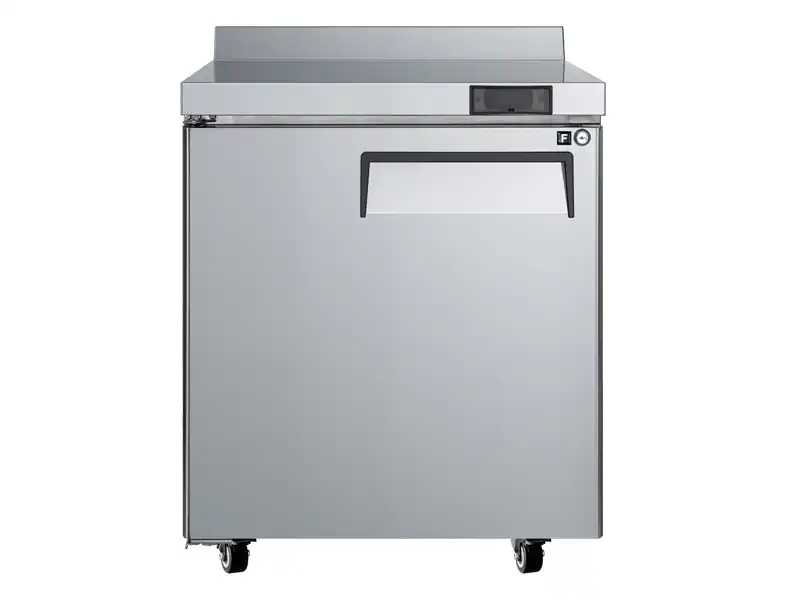
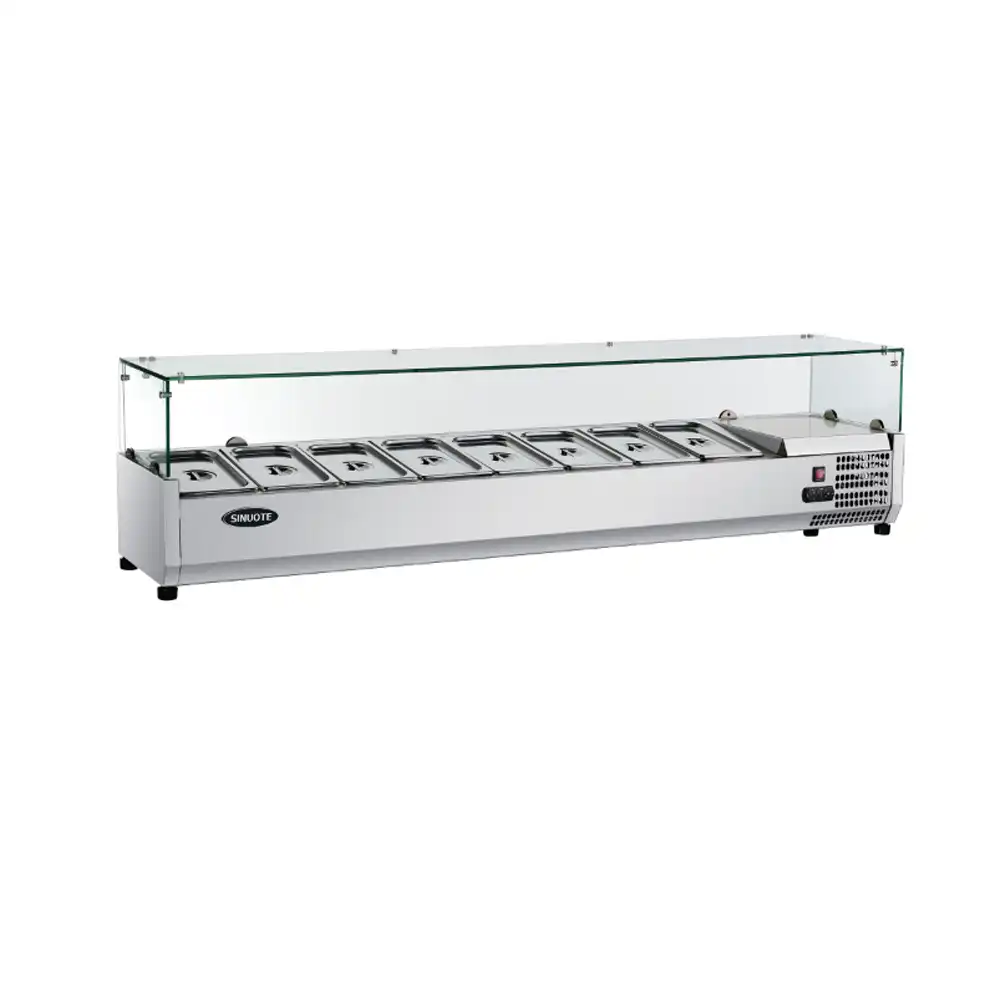
Not all salad tables are thermally equal, even when they hold the same GN pans. The Camay MSR-48M salad side prep table, for example, employs polyurethane/cyclopentane CFC-free foamed-in insulation and a Cubigel compressor running R290 refrigerant. The combination matters because R290 operates at lower compression ratios at moderate loads, and polyurethane foamed insulation holds cold for extended cycles, cutting compressor runtime. Add a smart digital temperature control with I.o.T optionality and you have a unit that can be monitored and adjusted remotely during peak buffet hours without opening the lid.
Yet I often see buyers focus on sticker capacity in liters while ignoring compressor-ambient compatibility. If the climate type is ST~T and the ambient installation is 38 °C, a lighter insulation build will force the compressor into long run cycles that erode the nominal energy rating. So before combining four or five tables, check that the insulation thickness and door gasket integrity match the real, not ideal, ambient conditions of your buffet hall. A table that passes ETL Safety and ETL Sanitation (NSF Standard) with integrated foamed-in polyurethane will maintain consistent temperature with less frequent defrost cycles, which directly reduces cumulative energy demand across the combination.
Layout Strategies That Lower Total Cooling Load
Once the individual units are selected, the physical arrangement becomes the energy multiplier. A curved buffet line that wraps around a corner can create a dead-air zone behind the units, trapping hot condenser discharge and elevating the local ambient for every unit downstream. I advise clients to either break the line with a 600 mm gap every three tables or switch to back-to-front air exhaust routing, where intake and discharge stay in separate aisles. That single change alone has restored rated efficiency on retrofit projects.
Another underused tactic is cross-coupling with undercounter refrigeration. In a hotel breakfast setup, the salad line often terminates near a beverage station. Placing a solid-door undercounter cooler at the end of the salad line, running the same refrigerant class and compressor supplier, creates a thermal barrier: the cooler absorbs some of the waste heat while maintaining its own compartment. The Camay MTR-48 2-door undercounter refrigerator, with its own polyurethane insulation and R290 system, can serve as both beverage storage and a heat buffer. The marginal energy penalty of the undercounter unit is often less than the efficiency gain from stabilizing the salad line’s ambient, provided the electrical circuit is sized correctly.
| Salad Table Model | Capacity (L / Cuft) | Temp Range (°C / °F) | Insulation Type | Compressor |
|---|---|---|---|---|
| MSR-48M | 368 / 13 | 0.5–5 / 33–41 | Polyurethane/Cyclopentane, CFC-free | Cubigel |
| MWTF-27-L | 202 / 7.13 | -25 to -15 / -13 to 5 (freezer) | Polyurethane/Cyclopentane, CFC-free | Cubigel |
| MTR-48 | 368 / 13 | 0.5–5 / 33–41 | Polyurethane/Cyclopentane, CFC-free | Cubigel |
If your program involves a high-ambient installation such as an outdoor poolside buffet for a resort, it is worth confirming the actual climate type compliance and ventilation clearance before final order. Reach out with your layout plan and projected foot traffic; we can model the thermal interaction. Sales@hzcamay.com or +8618157202219.
Operational Practices That Sustain Efficiency Across Multiple Units
Even the best combination will degrade over time if daily practice works against it. Condenser coils on a multi-table salad line often get overlooked because the cleaning cycle requires pulling units away from the wall, and in a busy buffet, no one wants to move heavy equipment. Yet a combination of four tables with mildly dirty coils can collectively draw 8–12% more power, night after night, simply from restricted heat rejection. I direct our partners to keep a coil brush and LED inspection light as part of the shift-close checklist and to allocate the same gap for cleaning access that was specified for ventilation.
Pantry doors also affect combination performance more than people think. When staff load fresh trays at speed, lids stay open longer, and warm air ingress triggers the compressor across all adjacent units almost simultaneously. The answer isn’t simply “close the lid faster,” it’s designing the pantry loading sequence to minimize simultaneous lid-up events. Put the highest-turn items in the front-center table and slow-turn garnishes at the far ends. That simple prioritization keeps cold air loss concentrated on the table with the fastest recovery time, rather than spreading the thermal shock across the entire line.
Common Questions About Salad Table Energy Efficiency
Are salad tables with R290 refrigerant always more efficient than older R134a models?
In most real installations, yes, but not solely due to the refrigerant. R290’s lower global warming potential and favorable thermodynamic properties allow compressors to run at lower discharge temperatures, which reduces overall heat rejection into the buffet space. The secondary benefit is that polyurethane insulation paired with R290 systems often achieves longer off-cycles. However, if ventilation behind the line is already poor, the advantage shrinks quickly because the condenser still cannot reject heat fast enough. So start with the airflow before betting everything on refrigerant.
Does adding more salad tables in one line really double the electricity cost?
It is rarely linear. Two tables installed with proper spacing and open rear airflow might consume 1.8 times the power of one, not 2.0, due to thermal shielding, but if the line grows to five tables without ventilation breaks, the load can jump to 6–7 times a single unit’s draw, not five. This compounding effect comes from the accumulating hot-air plume behind the units. I have seen a six-table banquet layout in Southeast Asia run at 20% above the combined nameplate consumption until we retrofitted a rear extraction duct.
Can an existing older salad table be combined with new energy-efficient units?
Only if the control logic and compressor cycling are separated by dedicated circuits. Mixing a newer digital-controller table with an older mechanical-thermostat unit on the same branch circuit can create voltage-drop interference that confuses the digital readout. It is usually safer to place older units at the far end of the line where their heat discharge least affects the newer ones, but ultimately the mismatch in insulation quality will raise the load on the efficient unit, not lower it.
How much space should I leave behind a buffet salad table line?
Minimum 150 mm for a single unit, but 300 mm if three or more tables are aligned with solid wall backing. The increase is needed to prevent the recirculation loop that forms when hot air hits the wall, curls upward, and gets drawn back into the intake. This is the single most common field correction I make on site visits. A gap at the top of the line to allow hot air to exit into the ceiling return is equally important.
What is the most overlooked factor when planning multiple salad tables for a hotel buffet?
Voltage stability. In older hotel buildings, multiple compressors starting simultaneously on a breakfast setup can dip the supply enough to cause digital controllers to reset. I require a dedicated circuit for the cold line with a delay-on-make timer staggered across the compressor starts. If the building cannot provide that, we spec units with built-in soft-start capability, which avoids the morning reboot scenario that leaves salad warm for the first 30 minutes of service. Share your buffet floor plan and electrical panel details; we will check the startup sequence feasibility before you commit. Sales@hzcamay.com or +8618157202219.
If you’re interested, check out these related articles:
Chef Base Fridge vs Undercounter Fridge Which Is Best for Your Kitchen
Essential Maintenance Tips for Your Commercial Chef Base Refrigerator
Heavy Duty Chef Base Refrigeration for Efficient Commercial Kitchens