

Commercial kitchens run on standardization. When a cook reaches for a third pan of diced onions, they shouldn’t have to check which pan fits which fridge. That’s the promise of Gastronorm (GN) compatibility. Yet not every commercial refrigerator labeled “GN compatible” holds a 1/1 pan without jamming the door or blocking airflow. At Camay, where I’ve spent more than two decades engineering refrigeration equipment for global partners, I know that true GN compatibility lives in the millimetres — the interior depth, the shelf rail spacing, the door swing clearance. This article explains what to look for before you buy, so your kitchen runs smoothly from day one.
Gastronorm (GN) Pan Sizes: The Standard That Drives Consistency
Gastronorm is a European standard (EN 631) that defines a modular system of food pan sizes. The base unit is the GN 1/1, measuring 530 × 325 mm. From that, fractional sizes scale in a predictable grid: 1/2 (325 × 265 mm), 1/3 (325 × 176 mm), 1/4 (265 × 162 mm), and so on. Depths range from 20 mm to 200 mm, covering everything from shallow ingredient bins to deep hotel pans.
The real strength of this system is interchangeability. A 1/1 pan of marinara sauce slides out of a refrigerated prep table and into a hot holding well on the line. Shelves, pan rails, and compartment dividers across multiple pieces of equipment can be designed to a single dimensional language. Kitchens that adopt GN pans from the start avoid a patchwork of mismatched containers that waste space and slow down service.
Why a GN-Compatible Fridge Improves Kitchen Workflow and Food Prep
When every pan on the cook line fits every cooling unit in the back-of-house, the time between prep and service shrinks. A prep cook fills a GN 1/3 pan with sliced tomatoes, carries it across the kitchen, and the pan seats directly onto the rails inside the reach-in cooler. No repacking, no searching for the right lid, no balancing a too-large pan on a shelf that was sized for something else.
GN compatibility also simplifies inventory. You stock one set of pans and lids, not three different styles. Over years of working with multinational restaurant groups, I’ve seen the difference this makes when scaling a concept from one outlet to fifty. Standardization eliminates the friction that causes inconsistency — the same pan, the same portion, the same storage, every time. This matters most in high-volume settings where seconds per task add up to hours of labour per week.
Checking Internal Dimensions: The Key to Genuine GN Compatibility
A “GN compatible” label on a spec sheet means nothing if the fridge’s interior geometry forces you to tilt a pan sideways to get the door shut. The critical measurement is internal depth. A standard 1/1 GN pan is 530 mm long. The usable shelf depth inside the cabinet must be at least 540 mm to allow air circulation around the pan and prevent the door gasket from pressing against the contents.
In our Camay undercounter refrigerators — the MTR-48, MTR-60, and MTR-72 — we maintain an interior depth of 601 mm across all models. That extra 60+ mm of clearance means a 1/1 pan sits comfortably on the shelf with room to spare, even when the door is fully closed. If your menu relies heavily on full-size pans, confirming this dimension before purchase is non-negotiable.
If your operation uses multiple pan depths, verify that shelf positions allow stacking without blocking airflow. Touch base with our team at Sales@hzcamay.com with your pan specs — we can confirm fitment in our Camay undercounter or chef base units.
Common Design Flaws That Prevent True GN Pan Integration
Several seemingly small design decisions can render a fridge unusable for GN pans. The most frequent problem I encounter in product evaluations is a shallow interior that was clearly designed around generic wire shelves rather than standard pan dimensions. A 500 mm deep cavity might work for loose produce, but it cannot hold a 1/1 pan.
Another issue is fixed shelf rails that are spaced too closely or positioned directly behind the door latch mechanism. Even if the depth is adequate, the pan may not slide fully in without hitting an obstruction. Door racks that project into the interior also cause trouble — they can catch the front lip of a pan, preventing the door from sealing. Rounded interior corners and smooth pan rails eliminate these snag points, which is why we use a round-corner shelf design and recessed handles throughout our undercounter line.
How Camay Engineers GN Compatibility into Our Refrigeration Range
Our MTR series undercounter refrigerators are built with GN integration in mind from the first sheet metal cut. The 601 mm interior depth, combined with adjustable, round-corner stainless steel shelves, means a 1/1 GN pan seats level and secure. We also maintain a clear door swing path by positioning the self-closing hinge mechanism outside the storage volume, so no hardware interferes with the front edge of the pan.
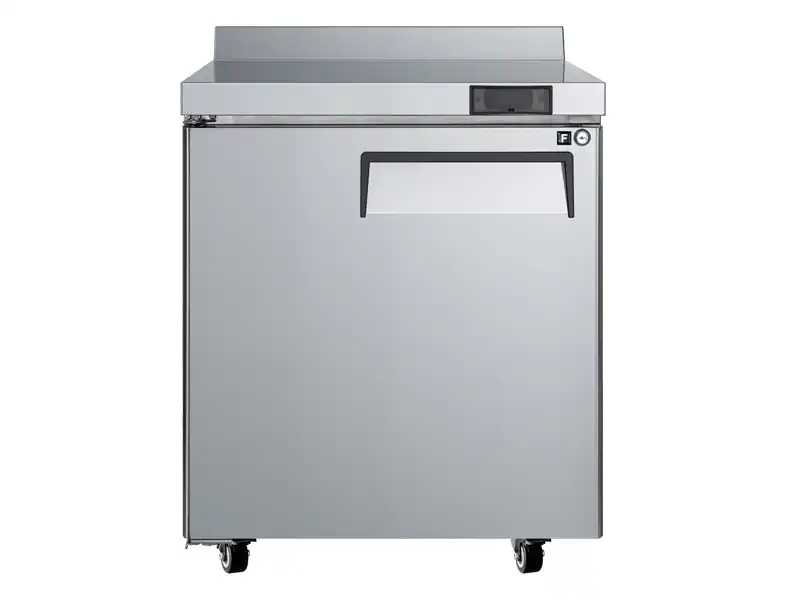
The table below lists our most popular undercounter units and the consistent interior depth that makes them GN-ready straight out of the crate.
| Model | Interior Depth (mm) | Door Type |
|---|---|---|
| MTR-48 | 601 | 2 solid doors |
| MTR-60 | 601 | 2 solid doors |
| MTR-72 | 601 | 3 solid doors |
All three models run on R290 refrigerant with polyurethane insulation, and they carry ETL, DOE, and Energy-Star certifications. Because we manufacture in-house, we can also adjust shelving configurations for partners who need a specific pan layout.
Common Questions About GN Compatibility and Commercial Fridges
Does a GN-compatible fridge cost more than a non-standard one?
In my experience, the initial purchase difference is negligible when you compare the lifetime cost. A fridge built to a recognized modular standard holds its value better when the kitchen layout changes, because the pans and the cabinetry still match. The real savings show up in reduced food waste from misfit containers and less time spent repacking.
Can I mix GN pans from different manufacturers in the same fridge?
Yes — that is the point of the standard. As long as each pan is certified to EN 631 dimensions, they will stack and slide identically. What matters more is that the fridge interior is flat and free of obstructions so that any brand of GN pan sits flush. When we validate a model for GN use, we test it with pans from multiple suppliers to be certain.
How do I confirm that a Camay fridge fits my specific GN pan set before ordering?
The simplest method is to give us your pan dimensions and the number of each size you need to store per section. Our engineering team can map those requirements onto the exact shelf layout of a given model. We frequently do this for hotel and restaurant chains standardizing their kitchens globally. If you send your pan list to Sales@hzcamay.com or call +86 181 5720 2219, we will return a fitment confirmation so you can order without uncertainty.
Getting the Right Fit for Your Kitchen
Kitchen standardization fails at the refrigerator door more often than most operators expect. A fridge that claims to be commercial but cannot hold a full-size gastronorm pan costs you time every shift — extra handling, extra cleaning, extra frustration. I have seen single-outlet kitchens lose hours each week simply because their cooling units were never verified against the actual pans in use.
At Camay, we build our undercounter and chef base units with internal dimensions that work with the GN standard from day one. If you are planning a new kitchen, replacing equipment, or expanding a restaurant group, share your required pan sizes and quantity with us. Reach our team at Sales@hzcamay.com or +86 181 5720 2219. We will confirm which model fits your kitchen precisely, so you can outfit the entire line with confidence.
If you’re interested, check out these related articles:
Boost Efficiency Energy Efficient Chef Base Units for Commercial Kitchens
How to Choose the Best Chef Base Refrigerator for Your Kitchen
Essential Maintenance Tips for Commercial Reach In Refrigerators
Boost Kitchen Efficiency Workflow Optimization with Chef Base Fridges
Upright Freezer vs Refrigerator Key Differences Explained