
Ultra-Low Freezers in Food Processing: Preserving Quality While Meeting Safety Standards
Food processors deal with a fundamental tension every day. Products need to stay fresh long enough to reach consumers, but the methods used to extend shelf life often compromise the very qualities that make food worth eating. Ultra-low freezers address this problem directly. By dropping temperatures far below conventional freezing points, they preserve cellular structure in ways that standard equipment simply cannot match. The result shows up in texture that holds, flavor that remains intact, and safety margins that satisfy even the most demanding regulatory frameworks.
Rapid Crystallization Prevents Cellular Damage
The science behind ultra-low freezing explains why it works so well for food preservation. When temperatures drop quickly to extreme lows, ice crystals form at a much smaller size than they would during conventional freezing. This matters because large ice crystals puncture cell walls, releasing moisture and breaking down the structural integrity that gives food its characteristic texture.
Ultra-low freezers achieve rapid crystallization by maintaining temperatures between -40°C and -86°C. At these levels, water transitions to ice so quickly that crystals remain microscopic. Cells stay intact. When the product thaws, it retains moisture instead of releasing it as drip loss. This preservation mechanism also halts microbial activity and enzymatic reactions almost completely, which are the primary drivers of spoilage in perishable goods.
The practical outcome is food that looks, tastes, and feels closer to its fresh state even after extended storage. For processors working toward HACCP compliance, this level of preservation control provides documented evidence that critical temperature points are being maintained consistently.
Operational Advantages Beyond Quality Preservation
Integrating ultra-low freezing into production lines delivers benefits that extend well beyond product quality. Spoilage rates drop significantly when food can be held at stable extreme temperatures, which translates directly to reduced waste and lower disposal costs. Products that previously had narrow distribution windows can now reach markets that were geographically impractical before.
The extended shelf life also changes inventory management. Processors gain flexibility in production scheduling because finished goods can be stored longer without quality degradation. Seasonal ingredients can be preserved at peak freshness and processed throughout the year, smoothing out production cycles and reducing the pressure of harvest-time bottlenecks.
Cold chain logistics become more manageable when products start their journey in a deeply frozen state. The thermal buffer provided by ultra-low temperatures means that minor temperature fluctuations during transport have less impact on final product quality. This reliability opens distribution channels that require longer transit times or pass through regions with less developed cold chain infrastructure.
Temperature Stability Determines Processing Outcomes
Precision temperature control separates effective ultra-low freezing from equipment that merely reaches low temperatures. The difference shows up in product consistency. Temperature fluctuations, even small ones, cause ice crystals to grow through a process called recrystallization. Each cycle of slight warming and cooling allows crystals to merge and expand, eventually causing the same cellular damage that rapid freezing was meant to prevent.
Freezer burn represents one visible consequence of inadequate temperature control. The surface dehydration and oxidation that characterize freezer burn occur when temperature instability creates localized thawing and refreezing. Beyond appearance, this process degrades nutritional content and creates off-flavors that consumers notice immediately.
Ultra-low freezers address these issues through refrigeration systems designed for stability rather than just achieving target temperatures. Uniform air circulation, responsive compressor controls, and effective insulation work together to maintain narrow temperature bands throughout the storage chamber. This consistency matters most during extended storage periods when even minor drift can accumulate into significant quality impacts.
Matching Equipment Specifications to Processing Requirements
Selecting appropriate ultra-low freezing equipment requires balancing several factors against specific operational needs. Capacity must accommodate production volumes without excessive empty space that wastes energy. Temperature range should match the requirements of the products being processed, with some margin for flexibility as product lines evolve.
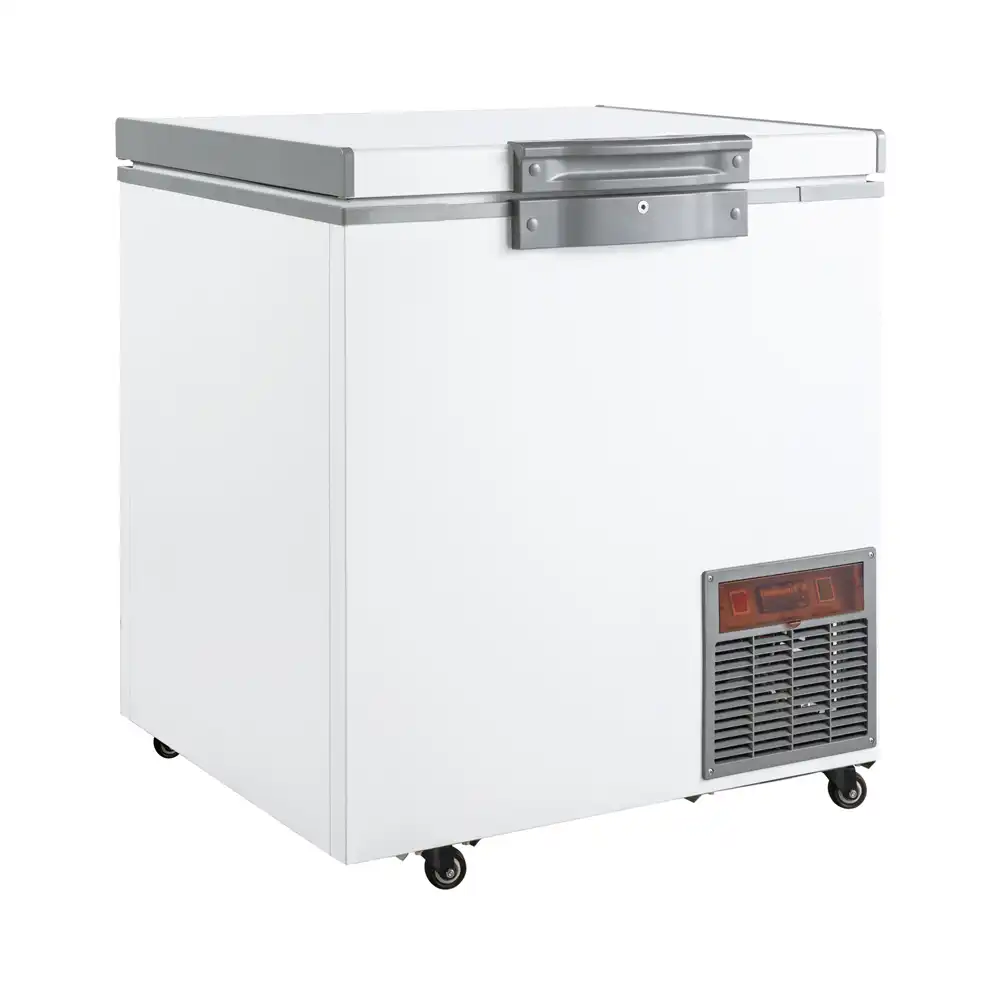
Current industrial ultra-low freezer technology offers options across a range of specifications. Models like the -86°C ULT Freezer (DW45W788) provide 768L capacity with internal temperatures adjustable from -15°C to -45°C, suitable for operations requiring substantial throughput. The -86°C ULT Freezer (DW45W685) offers 665L capacity with identical temperature capabilities for facilities with somewhat smaller volume requirements.
| Feature | -86°C ULT Freezer (DW45W788) | -86°C ULT Freezer (DW45W685) |
|---|---|---|
| Capacity (L) | 768 | 665 |
| Temp Range (°C) | -15 to -45 | -15 to -45 |
| Compressor | SECOP | SECOP |
| Refrigerant | Hydrocarbon mixed | Hydrocarbon mixed |
| Insulation | Polyurethane/Cyclopentane | Polyurethane/Cyclopentane |
Both Ultra Freezer configurations use SECOP compressors paired with hydrocarbon mixed refrigerants, a combination that delivers reliable temperature maintenance while meeting current environmental standards. Food-grade 304 stainless steel construction and ultra-thick foam insulation using polyurethane and cyclopentane provide the thermal retention necessary for consistent performance. Double door seals and integrated safety locks address both energy efficiency and security requirements.
Energy consumption deserves careful evaluation during selection. Equipment that maintains target temperatures with lower power draw reduces operating costs over the equipment’s service life, often offsetting higher initial purchase prices within a few years of operation.
Emerging Technologies Shape Future Capabilities
Ultra-low freezing technology continues advancing in directions that address both operational efficiency and environmental responsibility. Smart refrigeration systems now incorporate sensors and connectivity that enable real-time monitoring from remote locations. Operators can track temperature trends, receive alerts when parameters drift outside acceptable ranges, and access historical data for compliance documentation without being physically present at the equipment.
Predictive maintenance capabilities are becoming more sophisticated. By analyzing compressor performance patterns, power consumption trends, and temperature stability data, these systems can identify potential failures before they occur. This shifts maintenance from reactive repairs to planned interventions, reducing both downtime and emergency service costs.
Refrigerant choices are evolving toward options with lower global warming potential. Hydrocarbon refrigerants like R290 are gaining adoption because they provide effective cooling performance while minimizing environmental impact. This transition responds to both regulatory pressure and growing customer expectations around sustainability.
Automation integration allows ultra-low freezers to communicate with broader production management systems. Temperature data can feed directly into quality control documentation. Inventory tracking can account for storage duration at specific temperatures. These connections reduce manual data entry while improving the accuracy and completeness of production records.
Working with ZHEJIANG KAIMEI on Refrigeration Solutions
ZHEJIANG KAIMEI CATERING EQUIPMENT CO., LTD. provides consultation and equipment for food processing operations seeking ultra-low freezing capabilities matched to their specific requirements. Discussions can address capacity planning, temperature specifications, energy efficiency targets, and integration with existing production systems. Contact information: Email: Sales@hzcamay.com, Phone: +8618157202219.
Common Questions About Ultra-Low Freezing in Food Processing
What temperature range works best for ultra-low freezers in food applications?
Most food processing applications operate effectively with temperatures between -15°C and -45°C. Some specialized products benefit from even lower temperatures reaching -86°C. The appropriate setting depends on the specific food being processed and how long it needs to remain in storage. Proteins with high fat content, for instance, may require lower temperatures than lean products to prevent oxidation during extended storage.
How does ultra-low freezing support HACCP documentation requirements?
Ultra-low freezers equipped with data logging capabilities automatically record temperature readings at regular intervals. This creates the documented evidence that HACCP plans require for critical control points related to temperature. The stable environment these units maintain also reduces the likelihood of temperature excursions that would require corrective action documentation, simplifying overall compliance management.
What financial returns can processors expect from ultra-low freezing investment?
The return calculation involves several factors that vary by operation. Reduced spoilage typically provides the most immediate savings, particularly for processors handling high-value products or experiencing significant waste under current methods. Extended shelf life can open new sales channels that were previously impractical, adding revenue that offsets equipment costs. Energy-efficient models reduce ongoing operating expenses compared to older technology. Most operations find that the combination of waste reduction, market expansion, and efficiency gains produces positive returns within two to four years of installation.