
Stainless steel worktop durability is not something you can judge from a material spec sheet alone. After more than two decades in commercial equipment manufacturing, we have seen how the same 304 stainless steel can perform very differently depending on how it was handled during fabrication. The real story of durability lies in the welding, the finishing, and the consistency of the production process. This article examines the factors that separate a worktop that will hold up under heavy daily food prep from one that will start to show wear within the first year.
What Makes a Stainless Steel Worktop Durable
Material composition gets most of the attention, but durability is a system property, not a single number. The grade of stainless steel sets the corrosion resistance baseline, while gauge thickness, edge treatment, and sub-structure reinforcement determine how the worktop holds up under load over time.
Type 304 stainless steel contains 18-20% chromium and 8-10.5% nickel, giving it superior resistance to food acids and cleaning chemicals. Type 430 stainless steel, with 16-18% chromium and virtually no nickel, costs less but is less forgiving in aggressive kitchen environments. For most commercial food prep applications, 304 grade combined with a minimum 16-gauge (1.5 mm) thickness is the practical baseline for a durable worktop. Gauges thinner than 18 gauge (1.2 mm) tend to dent under heavy pot and pan impact, and the thin material makes it harder to achieve a warp-free weld.
| Property | 304 Stainless Steel | 430 Stainless Steel |
|---|---|---|
| Chromium content | 18-20% | 16-18% |
| Nickel content | 8-10.5% | 0-0.75% |
| Corrosion resistance | High — resists food acids and chlorides | Moderate — may pit in salty or acidic conditions |
| Weldability | Excellent | Requires careful post-weld treatment |
| Cost | Higher | Lower |
| Recommended gauge for heavy use | 14-16 gauge | Not recommended for heavy food prep |
Gauge and grade are only the starting point. A durable worktop must also have a consistent surface finish that resists bacterial adhesion while withstanding daily scrubbing. A #4 brushed finish is standard in commercial kitchens because it balances cleanability with scratch resistance.
How Manufacturing Quality Affects Worktop Longevity
The same sheet of 304 stainless steel can become a worktop that lasts ten years or one that warps and creaks within two. The difference is in the production process.
In our production facility, we consistently find that fully welded sub-structures with reinforced corners increase load-bearing capacity by over 30% compared to spot-welded designs. Spot welding creates small, concentrated joints that can crack under repeated impact. Full seam welding along the underside frame distributes stress evenly, preventing the worktop surface from developing low spots where water pools and cleaners concentrate. Another determinant is the skill of the press brake operator: inconsistent bend angles create gaps between the top skin and the under-structure, and those gaps amplify vibration and noise during daily use.
Quality control at scale also matters. A manufacturer running production lines under an ISO 9001:2015 quality management system implements in-process inspection of weld integrity, surface flatness, and dimension tolerance. Without that, variation between units in the same batch can mean one worktop stays dead-flat for years while the next one warps after a few hot water washdowns. A durable worktop is the product of repeatable processes, not a lucky run on the factory floor.
Design Features That Improve Durability and Food Safety
Durability and food safety reinforce each other in well-designed worktops. A seamless top skin with folded front and rear edges eliminates the crevices where food debris and moisture collect. The absence of exposed fasteners on the top surface further reduces spots where rust can initiate.
Underside bracing with a pitch of no more than 500 mm between supports prevents the stainless steel sheet from flexing under heavy loads. Flexing work-hardens the material over time, and in a high-volume kitchen that can eventually lead to fatigue cracks. A turned-down back edge, or marine edge, not only prevents spills from reaching walls but also adds bending stiffness to the rear section. These features add incremental cost during manufacturing but pay back several times over the life of the equipment.
If your kitchen environment involves aggressive cleaning chemicals or frequent disinfection, it is worth confirming the chemical resistance of the stainless steel finish with your supplier. Reach out at Sales@hzcamay.com for guidance on finish specifications.
Worktop Maintenance and Its Impact on Lifespan
Even a well-built stainless steel worktop will lose durability if maintenance practices work against the material. Chloride-based cleaners, such as bleach, can attack the passive chromium oxide layer that protects stainless steel. In our experience, kitchens that switch to neutral pH or alkaline cleaners after heavy chlorinated sanitation cycles see visibly less surface staining within six months.
Routine cleaning should use non-abrasive cloths and warm water, drying the surface after to prevent water spotting. For stubborn deposits, a stainless steel-safe cleaning paste applied along the grain direction removes buildup without scratching. Deep scratches from steel wool or scouring pads create sites where corrosion can gain a foothold, and once pitting starts, it becomes a maintenance problem that no amount of polishing will fully reverse.
Routine inspection of the under-structure joints and caster mounts is equally important. Loose bolts or cracked welds at the leg attachments transfer vibration into the top skin, accelerating stress fatigue. Tightening fasteners to the manufacturer’s torque specification once a quarter preserves the unit’s structural integrity.
Total Cost of Ownership: Why Durability Is an Investment
A $500 worktop replaced after three years costs more than a $1,200 worktop that serves for ten. Durable stainless steel worktops shift spending from capital replacement to operational productivity.
The factors covered in this article all contribute to total cost of ownership. A properly fabricated 304 stainless steel worktop with 14-gauge thickness, seam-welded underside, and chemical-resistant finish can hold its flatness and appearance through tens of thousands of prep cycles. Cheaper alternatives with spot-welded frames and thinner material frequently fail at the weld joints within 24 months, creating an ongoing replacement cycle that also introduces downtime for demounting and reinstalling connected equipment such as undercounter refrigerators or chef bases.
Procurement teams should request documentation of weld inspection and surface flatness tolerances from potential suppliers. A manufacturer that cannot provide those is unlikely to deliver the longevity your kitchen requires.
Choosing a Durable Worktop Supplier
Durability ultimately traces back to the supplier’s manufacturing discipline. A supplier with 26 years of experience and certifications such as ETL, DOE, and ENERGY STAR, combined with ISO 9001 factory management, has the process infrastructure to produce worktops with consistent quality. Large-scale production further indicates that the company has refined its fabrication methods over hundreds of thousands of units, building repeatable competence.
At ZHEJIANG KAIMEI CATERING EQUIPMENT CO., LTD, our Camay brand worktops are built with the same production rigor we apply to our refrigeration equipment. We select only mill-certified 304 stainless steel coil stock, form it on precision CNC press brakes, and inspect every weld before the unit leaves the line. Our factory’s integrated management system under ISO 9001, ISO 14001, and ISO 45001 ensures that these processes are not aspirational but auditable.
A durable worktop is a production decision, not a catalog option. Send your required dimensions and load conditions to Sales@hzcamay.com or call +86 181 5720 2219. We will provide a specification-matched recommendation so you are not guessing at what will hold up in your kitchen.
Common Questions About Stainless Steel Worktop Durability
Is 304 stainless steel always better than 430 for a worktop?
It depends on the food environment. 304’s nickel content gives it superior resistance to acidic foods like tomato sauce, citrus, and vinegar, as well as chloride-based sanitizers. In kitchens where these are present daily, 304 is the safer choice. In dry storage areas or light prep zones with neutral cleaning practices, 430 can perform adequately at a lower cost. The real risk with 430 is that any scratch that penetrates the passive layer in a humid environment can trigger rapid localized corrosion, so maintenance discipline must be higher.
Can stainless steel worktops rust?
Yes, though the mechanism is different from ordinary steel corrosion. Stainless steel relies on a self-healing chromium oxide layer. When that layer is damaged by chlorides, prolonged exposure to stagnant water, or contact with iron particles from other tools, rust can form. Most rust on commercial kitchen worktops is surface contamination from iron dust or steel wool particles that embed in the surface and then corrode. Passivation treatments during manufacturing and avoiding steel wool in daily cleaning prevent most of these problems.
How thick should a stainless steel worktop be for heavy use?
A general rule: 14-gauge (1.9 mm) for tables supporting heavy equipment or frequent impact, 16-gauge (1.5 mm) for standard prep work, and avoid anything thinner than 18-gauge (1.2 mm) in commercial kitchens. Underside framing design, however, can make a 16-gauge top perform better than an unsupported 14-gauge top. We recommend at least 1.2 mm thickness combined with weld-braced cross members spaced every 500 mm or less.
How often should I clean my stainless steel worktop?
At minimum, clean and sanitize after each shift. More intensive wipe-downs are needed after handling raw proteins or seafood. Avoid leaving standing water or cleaning solution residue on the surface overnight. For routine care, warm water and a microfiber cloth prevent most buildup. Weekly cleaning with a stainless steel polish formulated for food contact surfaces maintains the passive layer and enhances corrosion resistance.
How does undercounter refrigeration affect worktop durability?
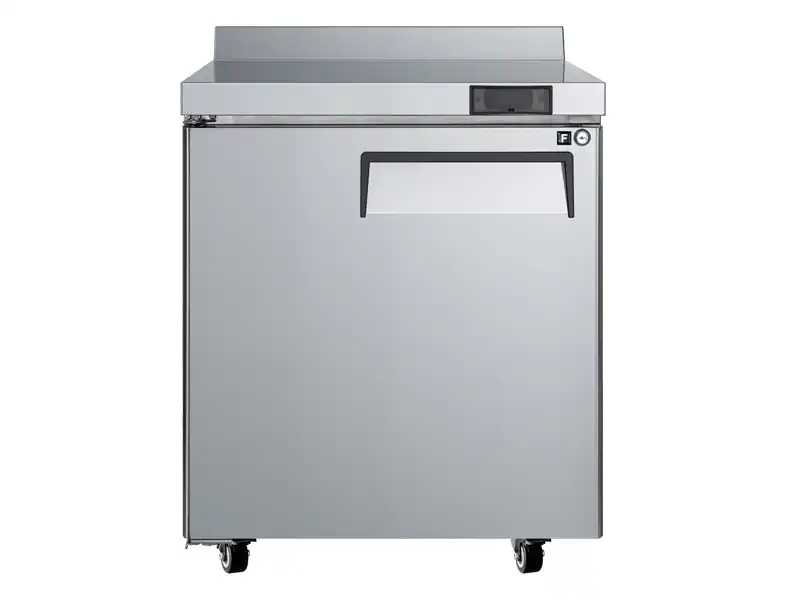
When a worktop is installed over an undercounter refrigerator or freezer, additional stress factors enter the equation: compressor vibration, condensation cycles, and temperature differentials between the top skin and the cabinet frame. A worktop designed to sit on a refrigerated base must have vibration-dampening gaskets and sufficient cross-bracing to absorb the cyclic loading. Without these, the constant micro-movement can crack welds and separate seams within the first year. If your layout includes undercounter cooling, confirm with the supplier that the worktop is engineered for co-installation. To discuss your specific kitchen configuration and get a durability assessment tailored to your equipment lineup, share your requirements at Sales@hzcamay.com.
If you’re interested, check out these related articles:
Essential Maintenance Tips for Your Commercial Chef Base Refrigerator
How to Choose the Best Chef Base Refrigerator for Your Kitchen