

Every restaurant design that fails early does so for one of two reasons: the worktop surface becomes impossible to sanitize effectively within six months, or it develops surface damage severe enough to trap contaminants. The hygiene problem and the durability problem are rarely separate. In more than two decades of manufacturing commercial kitchen equipment, I have seen how a stainless steel worktop that looks identical on day one to its competitor can, by year two, become the single most cited item during a health inspection. The root cause is almost always a combination of material grade, fabrication method, and cleaning practice. Getting the balance right does not require a bigger budget. It requires specifying the right features and then treating the surface with an owner’s awareness of what preserves it.
Why Stainless Steel Remains the Standard for Worktop Hygiene
Stainless steel is not automatically hygienic. Its advantages depend entirely on the grade and the surface finish. In commercial kitchens, Type 304 stainless has become the baseline for food contact surfaces because its chromium and nickel content resists the acids in citrus, tomatoes, and common cleaning agents. Lower-cost 430 stainless, which lacks nickel, can micro-pit under frequent exposure to chlorinated sanitizers. That pitting creates reservoirs for moisture and bacteria, and once it starts, the worktop is on a countdown to replacement.
The difference in longevity between the two grades is drastic. In a high-volume kitchen using chloride-based cleaners daily, a 430 worktop may show visible corrosion at welded seams within twelve months. A 304 worktop under the same conditions typically shows only some dulling of the surface finish after several years, and even that can be delayed by passivation. This is not a hypothetical. Our production team has evaluated returned worktops from kitchens in coastal areas where the combination of salt air and aggressive sanitation schedules accelerates failure on non-304 materials. The lesson is consistent: if the worktop will be sanitized with anything stronger than mild detergent, 304 is not an upgrade. It is the minimum.
| Stainless Grade | Nickel Content | Resistance to Chloride Cleaners | Typical Kitchen Life Expectancy |
|---|---|---|---|
| 304 | 8-10.5% | Good | 7-10+ years |
| 430 | 0% | Poor, pitting risk | 2-4 years in high-sanitation use |
| 316 | 10-14% (plus molybdenum) | Excellent | 15+ years, overkill for most restaurants |
Design Features That Directly Improve Sanitation
Hygiene in a worktop is primarily a function of geometry, not just material. The same 304 stainless sheet, if fabricated into a worktop with open seams, exposed screw heads, and sharp internal corners, will become a sanitation liability regardless of the alloy. Three design details matter disproportionately.
The first is the corner and edge treatment. Any 90-degree internal corner where the backsplash meets the horizontal surface creates a crevice that a cleaning cloth cannot fully penetrate. The solution is cove corners with a radius that a finger can sweep clean. The same principle applies to all seams. Continuous welding followed by grinding and polishing eliminates the threadline gaps where bacteria multiply. A smooth, flush surface is the only surface that can be reliably sanitized in under twenty seconds.
Second is the integration of the worktop with its support structure. Undersides that are open to the floor allow spillage to run down and pool on shelf edges. Worktops with a continuous drip-resistant front edge, a V-edge or similar, redirect liquids into a controlled zone rather than allowing them to spread across the cabinet body. This protects not only the floor but the hinges, gaskets, and controls of any refrigeration unit underneath.
Third, and often overlooked, is the specification of the backsplash. A 2-inch backsplash that is simply bent sheet metal with an open bottom creates a gap between the worktop and the wall that is difficult to seal permanently. A full-height integral backsplash that is welded and polished as part of the main surface eliminates that gap. In walk-in health inspections, inspectors routinely check behind back splashes with a mirror. A sealed, continuous surface passes that check every time.
Durability Factors: Gauge, Under-Bracing, and Load Rating
Hygiene fails when durability fails. A dented worktop surface can become a collection point for standing water even if the dent itself is in a quiet prep zone. Dents occur when the worktop gauge is too light for the weight it carries or when the under-structure lacks enough reinforcement to maintain flatness.
In practice, a 16-gauge (1.5 mm) stainless top with a properly spaced substructure of hat channels or square tubing will remain flat under the dynamic loads of a busy grill station, where pans are dropped and cast iron is dragged. A 20-gauge (0.9 mm) top with no bracing may oil-can under the heat of a pass-through window and develop permanent warping within the first year of service. The extra material cost of the thicker top is recovered many times over by avoiding a mid-life replacement and the associated downtime.
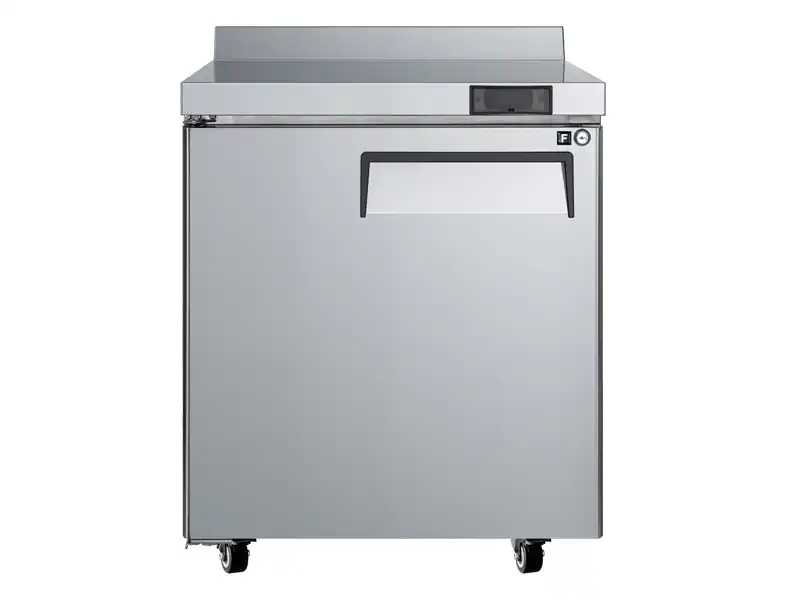
Another durability factor specific to refrigerated worktop units is the insulation and refrigeration system itself. A worktop that also serves as a cooler — such as the Camay MWTF line — uses polyurethane foam insulation that not only reduces compressor run time but adds structural rigidity. The foamed-in insulation bonds to the inner and outer walls, making the entire cabinet stiffer than a hollow shell. This rigidity prevents the top surface from flexing under heavy loads and helps the door gaskets maintain a consistent seal over years of operation.
Cleaning Protocols That Protect the Surface as Much as the Food
The most durable stainless steel can be prematurely damaged by cleaning routines that ignore chemical compatibility. Many commercial degreasers contain hydroxides that, if left on the surface to dry, will etch the passive chromium oxide layer that gives stainless its stain resistance. The correct sequence is straightforward: rinse after every chemical application, and dry the surface with a soft cloth when possible to prevent water spots that can turn into mineral-based corrosion sites.
Abrasion is the other silent surface killer. Green scrubbing pads, which are aluminum oxide based, leave microscopic scratches that over time create a matte finish with increased surface area for biofilm adhesion. White or blue pads, which are silicon carbide based and less aggressive, are the correct choice for daily cleaning. Scratches themselves are not harmful if the surface is properly sanitized afterward, but they make sanitizing harder over time because the disinfectant cannot contact deeply scratched areas as effectively as a smooth surface.
For worktops that incorporate a refrigeration compartment, the cleaning protocol must also consider the door gaskets and the drain line. Gaskets should be removed at least weekly and the channel wiped free of grease, which hardens and can cause the gasket to lose compression. A gasket that no longer seals tightly allows warm, humid air to enter the refrigerated compartment, causing condensation and potential mold growth that spreads to the work surface.
Worktop Layout and Its Impact on Both Sanitation and Longevity
The physical layout of worktops in the kitchen directly affects how long the surfaces remain clean during a shift and how much physical abuse they sustain. A worktop placed immediately next to a deep-fryer will run hot on one edge, causing thermal expansion that can break sealant beads and open gaps. A worktop used as a landing zone for dish racks from a high-temp dishwasher will experience more thermal cycling than one used for cold prep. Specifying heat shields or designing a buffer zone between cooking equipment and stainless prep surfaces extends the life of the worktop appreciably.
Similarly, the placement of the worktop relative to traffic patterns determines how much incidental impact it receives. A worktop oriented perpendicular to the main aisle will be struck by passing carts far more often than one oriented parallel. Each impact, even a minor one, can distort the front edge and eventually cause the integral backsplash to pull away from the wall. In a layout review, I always recommend that the longest continuous worktop run be parallel to the main circulation path, not crossing it.
Refrigerated worktop units, which combine cold storage with a prep surface, present an additional layout consideration: access to the compressor compartment for cleaning and service. A condenser coil caked with grease and flour dust operates hotter and cycles on more frequently, which accelerates compressor wear. Positioning the unit so that the front kick panel can be removed without moving heavy equipment ensures that the coil cleaning gets done on schedule, which in turn keeps the internal temperature stable and reduces thermal stress on the cabinet structure.
Common Questions About Worktop Hygiene and Durability
Does a No. 4 brushed finish resist bacteria better than a mirror finish?
A No. 4 brushed finish and a mirror polish are both smooth enough to present no significant difference in cleanability when properly maintained. The advantage of the brushed finish is that it hides surface scratches and water marks better than a mirror finish, which means staff are less likely to resort to abrasive methods to restore the appearance. However, if the application involves sticky doughs or raw seafood that require a scraping action, a smoother finish will release residues more easily.
How often should a stainless steel worktop be passivated?
Passivation, a chemical treatment that restores the chromium oxide layer, is not a routine maintenance step for most restaurant worktops. It is warranted when the surface shows signs of rust spotting or after a major scratch-repair episode. In normal use with proper cleaning, a 304 stainless worktop can go its entire service life without passivation. A facility using aggressive chloride-based sanitizers on every shift may benefit from passivation every two to three years, but a more cost-effective solution is to switch to a non-chloride sanitizer.
Is a thicker gauge always better for hygiene?
Not directly. A thicker gauge prevents denting, which indirectly protects hygiene by keeping the surface smooth and free of water-trapping depressions. But a 16-gauge worktop that is poorly welded at the seams will still harbor bacteria. Thickness is a durability-first consideration that supports hygiene, not a substitute for proper fabrication. The correct combination is a minimum 18-gauge 304 stainless with continuous welds and cove corners.
Can a worktop be both a prep counter and a refrigeration unit without compromising either function?
Yes, and this is the strongest argument for integrating refrigerated worktop units into a kitchen design. The Camay MWTF series, for example, places the evaporator coil in the cabinet body and uses the top surface as a full-load-bearing worktop with a drip-resistant V-edge. The insulation layer also prevents condensation from forming on the underside of the top, so the work surface stays dry even when the internal temperature is at 33°F. This design eliminates the need for a separate prep table and a reach-in refrigerator in the same zone, reducing the total number of seams and joints in the kitchen. If your current layout has a prep area crowded with free-standing tables and stand-alone refrigeration, consolidating into a single refrigerated worktop unit may be the single most effective step toward better hygiene and better space utilization. Send your kitchen dimensions and daily volume to Sales@hzcamay.com to see which configuration fits your specific workflow.
If you’re interested, check out these related articles:
Ultimate Buyers Guide for Commercial Reach In Refrigerators
Essential Maintenance Tips for Your Commercial Chef Base Refrigerator
Chef Base Fridge vs Undercounter Fridge Which Is Best for Your Kitchen