

Freezer burn in commercial storage isn’t a cosmetic flaw—it’s a direct drain on food cost, product quality, and customer trust. The condition develops when ice crystals sublimate from frozen food surfaces under fluctuating temperatures, leaving dehydrated, leathery patches that no amount of thawing can reverse. Most advice on the subject stops at wrapping techniques and FIFO rotation. With 26 years in commercial refrigeration manufacturing, I see it differently. The most effective prevention strategy starts with the equipment itself. A consistently cold, professionally designed freezer with stable air flow stops freezer burn before it begins.
Causes of Freezer Burn in Commercial Freezers
Freezer burn is fundamentally a moisture-loss problem driven by sublimation—the direct transition of ice from solid to vapor without melting. In a commercial freezer, this happens when frozen food surfaces warm just enough for surface ice to skip the liquid phase and evaporate into dry, circulating air. Temperature swings are the primary trigger: every defrost cycle, door opening, or uneven air distribution causes surface temperatures to spike briefly. Over days and weeks, the moisture migrates out of the product, leaving behind spongy, discolored patches.
Two factors accelerate the process. First, the quality of insulation and door seals determines how much heat creep reaches stored food between compressor cycles. Second, the air circulation pattern inside the cabinet decides whether cold, dry air hits product surfaces repeatedly. A freezer with poor door gaskets or a fan that channels air in a narrow jet will dehydrate stock near the blower outlet within a month. I’ve seen bulk meat shipments lose 3–5% net weight over 30 days in freezers with unchecked temperature swings, even when the average reading stayed at -18°C. The spoilage appears evenly across product categories: high-value seafood, prepared bakery goods, and portioned protein all suffer when the environment isn’t stable.
How Professional Refrigeration Equipment Prevents Freezer Burn
Commercial-grade freezers designed for high-usage kitchens address the root causes at the engineering level. The core advantage is temperature stability maintained through multiple systems working together rather than a single thermostat.
Three elements make the biggest difference. High-density foamed-in polyurethane insulation—in Camay units, this is cyclopentane-based and 4 to 5 inches thick depending on model—reduces ambient heat gain so the compressor cycles less frequently and the internal temperature band stays tight, typically within ±1°C. Ventilated cooling with multi-point sensor feedback distributes air evenly across all shelf levels, avoiding the cold spot/hot spot patterns that cause localized dehydration. Automatic electric defrost with rapid recovery brings the evaporator back to setpoint in minutes, not hours, limiting the time food surfaces spend above -12°C.
The compressor and controller matter as well. A heavy-duty compressor matched to the cabinet volume and designed for high-ambient operation (ST~T climate class, running up to 38°C ambient) prevents the slow temperature climb that occurs in underpowered units during peak kitchen hours. Smart digital controllers with optional IoT connectivity log temperature history, so a 2°C drift over a weekend goes into the maintenance log instead of being discovered through spoiled product.
High-density insulation and precise compressor sizing keep temperature bands tight, but for volume kitchens, a dedicated energy-efficient upright freezer can lower both your electric bill and product loss. <Boost Savings with Energy Efficient Commercial Upright Freezers> reviews how inverter-driven compressor technology and thick cabinet walls pay back within months on a 500-liter unit that sees 40 door openings per shift.
Key Equipment Features That Directly Reduce Freezer Burn
Buyers evaluating commercial freezers with product quality in mind should focus on a short list of measurable specifications. I’ve found that these five often separate units that merely chill food from those that genuinely protect it.
| Feature | What to check | Why it matters for freezer burn |
|---|---|---|
| Insulation thickness | Minimum 60 mm foamed polyurethane, ideally cyclopentane-blown | Reduces heat transmission so the evaporator runs less, narrowing temperature swing amplitude |
| Defrost type | Automatic electric with rapid recovery (less than 30-minute recovery to -15°C) | Limits the time food surfaces spend above sublimation temperature |
| Air circulation | Multi-directional ventilated system, not a single axial fan at the top | Prevents high-velocity dry air from constantly stripping moisture from the same product zone |
| Digital controller | NTC sensor with ±0.5°C setpoint accuracy and data logging | Confirms stable temperature, provides early warning of drift, and supports HACCP documentation |
| Door seal integrity | Replaceable magnetic gaskets with self-closing hinge and stay-open safety | Blocks warm, humid air infiltration during load/unload cycles; worn seals are the most common equipment-side cause of freezer burn |
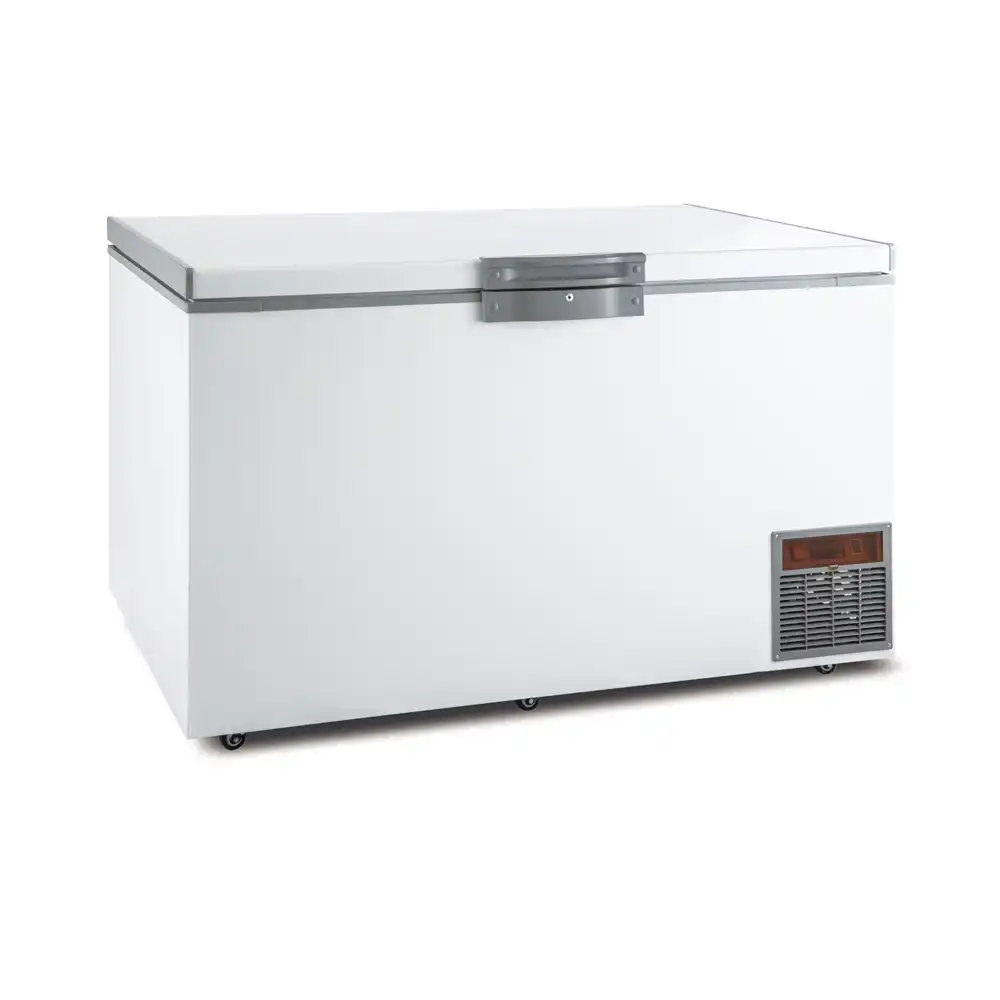
Camay solid-door freezers like the MF-23 incorporate all five of these—foamed-in polyurethane insulation, ventilated cooling, automatic defrost, and ETL-listed digital controls—in a kitchen-ready design. The combination isn’t novel, but it’s surprising how many commercial kitchens operate with freezers that lack proper air distribution or rely on a single-point thermostat, leading to hot spots on the top shelf and dehydrating cold drafts below.
Routine checks on these features keep the protective systems intact. <Essential Maintenance Tips for Commercial Reach In Refrigerators> explains coil cleaning and gasket inspection procedures that directly affect temperature stability and humidity control—small effort with a clear payback in food quality.
Operational Best Practices to Minimize Freezer Burn
Even the best-engineered freezer cannot prevent dehydration if daily habits work against it. These six practices align your kitchen routine with what the equipment was designed to deliver:
- Keep the core temperature at -18°C or below. Between -15°C and -10°C, sublimation rates double compared to -18°C. Use the digital controller to confirm the setpoint every shift.
- Pack to block air, not just to seal. Wrapping in plastic film slows sublimation, but a vacuum bag that removes air pockets around irregular cuts performs far better because there is no air space for moisture to migrate into.
- Run a strict first-expiring-first-out (FEFO) rotation. Older stock has already lost some surface moisture; moving it to the front prevents it from sitting another week and crossing the unusable threshold.
- Limit door-open time. Fifteen seconds of door-open in a 500-liter freezer can add a 3°C spike near the opening if warm kitchen air rushes in. Batch-pull ingredients to minimize repeated short openings.
- Check door gaskets monthly. A relaxed magnetic seal that lets a thin gap of room air pass will keep the compressor running longer and pull moisture onto the evaporator, which then forms frost and heats the interior during the defrost cycle.
- Maintain airflow by not overfilling. Stacking product against the back wall or air intake vents starves the circulation system, creating dead zones where the temperature can sit -3°C to -5°C warmer than the rest of the cabinet. Leave at least 50 mm clearance around active vents.
In our own factory test kitchen, we compared two identical batches of frozen pastry dough stored in the same model freezer under the same temperature setting. One batch followed the above rules; the other was stacked tight to the wall and pulled out with no set schedule. After four weeks, the well-managed batch had zero surface spotting, while the poorly stacked batch showed patchy dehydration on the outer 30% of dough pieces. The only difference was how the equipment was used.
Applying Professional Storage in a Workflow
In a central production kitchen supplying six hotel outlets, we saw weekly freezer burn losses reach roughly 4 kilograms of portioned seafood per week—mainly shrimp and squid rings—in spite of using -22°C setpoints. The root cause wasn’t the temperature setting but the equipment: two older freezers with unknown insulation condition and manual defrost timers that kept the evaporator heaters on too long, causing 25-minute temperature recoveries.
Replacing the pair with Camay solid-door models built with ventilated cooling and rapid automatic defrost changed the numbers. The kitchen maintained the same product rotation and packaging, but the temperature log over the next month showed a band of -20°C to -18°C instead of -22°C to -12°C. The reduced swing duration eliminated surface dehydration, and the weekly waste figure dropped to under 0.5 kilograms. The food cost relief alone paid back the equipment cost in less than three months.
The lesson isn’t that a better freezer makes every other practice unnecessary—it’s that when the equipment is designed to hold stable conditions, the daily kitchen routines work with it rather than fighting it.
Freezer burn doesn’t improve with time, and hesitant equipment decisions while product quality steadily declines cost more than a cold storage upgrade. We work with commercial kitchens to match their product categories with the right freezer capacity, insulation spec, and control setup. Share your menu type and typical frozen load at Sales@hzcamay.com or call +8618157202219, and we’ll recommend a configuration that protects your inventory from day one.
Common Questions About Freezer Burn Prevention
Is -18°C cold enough, or should I set the freezer even lower?
-18°C reliably keeps ice crystals from sublimating in most commercial products. Lower settings like -22°C or -25°C add a wider safety margin and become important for high-fat items (salmon, wagyu, butter-based pastries) where surface oils can oxidize alongside sublimation at the warmer end of the band. In manufacturing, we default to -20°C ±2°C as a practical balance between preservation and energy consumption. Going below -30°C rarely adds shelf-life benefit for general frozen storage and increases compressor duty significantly.
Does frost-free technology contribute to freezer burn?
The issue isn’t frost-free operation itself but the recovery time after the defrost cycle ends. In properly designed commercial freezers, the evaporator heaters run only long enough to melt frost, then the compressor restarts with full capacity and pulls the air temperature back below -15°C within 15 to 20 minutes. The problem arises in low-cost frost-free units where the defrost termination thermostat has a wide tolerance and the heaters stay on longer, stretching the food surface temperature excursion to 40 minutes or more. When we specify automatic defrost, we look for a maximum recovery curve that keeps the air temperature above -12°C for less than 10 minutes per cycle.
How long can frozen seafood be stored without noticeable freezer burn?
Properly frozen and vacuum-sealed lean white fish can sit at a stable -18°C for 8 to 12 months with negligible surface change. Oily fish like mackerel or tuna degrade sooner, around 3 to 6 months, because lipid oxidation proceeds even at low temperatures. These numbers assume the freezer holds temperature to within ±1°C and the product is protected from direct airflow. If temperature fluctuations are present, shelf life drops significantly—I’ve seen frozen shrimp show burn after just 5 weeks in a freezer that cycled between -16°C and -12°C. If your seafood program relies on precise inventory windows, send us your target species and we’ll recommend a storage configuration that fits your turnover rate.
If you’re interested, check out these related articles:
Choosing the Best Commercial Reach In Fridge for Your Restaurant
Essential Commercial Chef Base Fridge Installation Tips
Upright Freezer vs Refrigerator Key Differences Explained