

A laboratory freezer failure rarely announces itself as a full outage. The more common failure is a slow temperature excursion that destroys sample integrity between two routine checks. Medical lab ultra freezers have to do more than reach a low setpoint; they must hold that setpoint evenly across the storage space, recover quickly after a door opening, alarm early enough to protect the load, and arrive with the records a quality system can accept. After 26 years of manufacturing commercial and ultra-low refrigeration equipment, I would rather see a lab buyer spend more time on those four items than on cabinet size.
Which Medical and Laboratory Applications Fit Kaimei Ultra Freezers?
The storage task determines whether an ultra freezer is appropriate, not the department name. Biological research groups use these units for reagent banks, cell lysates, and protein extracts that degrade at ordinary freezer temperatures. Pharmaceutical storage may involve reference standards and temperature-sensitive intermediates. Chemical and food processing sites sometimes store raw materials that require stable sub-zero conditions. The common requirement is not the label on the door; it is a controlled low-temperature envelope that stays within the protocol range even when the room temperature is high.
A standard kitchen or reach-in freezer is not a substitute for this work. Its control band, defrost cycle, and door seal are built around frozen food, not lab samples.
Standard freezers are designed around intermittent access and food storage tolerances, not around the sustained low-temperature stability a laboratory protocol requires. <Upright Freezer vs Refrigerator Key Differences Explained> covers why defrost behavior, compressor sizing, and insulation differ between equipment classes.
What Temperature Performance Should You Verify on an Ultra Freezer?
Why read the working range instead of the product class?
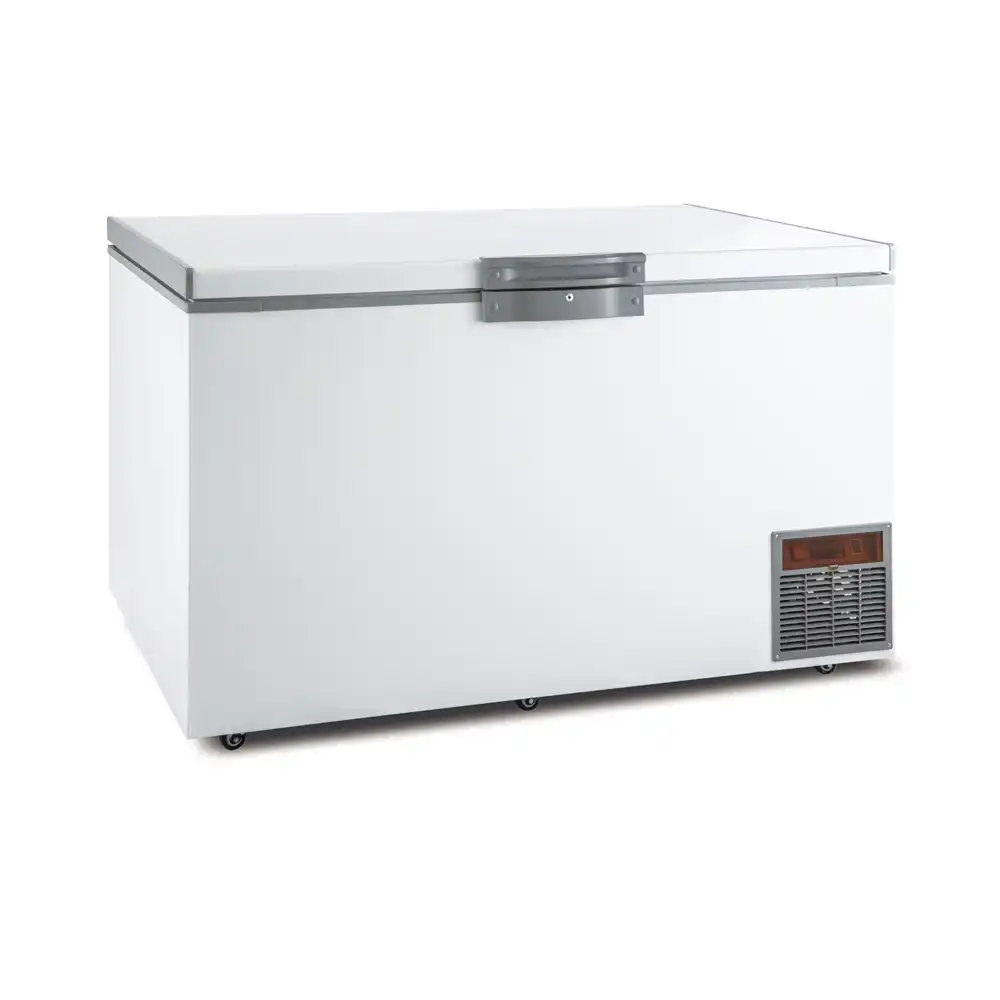
The product class can be misleading. A unit may carry an ultra freezer designation, but the published working range is what matters for a lab protocol. Our DW45W788 and DW45W685 models list a working range of -15°C to -45°C. That suits reagent banks and many temperature-sensitive intermediates, but it is not the same as a -80°C unit. If the storage plan requires -80°C or lower, this platform should not be specified. Model names and category labels can drift between manufacturers, and the setpoint display is not the same as a validated storage zone.
| Specification | DW45W788 | DW45W685 |
|---|---|---|
| Capacity | 768 L | 665 L |
| Working temperature range | -15°C to -45°C | -15°C to -45°C |
| Compressor | SECOP | SECOP |
| Power | 750 W | 700 W |
| Net dimensions | 2200 x 885 x 940 mm | 1950 x 885 x 940 mm |
Why does recovery after door openings matter more than setpoint?
A unit can hold temperature in a closed empty cabinet and still fail in a working lab. The more meaningful test is recovery after a door opening under partial load. We watch this in factory testing because field complaints usually point back to warm air entering through the seal followed by slow pull-down. In the DW45W788, the double door seal, foamed-in polyurethane insulation, and forced air cooling are the elements that keep recovery time short. Specify the loading pattern in the factory acceptance test and request recovery data from that condition, not a single spot temperature reading.
How Do Insulation, Door Seals, and Airflow Protect Stored Samples?
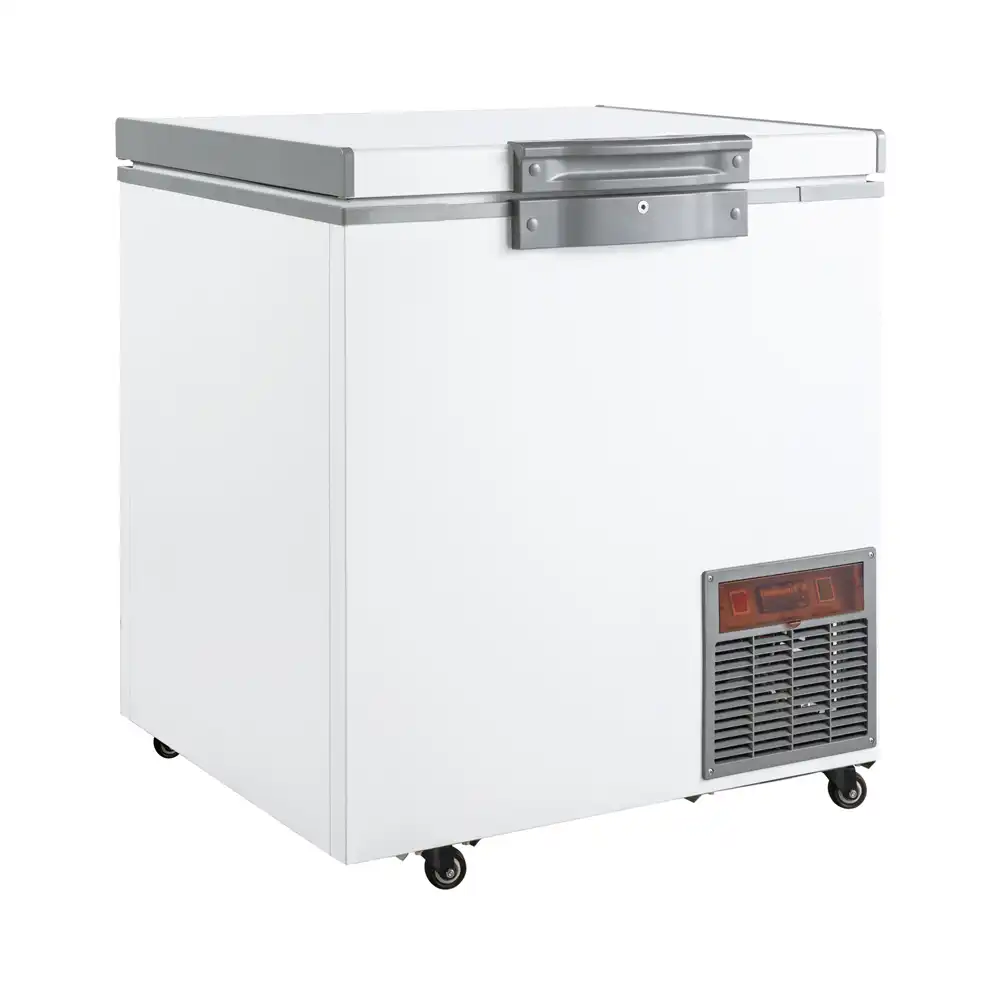
Temperature stability in a lab freezer comes from the cabinet system, not the compressor alone. The inner tank of the DW45W788 is food-grade 304 stainless steel, and the cabinet uses ultra-thick foamed-in insulation. The double door seal and air pressure balance limit warm air ingress and reduce the vacuum or pressure effect that can make a door hard to open after a cold soak. A safety door lock prevents accidental opening. These details matter when a freezer sits in a busy lab corridor where doors are opened by multiple people.
Airflow is easy to miss. A well-distributed air cooling system keeps the return air path from creating a warm corner behind a rack of samples. We ask buyers to think about where they will place high-value material in relation to the fan and evaporator. When a validation firm measures multiple points, differences between the controller sensor and the back corner show whether airflow is working for the real load or only for the sensor.
Energy is a significant part of ultra freezer ownership, and cabinet insulation is the largest controllable factor. <Boost Savings with Energy Efficient Commercial Upright Freezers> details how compressor sizing, airflow design, and foamed insulation shape long-term operating cost.
Which Documentation and Validation Records Matter for Ultra Freezer Procurement?
Laboratory and medical buyers usually need more than a commercial invoice. They need model-specific specification sheets, compressor and refrigerant details, temperature control parameters, and factory certification records. The DW45W788 and DW45W685 use a SECOP compressor and a microcomputer controller with LED digital display. The controller shows temperature and warning conditions with 0.1°C accuracy, which makes daily log reviews easier. Certified production under ISO 9001:2015, ISO 14001:2015, and ISO 45001:2018 gives the quality system a documented manufacturing base.
If your protocol involves cell lines, vaccines, or reference standards, it is worth confirming the setpoint range, alarm threshold, and recovery curve before finalizing your specification. Send the storage temperature and the validation checklist to Sales@hzcamay.com and we will confirm whether the unit matches the documented operating range.
What Should You Ask the Manufacturer Before You Order?
Most lab freezer selection mistakes come from incomplete spec alignment. Buyers often know their storage temperature but not the ambient temperature range, the access frequency, the rack dimensions, or the documentation their quality manager will ask for after delivery. We have learned to ask these questions early because they change the configuration. The unit that fits a small biotech lab is not automatically the right unit for a hospital pharmacy with multiple shifts and frequent door openings.
An ultra freezer purchase should end with a confirmed match between protocol requirements and factory capability. Send your required storage temperature, daily door opening estimate, internal container dimensions, and the acceptance test checklist to Sales@hzcamay.com or call +86 181 5720 2219. We will confirm the appropriate Kaimei ultra freezer model and the records available before the unit ships.
What Do Lab Buyers Ask About Ultra Freezer Compliance?
What is the difference between -40°C and -86°C storage?
The difference is the safety margin for the material, not just a colder number. A -40°C unit suits many reagents, enzymes, and process intermediates, while -80°C to -86°C units are specified for cells, tissues, and certain biological samples. Match the temperature to the preservation protocol and the intended storage time, then confirm the freezer can hold that setpoint across the full cabinet. For the DW45W788 and DW45W685, the published working range is -15°C to -45°C, so they are not a substitute for -80°C storage.
How often should temperature mapping be repeated?
Once is not enough if the load or the room changes. Many labs treat initial qualification as a one-time event, but moving racks, changing container types, or seasonal HVAC variation can shift the temperature distribution. Re-map after major changes and under worst-case ambient conditions. The mapped points should include the area near the door, the controller sensor, and the back corners. This is the only way to confirm the unit still protects the actual load, not just the display reading.
Can a standard commercial freezer be used for lab samples?
It depends on the sample sensitivity and the acceptance criteria. A standard freezer may be acceptable for short-term holding of stable materials, but it is not built around the same door seal, insulation, or controller tolerance as a laboratory ultra freezer. If the protocol requires a narrow band and documentation of stability, use equipment that can meet that requirement. The lower first cost disappears if a sample excursion triggers repeat testing or loss of a reference lot.
What documentation should be requested before purchase?
In lab procurement projects we have worked on, the most useful documents are the model specification sheet, temperature control parameters, compressor and refrigerant data, and factory quality certifications. A buyer should also request the controller accuracy statement and any available validation guidance. Having these records before the unit arrives makes installation qualification much less complicated. Share your required storage temperature and validation checklist with us at Sales@hzcamay.com and we will confirm which Kaimei ultra freezer configuration has the matching records available.
If you’re interested, check out these related articles:
Upright Freezer vs Refrigerator Key Differences Explained
Boost Savings with Energy Efficient Commercial Upright Freezers
Boost Efficiency Energy Efficient Chef Base Units for Commercial Kitchens