
Maintaining safe temperatures in open top prep tables fails most often when one check is treated as the whole answer. A cabinet can read 2°C at the controller while a pan of cut produce near the exposed rail sits above 5°C during service. Cold-holding is a system result: pan depth, fill line, gasket contact, defrost timing, condenser airflow, and probe placement act together. I verify all of them together when I specify or diagnose these tables in commercial kitchens. That approach catches drift before a health inspection does.
Why Do Open Top Prep Tables Lose Safe Temperatures Faster?
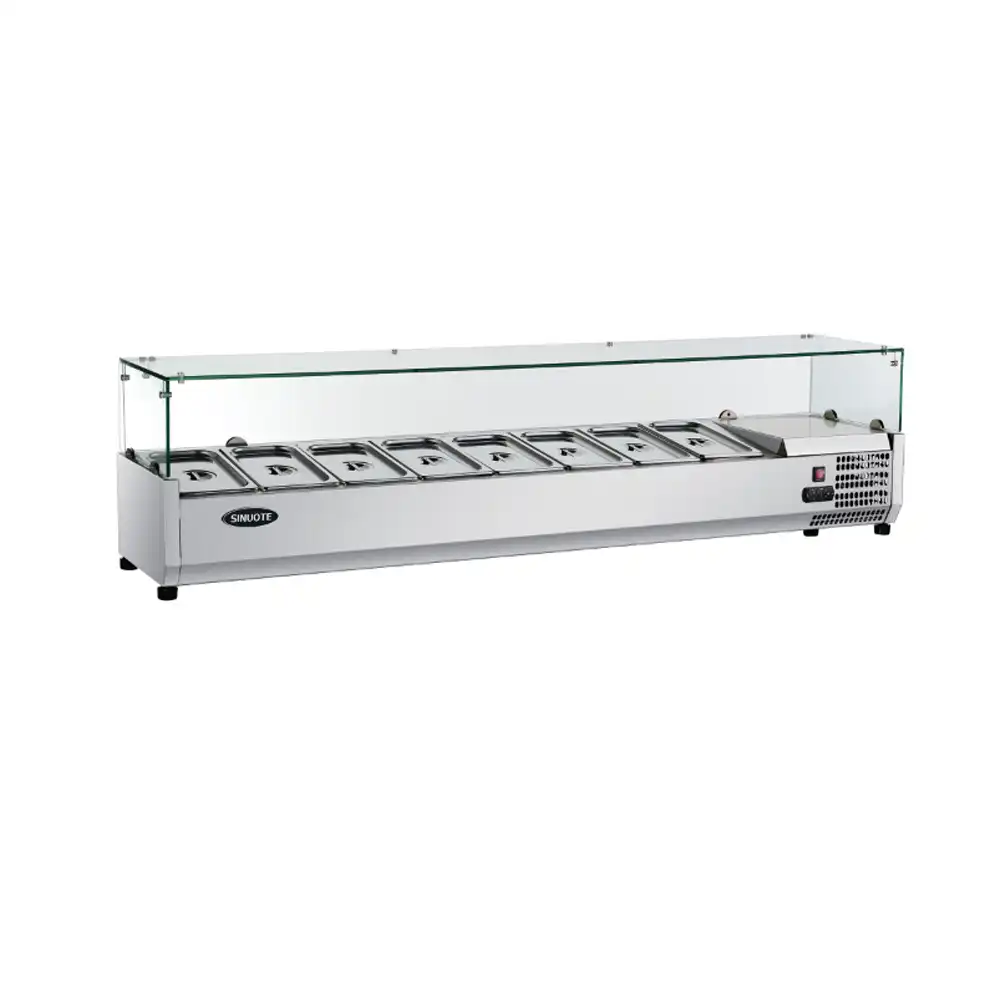
An open top prep table carries a heat load that sealed cabinets do not face. The refrigerated rail is exposed to the pass area, so warm kitchen air falls into the opening and displaces cold air. Heat lamps, fryers, and door traffic add load throughout service. The longer the rail is uncovered, the faster the upper pan surfaces rise toward the danger zone.
Product inside the pan is not evenly cooled. The bottom of the pan sits in the cold rail airflow; the top surface sits close to kitchen air. If the pan is overfilled, or the rail cover stays open between orders, the upper layer of food can run several degrees warmer than the cabinet controller reports. The cooling system may be performing correctly while the food is not safe.
I have inspected open top prep tables where the controller showed 3°C and the operator assumed the whole rail was safe. The probe was in the return air path inside the cabinet. A top pan of sliced tomatoes near a heat lamp measured 9°C at the surface. The refrigerant charge was fine. The measurement point did not represent the food.
What Safe Temperature Range Should an Open Top Prep Table Hold?
The relevant cold-holding limit comes from the 2022 FDA Food Code: cold-held food must remain at 41°F (5°C) or below. Many kitchens set a stricter house target of 38°F to 40°F to leave margin for pan changes, rail openings, and product placed into the rail during prep. The stricter target is not a sign that the table is underperforming. It is a buffer for real service conditions.
Manufacturer ratings describe the cooled cabinet interior under rated ambient conditions. The Camay MSR-48M salad prep table, for example, carries an interior rating of 0.5°C to 5°C (33°F to 41°F) with automatic defrost and R290 refrigerant. The top rail is an access point on that cooled space. Its pan temperatures depend on airflow, fill level, ambient temperature, and cover use.
| Check point | Target or safe range | Common failure | Correction |
|---|---|---|---|
| Cold-held product | 41°F (5°C) or below | Top layer above 41°F | Use correct pan depth and fill line |
| Cabinet controller | 33°F to 41°F (0.5°C to 5°C) | Reading only cold return air | Compare with product surface reading |
| Kitchen ambient | Inside rated range, usually below 38°C | Heat lamp or fryer too close | Reposition or add rail cover |
| Door and lid gaskets | Full contact, no tears | Cold air leakage | Replace worn gasket |
| Condenser airflow | Clear fins, no grease layer | High head pressure | Clean coil on schedule |
| Defrost operation | Automatic, no ice buildup | Evaporator icing | Clear drain, inspect coil |
Which Design and Airflow Factors Keep Open Top Prep Table Cooling Consistent?
Three design choices do most of the work. Air distribution comes first. A good open rail is not just a cold cabinet with an opening; discharge air must run across the base and return in a pattern that keeps the pan wells inside the cold stream. Second is insulation density. CFC-free polyurethane or cyclopentane foamed insulation reduces the external heat load that an open top unit carries. Third is the lid or pan seal. Stay-open lids are useful for fast service, but they must close when not in use so the rail is not pulling warm air continuously.
Pan Depth and Fill Line
I have seen pans fail temperature checks because they were overfilled, not because the table was weak. When product is piled above the pan lip, cold air cannot circulate around the pan. The upper layer becomes an insulated cap that traps heat. Fill to the rail line or leave a visible margin, and use standard gastronorm pans that match the rail cutout.
Airflow and Gasket Sealing
Door gaskets and lid gaskets are part of the air distribution system. A torn cabinet gasket lets cold air escape, so the compressor cycles longer and the rail receives less predictable airflow. Camay worktop and prep tables use self-closing doors and removable gaskets for this reason. The condenser coil also needs clear air exchange. If flour or grease blocks the coil, head pressure rises and the rail loses holding capacity before the controller alarm activates.
Integrated worktop refrigeration changes how heat loads are managed around the rail, not only inside the cabinet. <Optimizing Kitchen Efficiency with Integrated Worktop Refrigeration> covers the worktop edge, drip resistance, and coil access details that keep cold air distribution stable during high-volume prep.
How Do You Verify and Maintain Safe Temperatures in an Open Top Prep Table?
Verification compares two readings: the unit controller and the actual product. The controller reports what the cabinet is doing. The product reading reports what the food is doing. Use a calibrated probe thermometer and place it in the warmest part of the pan, usually near the top edge and close to the rail opening. Do not accept a controller reading as a food temperature reading.
Controller Reading vs Product Reading
The controller sensor is often placed in the return air path or on the cabinet wall. That placement is correct for controlling the cooling cycle, but it is not the same as the pan product temperature during heavy service. Shift checks should record both readings. If the gap is more than a few degrees, trace the cause before changing the controller offset. The offset masks a problem; it does not fix the heat load.
Scheduled Maintenance That Prevents Drift
Most temperature drift follows a predictable pattern. The cabinet cools well after cleaning, then loses ground after two or three weeks. The refrigerant charge did not change. The heat load and the airflow path changed. Grease on condenser fins, dust on evaporator blades, torn gaskets, and blocked defrost drains all reduce capacity. Clean the condenser coil on a fixed schedule, not only when the controller alarms. Replace gaskets when they no longer show full contact, and clear the defrost drain so automatic defrost water does not refreeze on the evaporator.
Maintenance practices that apply to sealed cabinets also affect open top prep tables through gasket condition, coil cleanliness, and defrost behavior. <Essential Maintenance Tips for Commercial Reach In Refrigerators> covers cleaning sequences and inspection points that reduce heat load before the top rail loses holding temperature.
If the table runs in a kitchen below 38°C ambient but still fails mid-shift product checks, the cause is usually airflow or fill depth rather than refrigerant charge. It is worth confirming pan layout, rail air pattern, and condenser capacity together before replacing the unit. Send your pan configuration, kitchen ambient temperature, and current controller readings to Sales@hzcamay.com, or call +8618157202219 for a cooling load review.
How to Specify an Open Top Prep Table That Will Pass a Temperature Audit
Open top prep table temperature drift rarely has a single cause. The kitchens I support usually find a group of three or four small issues: pan overfill, gasket leakage, coil heat load, and a probe placed where it reads cold air instead of food. A well-specified table removes some of those variables before installation. That means matching rail size to pan count, confirming condensing unit capacity at the kitchen’s maximum ambient temperature, and choosing a stainless rail and cabinet with dense foamed-in insulation.
Camay manufactures these prep tables with rated cabinet interiors, R290 refrigerant, automatic defrost, and certification records including ETL Safety and ETL Sanitation. If you are replacing a table that fails temperature audits or sizing a new station, send your pan configuration, kitchen ambient temperature, and target holding window to Sales@hzcamay.com or call +8618157202219. A cooling load check before you commit is faster than a retrofitted rail after the first inspection.
What Do Buyers Ask About Open Top Prep Table Temperature Control?
Does an open top prep table hold temperature as well as a sealed cabinet?
No, and it is not expected to. A sealed cabinet generally holds product temperature with less energy because the evaporator manages a closed space. An open top prep table trades some cold-holding efficiency for access. The rail can still be safe, but it needs correct airflow, pan depth, and cover use. When those are right, the product stays within the same 0.5°C to 5°C range as the cabinet interior.
Can I put hot or partially cooled food into the prep rail?
A common mistake is treating the prep rail as a rapid chiller. It is designed to hold already chilled food at safe temperature, not remove a large heat load from warm product. Loading several liters of warm sauce into a rail raises adjacent pan temperatures and forces the compressor to run long cycles. Chill product before it enters the rail, and stagger warm prep tasks instead of loading all at once.
What should I do if the controller shows 2°C but food reads 7°C?
The controller reading can be correct while the food reading is not safe. This usually means the cabinet is cooling properly but the product is not in the cold air path or is loaded too high. Check pan fill level, look for a torn gasket, and take a reading at the bottom and top of the same pan. If the bottom is cold and the top is warm, airflow or overfill is the problem. If both are warm, check the condenser coil and defrost system.
Does using a cover on every pan really matter?
In kitchens where staff keep the rail covered between orders, we see fewer mid-shift temperature failures. A closed lid cuts the continuous heat gain from the pass area and keeps cold air over the pan surface. Covers do not fix a failing refrigeration system, but they reduce avoidable heat load. If the table still fails with covers in place and correct fill levels, the next step is a service check on airflow and refrigerant performance. Share your readings and pan layout with us at Sales@hzcamay.com and we will confirm the next step.
If you’re interested, check out these related articles:
Boost Savings with Energy Efficient Commercial Upright Freezers
Boost Efficiency Energy Efficient Chef Base Units for Commercial Kitchens
Heavy Duty Chef Base Refrigeration for Efficient Commercial Kitchens
Choosing the Best Commercial Reach In Fridge for Your Restaurant