

Running a restaurant means juggling food quality and costs every single day. Ultra freezers sit at the heart of that balance—they keep ingredients safe, but they also run around the clock and pull serious power. After years of watching utility bills climb while margins shrink, I’ve come to see energy-efficient freezer selection less as a nice-to-have and more as a survival skill. The right unit pays for itself. The wrong one quietly drains your budget month after month.
Why Energy Consumption Shapes Your Bottom Line
Commercial freezers never stop working. That constant hum translates directly into electricity costs, and older units can be surprisingly expensive to operate. A traditional model might draw 5–8 kWh per day, while a modern ENERGY STAR-certified unit often runs at 2–4 kWh daily. The gap sounds modest until you multiply it across a full year.
Consider a restaurant running five freezers. Upgrading from older equipment to energy-efficient ultra freezers can cut daily consumption by roughly 3 kWh per unit. Over twelve months, that adds up to 5,475 kWh saved. At an average commercial rate of $0.15 per kWh, annual savings exceed $820—and that’s before factoring in reduced maintenance costs or longer equipment life.
The Camay Commercial Worktop Refrigerator Cooler Fridge (Model MWTF-27-L) illustrates what newer technology can deliver. It uses R290 refrigerant paired with polyurethane/cyclopentane insulation, a combination that significantly lowers energy draw compared to conventional designs.
Lifecycle costs matter more than sticker price. Energy consumption, maintenance intervals, and repair frequency all contribute to total ownership expense. A high-efficiency model reduces each of those line items. Conducting an energy audit of your existing refrigeration setup can reveal exactly where improvements will have the biggest impact.
| Feature | Old Freezer Model (Estimated) | New Energy-Efficient Model (Estimated) | Annual Savings (per unit) |
|---|---|---|---|
| Daily Energy Use | 8 kWh | 4 kWh | 4 kWh |
| Annual Energy Use | 2920 kWh | 1460 kWh | 1460 kWh |
| Annual Cost (@$0.15/kWh) | $438 | $219 | $219 |
These numbers show why energy-efficient restaurant refrigeration has become a competitive advantage rather than a luxury.
Technologies That Actually Lower Your Power Bill
Modern energy-efficient ultra freezers rely on several engineering advances working together. Understanding what’s inside helps you separate marketing claims from genuine performance.
Variable speed compressors represent one of the biggest efficiency gains. Traditional compressors cycle on and off at full power, wasting energy during each startup. Variable speed units adjust output to match actual cooling demand, running continuously at lower, more efficient speeds. This approach cuts energy waste and extends compressor life. Many Camay products use Cubigel compressors, which have earned a reputation for reliable efficiency.
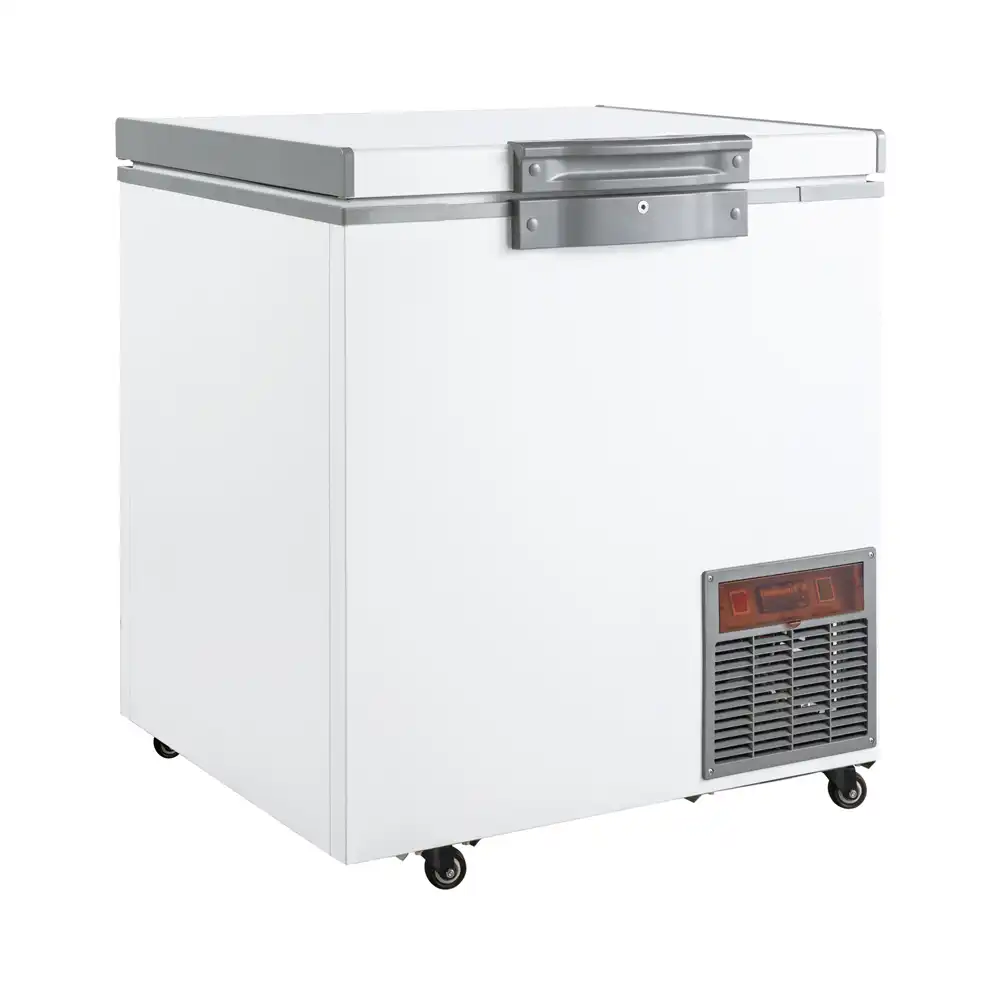
Insulation quality determines how hard the compressor has to work. Polyurethane/cyclopentane foaming—typically 40mm thick in commercial units—creates a thermal barrier that minimizes heat transfer from the surrounding kitchen. This CFC-free insulation appears across the Camay range, including Solid Door Freezer Cooler and Under Counter models.
Refrigerant choice affects both efficiency and environmental impact. Natural refrigerants like R290 (propane) and R600a (isobutane) have low Global Warming Potential and excellent thermodynamic properties. R290, used in many Camay models, delivers strong cooling performance while reducing environmental footprint.
Smart defrost systems prevent ice buildup without wasting energy on unnecessary heating cycles. Instead of defrosting on a fixed schedule, these systems monitor frost accumulation and activate only when needed. The result is cleaner coils and lower power consumption.
Condenser coil design influences heat exchange efficiency. Well-engineered coils allow the compressor to reject heat more effectively, reducing runtime. Door gasket quality matters too—removable gaskets that seal tightly prevent cold air leaks, one of the most common sources of energy waste. Self-closing doors with magnetic seals add another layer of protection.
Making Sense of Certifications and Ratings
Manufacturers make plenty of efficiency claims. Certifications provide independent verification that a unit actually performs as advertised.
ENERGY STAR certification remains the most recognized benchmark for energy-efficient ultra freezers. Products earning this label meet strict criteria set by the U.S. Environmental Protection Agency, typically consuming 20–30% less energy than standard models. The Camay Commercial Worktop Refrigerator Cooler Fridge carries ETL, DOE, and ENERGY-STAR certifications, confirming it meets multiple performance standards.
| ENERGY STAR Rating | What It Means |
|---|---|
| Certified | Meets EPA efficiency criteria; verified by third-party testing |
| Most Efficient | Top performers within the ENERGY STAR category |
BTU ratings, familiar from air conditioning, don’t translate well to freezer performance. Look instead for Uniform Energy Factor (UEF) ratings, which provide a more accurate picture of commercial freezer efficiency. NSF standards address food safety and equipment cleanability—factors that indirectly support optimal operation and longevity.
Government incentive programs often provide rebates for businesses investing in energy-efficient equipment. These programs can offset a significant portion of the purchase price, improving return on investment. Check local and national offerings before finalizing any purchase. Camay products meet various international certifications including ETL, DOE, ENERGY-STAR, and CE, reflecting a commitment to both performance and regulatory compliance.
For restaurants looking to extend efficiency gains beyond freezers, exploring options like the 《Boost Efficiency Energy Efficient Chef Base Units for Commercial Kitchens》 can provide additional savings opportunities.
Installation and Maintenance That Protect Your Investment
Buying an energy-efficient ultra freezer is only the first step. Proper installation and consistent maintenance determine whether you actually capture those efficiency gains over the equipment’s lifetime.
Ventilation matters more than most operators realize. Condenser coils release heat, and if that heat can’t dissipate, the compressor works harder and consumes more energy. Maintain several inches of clearance around the back and sides of each unit. Cramming a freezer into a tight corner might save floor space, but it costs money every month in wasted electricity.
Condenser coil cleaning is one of the highest-impact maintenance tasks. Dust and grease accumulation impedes heat exchange, potentially increasing energy consumption by up to 25%. Camay units feature accessible condenser coils specifically to simplify this task.
Temperature calibration deserves regular attention. Ultra freezers should maintain a range of -25°C to -15°C (-13°F to 5°F). Thermostat drift can compromise food safety and waste energy. Many Camay models, including the Commercial Worktop Refrigerator Cooler Fridge, offer smart digital temperature systems with optional IoT and WiFi connectivity for precise monitoring.
Staff habits have a measurable impact on energy use. Every door opening lets cold air escape and warm air enter, forcing the compressor to recover. Self-closing doors with robust gaskets help, but training staff to minimize unnecessary openings and verify proper closure makes a real difference.
Maintenance Checklist for Energy-Efficient Ultra Freezers
Daily:
– Check and log internal temperatures
– Verify doors close and seal completely
Weekly:
– Wipe down exterior and interior surfaces
– Inspect door gaskets for tears or wear
Monthly:
– Clean condenser coils (increase frequency in dusty environments)
Quarterly:
– Schedule professional service to check refrigerant levels and system pressure
Following these practices keeps your energy-efficient ultra freezer operating at peak performance. For more detailed guidance, refer to 《Essential Maintenance Tips for Commercial Reach In Refrigerators》.
Building a Sustainable Operation for the Long Term
Sustainable refrigeration has moved from feel-good initiative to business necessity. Regulations are tightening, customer expectations are shifting, and equipment that meets tomorrow’s standards costs less to operate today.
Refrigeration contributes to environmental impact through both energy consumption and refrigerant emissions. Natural refrigerants like R290 substantially reduce carbon footprint compared to traditional HFCs. CFC-free polyurethane/cyclopentane insulation eliminates another source of environmental harm. The Camay Commercial Undercounter Refrigerator demonstrates how these technologies work together in practical commercial applications.
Regulatory changes are already reshaping the market. Phase-downs of high-GWP refrigerants mean equipment purchased today may face compliance issues within its useful life. Investing in energy-efficient ultra freezers that already use natural refrigerants avoids costly retrofits or early replacement.
Customers increasingly notice environmental commitments. Highlighting your use of eco-friendly equipment can strengthen brand appeal among diners who value sustainability. This positioning extends beyond freezers to all kitchen equipment, including Chef Base units.
Choosing energy-efficient ultra freezers isn’t just about reducing utility bills. It’s about building an operation that remains competitive as costs rise and regulations evolve.
Frequently Asked Questions About Ultra Freezer Efficiency
What are the long-term cost benefits of investing in energy-efficient ultra freezers for a restaurant?
The primary benefit is reduced electricity expense—often 30–50% lower than older equipment. Beyond monthly utility savings, energy-efficient ultra freezers typically require less frequent maintenance and experience fewer breakdowns, which reduces both repair costs and food spoilage losses. Over a 10–15 year equipment lifespan, these combined savings often exceed the original purchase price.
How do different refrigerant types impact the energy efficiency and environmental footprint of commercial freezers?
Refrigerant choice affects both operating cost and regulatory compliance. Traditional HFC refrigerants have high Global Warming Potential and face increasing restrictions. Natural refrigerants like R290 (propane) deliver comparable or better cooling performance with a fraction of the environmental impact. R290 also tends to improve thermodynamic efficiency, meaning the compressor runs less to achieve the same temperature. Many Camay products use R290 specifically for these advantages.
What key features should restaurants prioritize when selecting an ultra freezer to maximize energy savings?
Focus on insulation thickness and type (polyurethane/cyclopentane is current best practice), compressor technology (variable speed outperforms fixed-speed), refrigerant type (natural refrigerants like R290), and door sealing quality (self-closing doors with magnetic gaskets). Smart temperature controls with digital monitoring help maintain optimal conditions without energy waste. These energy-saving freezer features work together—no single component delivers maximum efficiency alone.
Partner with ZHEJIANG KAIMEI for Your Refrigeration Needs
Selecting the right energy-efficient ultra freezer requires balancing upfront cost, operating expense, and long-term reliability. ZHEJIANG KAIMEI offers commercial refrigeration solutions engineered for performance and efficiency, backed by comprehensive support and a “One-Stop-Shop” approach to equipment sourcing. Contact us for expert consultation at Phone: +86 181 5720 2219 or Email: Sales@hzcamay.com.