

Energy-efficient commercial salad tables have become a must-have for kitchens that want to keep energy bills in check without sacrificing daily performance. Over 26 years of manufacturing and supplying to global partners, I’ve seen how the right insulation, refrigerant, and compressor choices separate durable workhorses from units that fail prematurely. This guide walks through the engineering decisions that determine both energy consumption and long-term reliability, so you can evaluate commercial salad tables with the same criteria we use in production.
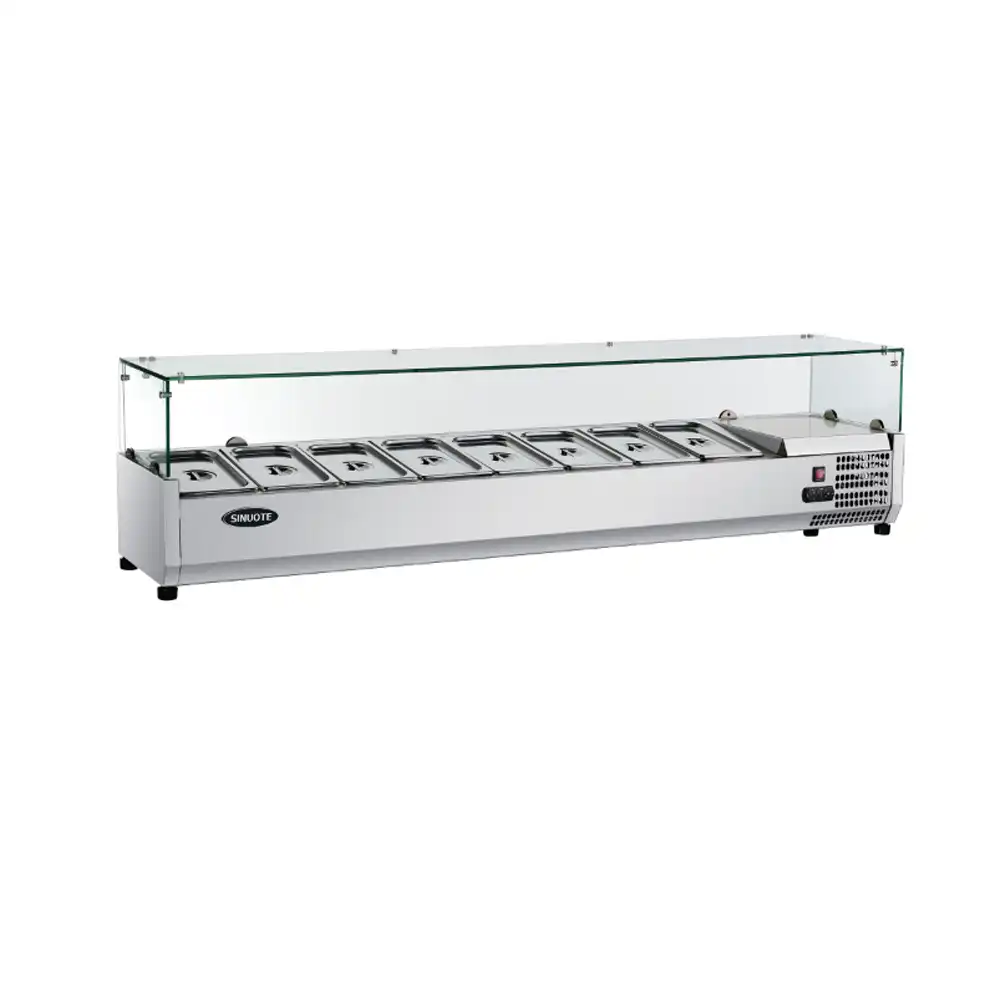
How Do Insulation and Refrigerant Choice Reduce Energy Bills in Salad Tables?
The single largest factor in a salad table’s daily energy consumption is how well it holds cold after the compressor cycles off. If heat leaks through the cabinet walls, the compressor runs longer and more often. In our production lines, we use polyurethane foam blown with cyclopentane because it delivers a dense, closed-cell structure that resists heat transfer far better than standard foams. The foam is injected between the stainless steel inner and outer walls to eliminate voids and cold spots. Thicker insulation means fewer compressor starts per hour and less strain on the entire refrigeration circuit.
The second major lever is refrigerant. Many older commercial units still use refrigerants with higher global warming potential and lower thermodynamic efficiency in small hermetic systems. The models we build at Camay use R290, a natural hydrocarbon refrigerant. R290 has excellent heat transfer properties at the temperatures salad tables operate in (0.5°C to 5°C), which means the compressor reaches setpoint faster and consumes less electricity over a 24-hour shift. Independent testing has shown that R290 systems can achieve 10–15% lower energy use than comparable R134a or R404A units in the same ambient conditions. Combined with polyurethane insulation, the two design decisions create a compounding energy saving that shows up clearly when you compare annual utility costs.
Why R290 Refrigerant Saves More Energy than Older Refrigerants
R290’s pressure-enthalpy characteristics suit the medium-temperature range of salad tables far better than legacy refrigerants. It requires a smaller refrigerant charge, and its high latent heat of vaporization means more cooling per gram circulated. In practice, we’ve seen that a 13-cubic-foot salad table using R290 and a Cubigel compressor can maintain 2°C to 4°C storage on a 115V circuit drawing less than 2 amps. That efficiency translates directly into operating cost reductions, especially in busy kitchens where ambient heat loads fluctuate all day.
How Polyurethane Insulation Thickness Affects Cooling Cycle Frequency
During production, we foam the insulation directly between the inner and outer stainless steel shells. The foam’s density and thickness determine how slowly the cabinet temperature rises when the door is closed. In our salad table models, the insulation is thick enough that in a 38°C ambient test chamber, the compressor cycles off for 12–15 minutes before kicking back on. A thinner or less uniform foam layer can cut that off-cycle time in half, forcing the compressor to run more cycles per hour and wearing out components faster. When you compare spec sheets, look for insulation type and thickness explicitly.
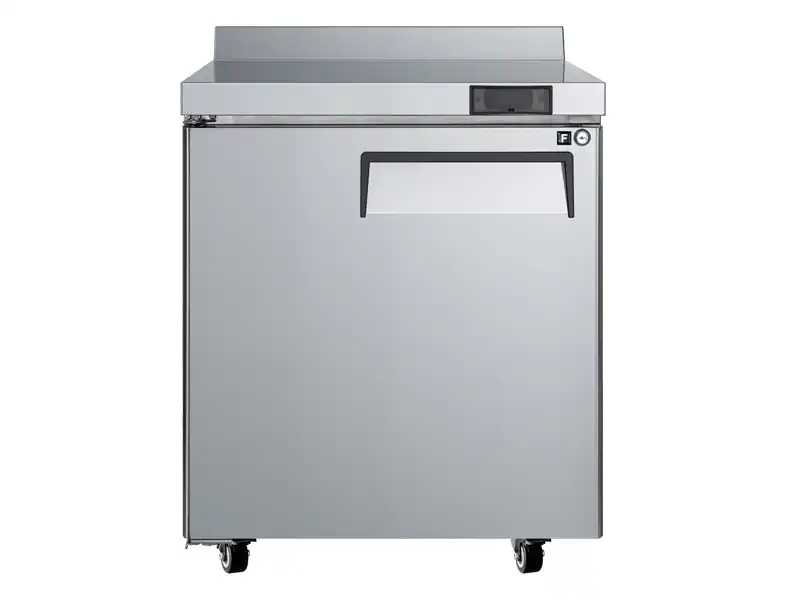
What Components Make a Commercial Salad Table Durable Over Time?
Durability in a refrigerated prep station comes down to three things: the compressor, the cabinet construction, and the hardware that gets touched every day. The compressor is the heart of the system. We standardize on brands like Cubigel and Embraco because their small hermetic units are built for thousands of start-stop cycles with consistent airflow cooling. A compressor that overheats or seizes prematurely can scrap an entire unit, and we’ve learned from field returns that cutting cost here is never worth the failure risk.
The cabinet itself must resist dents, corrosion, and thermal expansion in a kitchen that cycles between hot and cold dozens of times a day. We use 304 stainless steel for both the interior and exterior because it holds up to cleaning chemicals and food acids without pitting. The interior floor has rounded corners, which may seem small, but that detail eliminates the hard edges where food debris and moisture collect, reducing long-term corrosion risk. The door hinges are another reliability point; self-closing hinges with a lock and key reduce the chance of a door being left ajar, which would load the compressor unnecessarily.
The Role of Compressor Quality in Long-Term Reliability
Not all compressors with the same horsepower rating perform the same in a ventilated cabinet. The compressor must be sized correctly for the cabinet volume and ambient conditions. We match the compressor model to the specific cabinet dimensions and target temperature range. For a 368-liter salad table drawing 115V, a 1.8 A Cubigel compressor paired with automatic defrost and a forced-air cooling system gives consistent performance year after year. We’ve tracked replacement rates across different compressor brands in the field, and the difference between an industrial-grade compressor and a consumer-grade alternative is stark after 18 to 24 months of heavy use.
Why Stainless Steel Construction and Hinge Design Matter
Salad tables live in wet, acidic environments; dressings, produce juices, and frequent wipe-downs mean the metal sees constant chemical attack. Type 304 stainless steel is standard in our worktops and undercounter units because it doesn’t delaminate like coated steels. The door hinges are designed to self-close from a 90-degree open position, which protects food safety and prevents the compressor from fighting against an open door. A recessed handle cuts down on accidental bumps that can loosen door alignment over time, keeping the gasket seal tight and the cold air inside.
Which Specifications Should Buyers Compare in Energy-Efficient Salad Tables?
When you line up data sheets from different manufacturers, the numbers that matter most for energy and durability are not always the headline capacity figures. Use the table below to compare the engineering of a well-built energy-efficient salad table against a typical budget model.
| Specification | Energy-Efficient Salad Table | Typical Budget Salad Table |
|---|---|---|
| Refrigerant | R290 (natural, low GWP) | R134a or R404A (higher GWP, less efficient) |
| Insulation | Polyurethane/cyclopentane, CFC-free, thick and dense | EPS or lower-density foam, thinner wall |
| Compressor | Cubigel or Embraco, matched to load | Unbranded or consumer-grade compressor |
| Temperature Control | Smart digital thermostat with optional IoT/WiFi | Mechanical thermostat with wide deadband |
| Cabinet Material | 304 stainless steel inside and out | Partial stainless or coated steel |
| Certifications | ETL Safety, ETL Sanitation (NSF), ENERGY STAR, DOE | CE only or no third-party verification |
| Defrost System | Automatic, with evaporation of defrost water | Manual or auto with drain pan |
Beyond the table, look for the rated ambient temperature class. A salad table rated for ST~T climate class (up to 38°C ambient) will perform reliably in a hot commercial kitchen, while a unit only rated for cooler environments may struggle during peak service. Also check the door gasket design: a removable gasket simplifies cleaning and replacement, which directly affects long-term energy performance because a dirty or worn gasket lets humid air enter, increasing frost build-up and compressor runtime.
What Maintenance Practices Extend the Life of Your Salad Table?
The best engineering still requires consistent care, but the maintenance tasks are straightforward. Clean the condenser coil every 30 days. In a busy kitchen, flour dust, grease, and airborne debris collect on the coil fins, reducing heat rejection and raising condensing temperature. We see a 10–15% energy penalty from a heavily fouled condenser, and it accelerates compressor wear. Use a soft brush and a vacuum; never use high-pressure water.
Inspect the door gasket weekly for cracks or food residue build-up. A damaged gasket lets moisture in and cold out, driving the compressor to run longer and potentially creating frost on the evaporator. Our gaskets are removable and replaceable without tools, so swapping one takes minutes. Also, keep the drain line clear to prevent water accumulation inside the cabinet, which can cause mold and corrosion.
Finally, confirm the unit is level and the casters are locked. An unlevel cabinet can prevent the door from self-closing properly, and constant vibration from misaligned casters can loosen refrigerant line connections over time. Small adjustments here prevent larger mechanical repairs down the road.
How Do Energy Savings and Durability Impact Total Cost of Ownership?
When comparing the purchase price of a commercial salad table, it’s tempting to focus on the upfront number. But if the unit costs $300 less and fails after 18 months, the replacement cost plus lost product and downtime far outweigh the initial saving. On the energy side, a salad table that runs at 1.8 amps versus 2.5 amps for 16 hours a day saves roughly 1.5 kWh per day. At a commercial electricity rate of $0.12 per kWh, that adds up to about $65 per year. Over a 7-year equipment lifespan, that difference nearly covers the price premium of the more efficient unit, even before considering reduced repair costs.
Adding in durability factors, a stainless steel cabinet that doesn’t rust and a compressor that keeps running reliably for 5 to 7 years means the kitchen avoids unplanned capital expenditures and emergency service calls. For a multi-unit operator, that consistency translates into predictable budgeting and less operational disruption.
I’ve seen this pattern repeat across different kitchen types: a well-engineered salad table from the start pays back its cost through lower utilities and fewer breakdowns. If you’re specifying equipment for a new kitchen or upgrading an existing line, the choice of insulation, refrigerant, and compressor brand should carry more weight than a slightly lower sticker price.
Common Questions About Energy-Efficient Commercial Salad Tables
Do energy-efficient salad tables cost more upfront?
Yes, typically 10–20% more than a basic unit, because the insulation, refrigerant technology, and compressor quality add to the bill of materials. Still, the energy savings and longer service life usually recover that premium within two to three years. The total cost over seven years normally favors the efficient model.
Can older salad tables be retrofitted with a more efficient compressor?
Not practically. The compressor is matched to the refrigerant charge, the metering device, and the cabinet volume. Swapping the compressor without redesigning the rest of the system can cause capacity mismatches and reliability problems. If energy efficiency is the goal, it’s more effective to replace the whole unit with a purpose-built energy-efficient model.
How can I verify energy efficiency claims before purchasing?
Ask for the unit’s DOE-compliant energy consumption data and look for third-party certifications: ETL Safety and ETL Sanitation (to NSF/ANSI standards), plus ENERGY STAR qualification if applicable. At Camay, our model MSR-48M holds ETL, DOE, and ENERGY STAR listings, and we can provide the specific test data on request. A legitimate manufacturer will have this documentation ready.
Is a salad table with automatic defrost really more efficient?
In most climates, yes. Automatic defrost removes frost buildup on the evaporator coil before it becomes thick enough to act as an insulator. A heavily frosted coil reduces heat exchange and forces the compressor to run longer. The short energy spike during the defrost cycle is more than offset by the efficiency gained from clean coil operation throughout the day.
What if my kitchen has limited space but needs salad prep capacity?
The dimensions of undercounter and worktop salad tables vary, so it’s worth checking the exact footprint against your floor plan. Some models can nest under a counter while still providing pan capacity for a full salad station. If your layout is tight, share your available dimensions and daily serving volume with a manufacturer that offers multiple size options, and they can confirm which configuration fits. For custom requirements, you can reach me at Sales@hzcamay.com or call +8618157202219 with your part numbers and quantity; we’ll verify the best fit for your kitchen.
If you’re interested, check out these related articles:
Choosing the Best Commercial Reach In Fridge for Your Restaurant
Essential Commercial Chef Base Fridge Installation Tips