

After years of watching kitchens burn through equipment faster than they burn through line cooks, I’ve learned that the workstation you choose on day one shapes everything that follows. A poorly chosen prep table doesn’t just fail—it drags down your whole operation with wobbly surfaces, rust spots that won’t quit, and cleaning routines that eat into service time. The right commercial kitchen workstations become invisible in the best way: they hold up, they clean fast, and they let your team focus on the food instead of fighting the equipment.
Why Material Choice Determines Whether Your Workstation Lasts Five Years or Fifteen
The longevity of commercial kitchen workstations comes down to what they’re made of, and getting this wrong costs more than the initial savings suggest. Stainless steel dominates commercial kitchens for good reason—it resists corrosion, cleans without absorbing odors, and handles the daily abuse of a busy service. Food-grade stainless steel in grades 304 and 430 covers most applications, though they serve different purposes.
| Feature | Stainless Steel 304 | Stainless Steel 430 |
|---|---|---|
| Composition | Contains chromium and nickel | Contains chromium, no nickel |
| Corrosion Resistance | Excellent, ideal for high-moisture/acidic environments | Good, suitable for general use, less resistant to acids |
| Cost | Higher | Lower |
| Magnetic | Non-magnetic | Magnetic |
| Applications | Food prep, sinks, areas with frequent chemical exposure | Dry storage, general work surfaces |
Grade 304 earns its higher price through the nickel content, which creates a more stable oxide layer on the surface. This matters when your prep station sees citrus marinades, vinegar-based sauces, or aggressive sanitizing chemicals daily. Grade 430 works fine for dry storage shelving or back-of-house surfaces that don’t face constant moisture.
Galvanized steel fills a role for non-food contact areas where cost matters more than corrosion resistance. Polyethylene cutting boards remain essential for actual cutting work—they’re gentler on knife edges than steel and can be color-coded for cross-contamination control. Material thickness also plays a bigger role than most buyers realize. Heavier gauge stainless steel resists the denting and warping that turns a flat work surface into a frustrating slope over time.
What materials offer the best durability for restaurant kitchen workstations?
Food-grade stainless steel, particularly Grade 304, delivers the best durability for restaurant kitchen workstations. The chromium-nickel composition creates superior corrosion resistance against acids, moisture, and the chemical assault of daily cleaning. For structural components that don’t contact food directly, heavy-duty galvanized steel provides solid support at lower cost. Polyethylene remains the standard for integrated cutting surfaces, offering both durability and the hygiene properties that health inspectors look for.
How Construction Methods Separate Workstations That Last From Those That Don’t
Material selection only tells half the story. How those materials get assembled determines whether your commercial kitchen workstations hold together under pressure or develop wobbles and weak points within the first year. Welded construction creates joints that become as strong as the surrounding metal, while bolted alternatives introduce potential failure points that loosen over time.
Heavy-duty kitchen tables built with fully welded frames handle the constant loading and unloading of sheet pans, the impact of dropped equipment, and the vibration from nearby machinery without developing the creaks and shifts that plague lesser construction. Reinforced work surfaces prevent the sagging that happens when someone inevitably stacks too many hotel pans in one spot.
Ergonomic kitchen design affects more than comfort—it affects how long your staff can work before fatigue leads to mistakes. Adjustable legs accommodate different tasks and different workers. Modular kitchen systems let you reconfigure as your menu or volume changes, which beats replacing equipment every time your operation evolves. Recessed handles, like those on the Camay Commercial Worktop Refrigerator Cooler Fridge (Model MWTF-27-L), prevent the bruised hips that come from bumping into protruding hardware during a rush.
Meeting Food Safety Standards Without Making Cleaning a Full-Time Job
Health department compliance isn’t optional, and commercial kitchen workstations either make compliance easier or turn every inspection into a stress test. NSF certified equipment meets established standards for food contact surfaces, covering everything from material safety to construction methods that prevent contamination.
Seamless construction eliminates the crevices where food particles hide and bacteria multiply. Fully welded joints leave no gaps for yesterday’s prep to become tomorrow’s health violation. The difference between a workstation that cleans in minutes and one that requires scrubbing every seam shows up in labor costs and inspection scores alike.
Polished stainless steel surfaces wipe down quickly and don’t hold onto residue the way textured finishes can. The Camay MTR-48 2-Door Commercial Undercounter Refrigerator demonstrates thoughtful hygiene design with rounded inner bottom corners that eliminate the sharp angles where grime accumulates. Removable gaskets allow for the deep cleaning that keeps door seals sanitary instead of becoming mold farms.
How do I choose a workstation that meets food safety and hygiene standards?
Start with NSF certified equipment—this certification confirms the materials and construction meet public health requirements for food contact surfaces. Look for seamless construction with fully welded joints rather than bolted assemblies with gaps. Easy-to-clean surfaces in food-grade stainless steel should be standard. Design details like rounded corners and removable gaskets make the difference between adequate cleaning and thorough sanitation that passes inspection without anxiety.
Calculating the Real Cost of Workstation Durability Over Time
The purchase price of commercial kitchen workstations represents a fraction of their true cost. Equipment lifespan, maintenance demands, and operational efficiency all factor into whether that workstation becomes an asset or a recurring expense. Robust construction and quality materials reduce replacement frequency, which matters when you’re looking at a ten-year planning horizon instead of just next quarter’s budget.
| Workstation Type | Initial Cost | Expected Lifespan | Annual Maintenance | ROI Factor (Durability) |
|---|---|---|---|---|
| Standard Bolted Steel | Low | 3-5 years | Moderate | Low |
| Welded Stainless Steel (304) | High | 10-15+ years | Low | High |
| Refrigerated Chef Base | Medium | 8-12 years | Moderate | Medium-High |
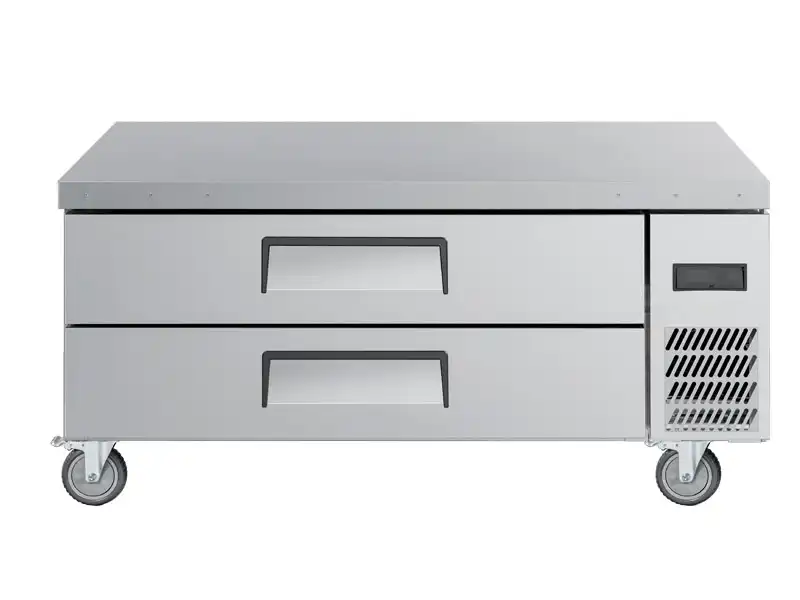
The Camay 60″ Countertop Refrigerated Chef Base (Model MAR-60A) illustrates how durable construction and efficient insulation work together. The stainless steel body handles the physical demands while proper insulation reduces compressor cycling, cutting energy costs and extending component life.
Maintenance accessibility matters more than most spec sheets suggest. Workstations with components you can actually reach get maintained properly. Those with sealed compartments and inaccessible corners get neglected until something fails. Simple designs that facilitate quick cleaning and straightforward repairs minimize the operational disruptions that cost more than the repair itself.
What are the key considerations for workstation longevity and ROI in a commercial kitchen?
Material quality and construction methods form the foundation—food-grade stainless steel and welded construction deliver maximum durability. Beyond initial build quality, assess how easily the workstation can be cleaned and repaired. Accessible components and simple designs reduce both maintenance time and the likelihood of deferred maintenance. A higher initial investment in robust commercial kitchen workstations typically delivers superior returns through longer equipment lifespan and improved kitchen workflow efficiency.
Making Workstations Work Within Your Complete Kitchen Layout
Commercial kitchen workstations function as part of a larger system, and their value depends partly on how well they integrate with everything around them. Restaurant kitchen layout planning should position prep surfaces, cooking equipment, and storage in a flow that minimizes unnecessary movement. Space optimization in tight kitchens often means choosing equipment that serves multiple purposes.
Under Counter refrigeration, like the Camay Commercial Undercounter Refrigerator (Model MTR-60), demonstrates this principle. Placing refrigerated storage directly beneath work surfaces keeps ingredients within arm’s reach while preserving the counter space that cramped kitchens can’t afford to lose. Custom kitchen fabrication allows workstations to fit specific layouts rather than forcing layouts to accommodate standard dimensions.
The relationship between prep areas and cooking stations deserves particular attention. A Pizza Table positioned near ovens eliminates the back-and-forth that slows service. Salad prep tables like the MSR-48M placed near serving lines reduce the distance between preparation and plating. These positioning decisions compound over thousands of services into meaningful efficiency gains.
Optimize Your Kitchen Foundation
Elevate your commercial kitchen with workstations built for enduring performance and seamless integration. As a professional one-stop-shop refrigeration equipment manufacturer, ZHEJIANG KAIMEI offers expertise in crafting robust, compliant, and efficient solutions for your catering needs. Contact us today at +8618157202219 or Sales@hzcamay.com for a consultation on optimizing your kitchen’s foundation.
What are the most common mistakes to avoid when selecting durable restaurant kitchen workstations?
The most damaging mistakes include underestimating material quality, choosing bolted construction for heavy-use applications, and overlooking NSF certification. Saving money on lighter gauge steel or inferior construction methods creates costs that exceed the initial savings within a few years. Heavy-duty kitchen tables in food-grade stainless steel cost more upfront but deliver the workstation longevity that protects your investment.
How does proper workstation selection impact overall kitchen operational efficiency?
Well-chosen commercial kitchen workstations improve kitchen workflow efficiency in ways that accumulate daily. Ergonomic design reduces physical strain that leads to slower work and more mistakes. Appropriate sizing prevents the bottlenecks that happen when prep space runs short during service. Durable surfaces that clean quickly free up labor for productive tasks instead of maintenance. These factors combine into measurably better output from the same staff hours.
Can ZHEJIANG KAIMEI assist with custom solutions for unique restaurant kitchen layouts?
ZHEJIANG KAIMEI provides custom kitchen fabrication services that address the specific constraints of individual kitchen layouts. As a comprehensive refrigeration equipment manufacturer, the company understands how workstations need to integrate with refrigeration equipment and other kitchen systems. This expertise allows for solutions optimized around your actual space and workflow rather than generic configurations that force compromises.