

Dough management is easier to repeat when fermentation is treated as a temperature-and-time process, not a single recipe step. Refrigerated tables give a bakery, pizzeria, or central kitchen a cold work surface and a pan rail at the same station, so staff can scale, ball, and hold dough without walking back to a walk-in cooler. The goal is not simply to keep dough cold; it is to hold the temperature band stable enough that yeast activity, gluten development, and flavor formation stay predictable from batch to batch.
Why Temperature Control Drives Dough Fermentation
Yeast activity slows noticeably under refrigeration, but it does not stop. The U.S. FDA Food Code uses 41°F (5°C) as the cold-holding ceiling for refrigerated food [1]. For dough, the practical target is usually a tighter band—not because 41°F is unsafe, but because wide swings above and below the target change fermentation speed and make bench behavior harder to predict.
A refrigerated table supports that control because the dough remains at the prep station instead of spending time on a warm bench between mixing, portioning, and loading. The more consistent the surface and air temperature around the dough, the less you need to adjust proofing times later.
Refrigerated Table Features That Support Dough Work
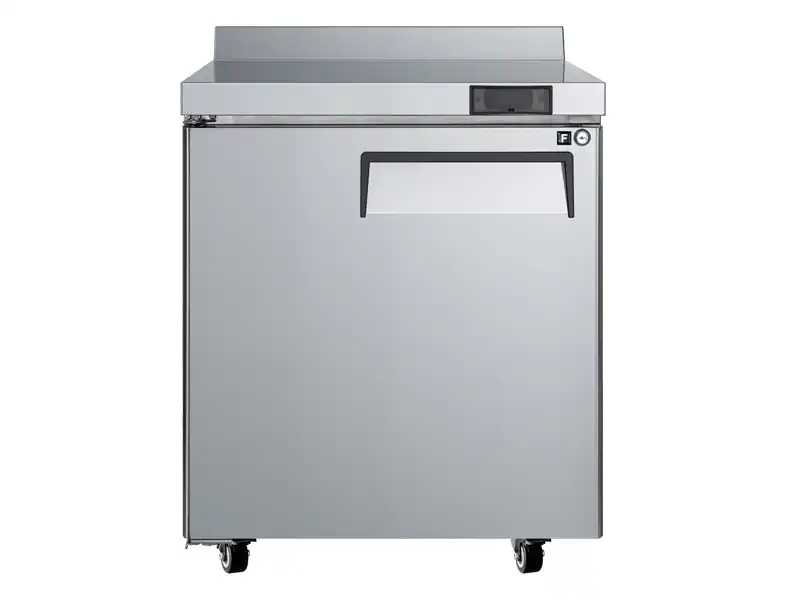
Not every refrigerated cabinet works well as a dough station. The features that matter most in dough production are a durable worktop, predictable temperature recovery, and storage that matches the container system the kitchen already uses.
Key features to evaluate include:
- One-piece stainless steel top that can handle repeated scaling, cutting, and light pan traffic
- Self-closing doors with good gasket contact to limit warm-air intake
- Digital temperature control with a clear display for logging and spot checks
- Pan-rail or shelving compatibility with the kitchen’s sheet pans, bus tubs, or GN pans
- Casters or adjustable legs for leveling and cleaning access
- Ventilated cooling that distributes air rather than freezing only the back wall
For example, the Camay MWTF-27-L worktop refrigerator holds a 0.5–5°C (33–41°F) band, uses R290 refrigerant, and has a ventilated system that keeps air moving around stored dough rather than relying on cold-wall contact. That type of distribution helps prevent one pan of dough from fermenting faster than another.
Building a Fermentation Schedule Around the Table
A refrigerated table should be placed where the schedule needs it: between mixing and forming, between balling and cold proofing, or directly at the station where dough is sheeted and loaded into pans. The table itself does not create fermentation control; the schedule does.
A practical starting point for many cold-fermented dough programs is 24–48 hours of refrigerated bulk fermentation, followed by portioning and a shorter cold rest. The correct window depends on flour strength, hydration, yeast percentage, salt level, and the flavor profile the operation wants. Validate any schedule with small batches before scaling it across a full production day.
Keep the table organized by batch time. Label each container with mix time, target use time, and the operator who loaded it. Rotate older dough to the front. If dough sits too long and begins to over-proof, move it to the freezer only if your process was designed for that step; otherwise, track the loss and adjust batch size for the next run.
Need help matching a refrigerated table to your dough program? Camay’s engineering team can review your batch sizes, pan configuration, and target fermentation schedule. Contact +86 181 5720 2219 or Sales@hzcamay.com for a specification discussion.
Food Safety and Quality Control During Cold Fermentation
Time/temperature control is the central food-safety discipline in refrigerated dough production [2]. A table that holds product at 41°F (5°C) or below narrows the risk window, but only if the dough actually enters refrigeration quickly after mixing and is not left on a warm bench for extended periods.
Temperature fluctuation can create condensation on dough surfaces and encourage microbial growth when product repeatedly moves into warmer air [3]. That is why door habits matter. Every time a door is opened during a rush, warm air enters and the unit must recover. A staff member who props a door open during portioning undoes the benefit of a tight temperature band.
Use a simple log for morning, mid-shift, and closing checks. Record air temperature and, where practical, spot-check dough temperature. If the unit struggles to recover after heavy use, adjust workflow or maintenance before changing the fermentation schedule.
Integrating Refrigerated Tables into the Production Line
The highest-value position for a refrigerated dough table is usually between mixing and forming, not isolated in a storage corner. When the table sits in the production path, staff can scale dough cold, load pans, and hold staged dough without leaving the station. That placement reduces warm bench time and keeps the batch moving.
A refrigerated worktop is most effective when it is placed between mixing and forming rather than treated as a storage box. <Optimizing Kitchen Efficiency with Integrated Worktop Refrigeration> covers how pairing worktop refrigeration with adjacent prep flow shortens walking distance and helps keep temperature-sensitive ingredients close to the station.
For dough-heavy lines, the table can also work with a chef base or undercounter refrigerator nearby. Dough balls can be staged in the lower cabinet while the top is used for cutting and scaling. This setup keeps the number of door openings lower than using a walk-in cooler repeatedly during the shift.
Maintenance and Preventative Checks for Dough Stations
Refrigerated tables used for dough need the same maintenance discipline as any high-use refrigeration equipment, but the consequences of a warm unit are more immediate because dough can over-ferment within a shift.
Check coil cleanliness, gasket condition, door alignment, and fan operation on a fixed schedule. Clean flour dust from door edges and vents; flour can build up quickly in a dough room and reduce airflow or gasket sealing. Verify that the temperature display matches an independent thermometer placed near the dough pans, not just the air sensor location.
Consistent temperature recovery depends on clean coils, intact gaskets, and proper door habits; a unit that runs warm during peak production can push dough into an uncontrolled rise. <Essential Maintenance Tips for Your Commercial Chef Base Refrigerator> covers inspection points and maintenance routines that help refrigeration hold its band during heavy kitchen use.
Specifying Support for Your Dough Production Setup
To specify a refrigerated table for dough production, confirm the following variables with a refrigeration engineer:
- Batch volume and container size
- Desired temperature band and recovery behavior
- Number of staff working the station during peak hours
- Voltage, ambient conditions, and available footprint
- Door, drawer, caster, or leg configuration
- Local sanitation, certification, and refrigerant requirements
Camay supports OEM and ODM specification discussions for these points. Contact Sales@hzcamay.com or +86 181 5720 2219 to review your dough station requirements.
Frequently Asked Questions
What is the best temperature for cold-fermented dough?
Food safety guidance uses 41°F (5°C) or below as the refrigerated holding ceiling [1]. For practical dough management, many operations target a somewhat tighter band, such as 33–41°F (0.5–5°C), but the correct target depends on the product and production schedule.
How long can dough stay in a refrigerated prep table?
There is no single universal limit. Many cold-fermentation schedules run from 24 to 72 hours, but dough condition, flour strength, hydration, and yeast level determine the actual window. Track temperature and bake-test small batches before relying on an extended timeline.
Does a refrigerated table dry out dough?
It can if dough is left uncovered or if airflow is too direct on exposed surfaces. Cover dough with lids, film, or damp cloth where appropriate, and monitor surface condition after long cold storage.
Can I use a standard worktop refrigerator for fermentation, or do I need a specialized proofer?
A standard refrigerated worktop is usually appropriate for cold fermentation and staging. A proofer is a separate tool for warm, humidity-controlled rising. Many dough programs use both: refrigerated tables for cold fermentation and a proofer for final proof.
What maintenance keeps dough at a consistent temperature?
Clean coils, intact door gaskets, clear airflow, accurate temperature displays, and prompt door closing matter most. Regular independent temperature checks help catch drift before it affects dough quality.
References
[1] U.S. Food and Drug Administration. Food Code 2022. U.S. Department of Health and Human Services. Available: https://www.fda.gov/food/fda-food-code/food-code-2022
[2] Codex Alimentarius Commission. Code of Hygienic Practice for Refrigerated Packaged Foods with Extended Shelf Life. CAC/RCP 46-1999. FAO/WHO.
[3] U.S. Department of Agriculture, Food Safety and Inspection Service. How Temperatures Affect Food. Available: https://www.fsis.usda.gov/food-safety/safe-food-handling-and-preparation/food-safety-basics/how-temperatures-affect-food
If you’re interested, check out these related articles:
Ultimate Buyers Guide for Commercial Reach In Refrigerators
Choosing the Best Commercial Reach In Fridge for Your Restaurant
Heavy Duty Chef Base Refrigeration for Efficient Commercial Kitchens
How to Choose the Best Chef Base Refrigerator for Your Kitchen