
Commercial ice makers for nightclubs fail more often from peak-surge mismatch than from a low daily production number. A machine rated for 200 kg in 24 hours can still leave a 400-person venue dry between 10 p.m. and 1 a.m. if the bin buffer and recovery rate are undersized. I approach this from manufacturing and site commissioning: fix the peak requirement first, then select ice shape, bin size, filtration, and condenser clearance. This article sets out that sizing path for nightclubs, event halls, and other high-volume venues.
Peak Demand Planning for Nightclub Ice Makers
Most commercial ice makers are sold with a 24-hour production rating, but that number hides the real test. The real constraint is the three-hour peak when every service station pulls from the same bin. I start with guest count, drinks per guest, and the ice type. Cocktail service in a nightclub commonly displaces 0.4 to 0.6 kg per guest across the peak window once glass chilling, shaker work, and spillage are included. That figure is a planning range, not a measured industry average, and I adjust it upward for outdoor bars or warm climates.
Peak Demand Calculation
For a 400-guest venue, the range lands around 160 to 240 kg for the peak period. Add the bar well and bottle trough load, and the total can approach 300 kg in three hours. The table below uses the same planning range for three venue sizes.
| Venue size | Peak ice range, 3 hours | Suggested bin reserve |
|---|---|---|
| 200 guests | 100 to 130 kg | 40 to 60 kg |
| 400 guests | 200 to 260 kg | 80 to 120 kg |
| 800 guests | 400 to 520 kg | 160 to 240 kg |
Recovery and Bin Buffer
The bin is not just storage. It is the buffer between peak draw and machine recovery. A machine that makes 200 kg per day but only 8 kg per hour will not refill a bar fast enough at midnight. I look at output per hour during the peak more than the 24-hour total. The bin should cover at least 45 minutes of steady peak draw, and the recovery rate should exceed the average hourly draw.
Ice Shape and Bin Selection for Bar Service
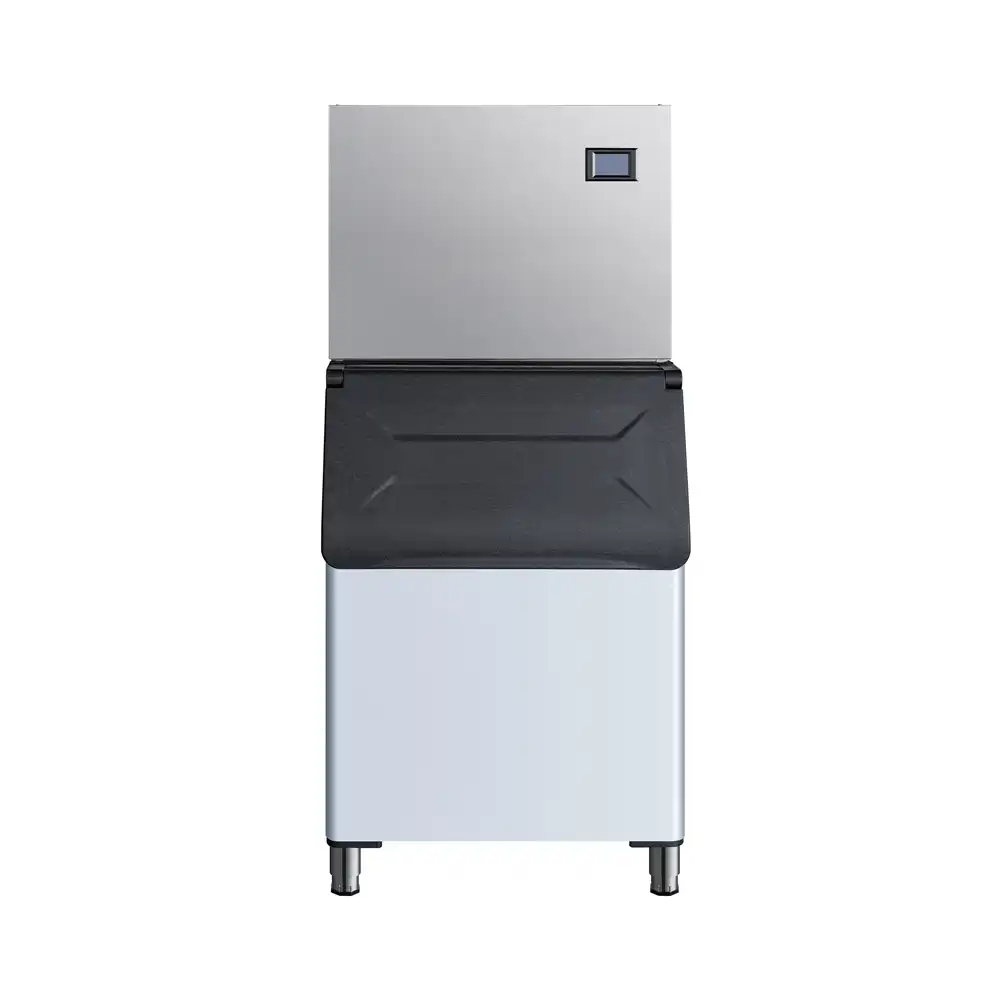
Ice shape determines melt rate, scoop speed, and how much liquor ends up over-diluted. Nightclubs usually need cube ice for mixed drinks and cocktails. Flake ice chills bottles and display trays well but is messy in a served drink. Nugget ice is soft and chewable, but it melts faster and reduces measured volume in the glass faster than a solid cube. For beverage-forward venues, a 22 mm cube is a practical middle ground. It melts slower than flake, stacks well in a bin, and flows through standard scoops.
The Camay FB210A is a useful reference point for that format: a water-flow cube machine rated at 100 kg per 24 hours with 45 kg storage and 22 by 22 by 22 mm cube size.
| Specification | FB210A |
|---|---|
| Maximum ice output | 100 kg per 24 hours |
| Maximum storage | 45 kg |
| Ice shape | Cube, 22 x 22 x 22 mm |
| Refrigerant | R290 |
| Compressor | CUBIGEL |
A 400-guest nightclub usually needs several of these modules or a larger production platform. The useful question is not whether one machine can hit a daily number, but whether the bin and hourly recovery match the bar layout and drink mix.
Water Filtration and Condenser Clearance for Commercial Ice Makers
Water Quality and Filtration
Water quality changes the taste, clarity, and service life of a nightclub ice machine. Hard water deposits scale on the evaporator and slows the harvest cycle. Sediment clogs distribution tubes and produces cloudy cubes. I ask for a water hardness and sediment reading before ordering. If hardness is high or sediment is visible, the machine needs filtration ahead of the inlet. Filtration is not a one-time add-on. Cartridges need scheduled replacement, and water pressure must stay inside the machine’s rated inlet pressure range. Long drain runs, floor sinks, or basement placements require attention to discharge air gap and backflow requirements.
Condenser Clearance
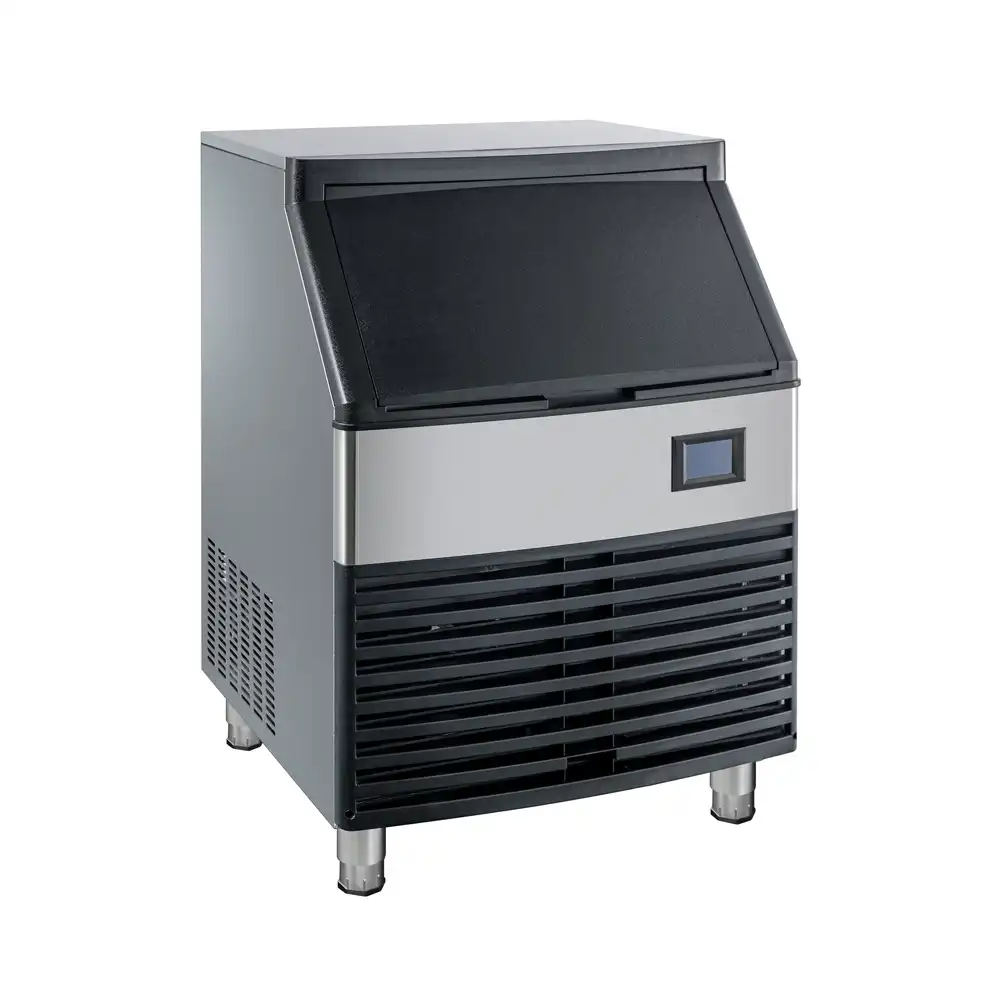
Most nightclub machines are air-cooled. The condenser can only reject heat into the space available. A machine installed in a tight underbar cabinet or behind a cosmetic panel with little clearance draws warm air back into the intake. I want the manufacturer’s stated front and side clearances kept open. The FB210A uses front air intake and side hot-air exhaust, so the supply and discharge sides cannot be reversed or boxed in.
If the site has softened water, high ambient temperature, or clearance restrictions, those conditions change the machine selection. Send your water quality data and the proposed cabinet opening to Sales@hzcamay.com, and we can confirm the correct condenser orientation, filtration, and drain configuration.
Total Operating Cost of Commercial Ice Makers
The purchase price is only the first cost. Compressor run time, water use, and harvest frequency set the long-term expense. A machine with a smaller evaporator may run longer to reach the same output, and in a nightclub’s warm room under peak occupancy that inflates energy cost. R290 refrigerant carries a smaller charge and lower GWP, but it does not change the requirement for clean condenser fins and correct airflow. Across long-running bar installations, the highest-cost failure we see is a blocked condenser after months without cleaning. It drives head pressure up, slows harvest, and eventually trips the compressor.
Nightclub ice makers share the same recurring-cost discipline as other high-cycle refrigeration. <Boost Efficiency Energy Efficient [Chef Base](https://zjcamay.com/category/service/product-catalogue/chef-base/) Units for Commercial Kitchens> covers how insulation, compressor cycling, and airflow shape energy use in sustained kitchen duty, which also applies to air-cooled ice machine condensers running across evening and overnight shifts.
Nightclub Ice Machine Specification Confirmation
A sizing error in a nightclub shows up at the worst possible time: the bin is empty while the line is still growing. That is why the final stage is a confirmed specification, not a fast part-number match. Share your peak occupancy, average drink mix, available floor space, water quality report, and any OEM branding or cabinet matching requirements. We will check the peak recovery calculation, bin buffer, condenser air path, and filtration arrangement as a complete package. Send those details to Sales@hzcamay.com or call +8618157202219 with the project timing, and we will confirm the exact machine configuration, finish, and compliance documents.
Common Questions About Nightclub Ice Machines
How much ice should a nightclub plan per guest?
Start with 0.4 to 0.6 kg per guest for the peak three hours for mixed-drink service. That range covers glass chilling, shaker ice, spillage, and bottle trough loading. Wine-heavy or bottle-service venues sit lower; highball and crushed-ice cocktail programs sit higher. I treat the number as a planning floor, not a fixed standard, and add a margin when the venue has an outdoor bar, humid space, or long peak window.
Should a nightclub choose cube, nugget, or flake ice?
It depends on where the ice goes. Cube ice fits mixed drinks and cocktails because it melts slower and looks clean in a served glass. Nugget ice works for soft drinks and some branded chewable-ice programs, but it melts faster and can increase dilution if drinks wait in the tray. Flake ice belongs in display trays and bottle wells. Most clubs run cube as the primary type and keep flake or nugget only where the beverage program demands it.
Why does the machine run all night but the bin stays low?
The daily output rating can be misleading. If the machine makes 200 kg over 24 hours but only 6 to 8 kg per hour, a midnight rush can drain the bin faster than the machine recovers. The fault is usually a peak recovery mismatch, a small bin, or condenser and scale problems limiting capacity by 2 a.m. I check hourly recovery before I blame the operator or the compressor.
Should I order by daily output alone?
No. The more useful number is the three-hour peak draw against the bin reserve and hourly recovery. A 200 kg daily rating without a matched bin will still stop service at the busiest point. Write down the peak window, the number of bartenders pulling ice, and the available bin height under the bar. Share those figures and the site water report with Sales@hzcamay.com, and we will verify whether the selected unit can hold the bar through the peak without oversized utility demand.
If you’re interested, check out these related articles:
Optimizing Kitchen Efficiency with Integrated Worktop Refrigeration
Heavy Duty Chef Base Refrigeration for Efficient Commercial Kitchens
Boost Efficiency Energy Efficient Chef Base Units for Commercial Kitchens
Boost Savings with Energy Efficient Commercial Upright Freezers
How to Choose the Best Chef Base Refrigerator for Your Kitchen