

Commercial bar fridge LED displays do more than make bottles visible. They add heat inside the cabinet, interact with the glass door, and create service points that need to be specified correctly before a purchase. In OEM and ODM work with bar chains and beverage equipment importers, the lighting conversation usually starts as a merchandising question and turns into a thermal and condensation problem within the first field service season. Buyers who treat LED lighting as a low-cost cosmetic option tend to order replacement strips more often and carry more condensation complaints. This article outlines what to check before ordering bar fridge LED displays.
LED Lighting and the Thermal Load in a Bar Fridge
The lighting choice changes the cabinet’s heat balance. LED modules are far more efficient than incandescent or fluorescent lamps, but they still convert part of their electrical input into heat. In a sealed bar fridge, that heat is not confined to the light source. It raises the air temperature near the door liner, and the evaporator must remove it along with the product load. During restocking, this extra load slows pull-down more in glass door units than in solid door cabinets because the glass itself transfers some heat from the room.
From an engineering view, the LED position matters as much as the wattage. A surface mounted strip near the top mullion creates a local warm zone, while a recessed array with a diffuser spreads the heat into the metal frame. The frame then conducts some of that heat outward, which can reduce door fog but only when the thermal path is continuous. A poorly mounted diffuser acts as an insulator and traps the heat at the glass edge.
| Configuration | Thermal pattern | Visibility result | Service implication |
|---|---|---|---|
| Surface mounted LED bar without lens | Heat concentrated near glass | Bright spots and dark gaps | Easy to replace if standard length |
| Recessed LED array with diffuser | Heat spread into frame | Even product illumination | Panel removal needed for service |
| Frame integrated LED with door heating | Heat shared with anti-sweat circuit | Consistent lighting but higher continuous load | Driver matching required before replacement |
Lighting is not the only door-related heat source in a glass door cabinet. <Ultimate Buyers Guide for Commercial Reach In Refrigerators explains how glass, lighting, and door seals should be evaluated together rather than as separate line items.
Glass Door Optics and LED Product Visibility
Visibility is a door and lens problem, not just a brightness problem. A clear door with a low-emissivity glass layer can reflect LED output directly back toward the customer, leaving the bottles darker than expected. The most common result is a bright line across the top of the door and a shadow band across the middle shelves. Diffusers reduce point-source reflection, but they also reduce peak brightness, so the LED layout must be matched to the door height and shelf spacing.
Why does bare LED strip create glare on bar fridge doors?
A bare LED strip places a series of point emitters close to the glass. The glass acts as a partial mirror, so every bright point reflects at eye level. The same issue occurs with polished shelf edges or clear bottle surfaces. When we evaluate a display door, we check the LED beam angle and diffuser transmittance together. A wide beam with a frosted lens spreads the light and lowers the contrast between the strip and the cabinet background, which makes labels easier to read.
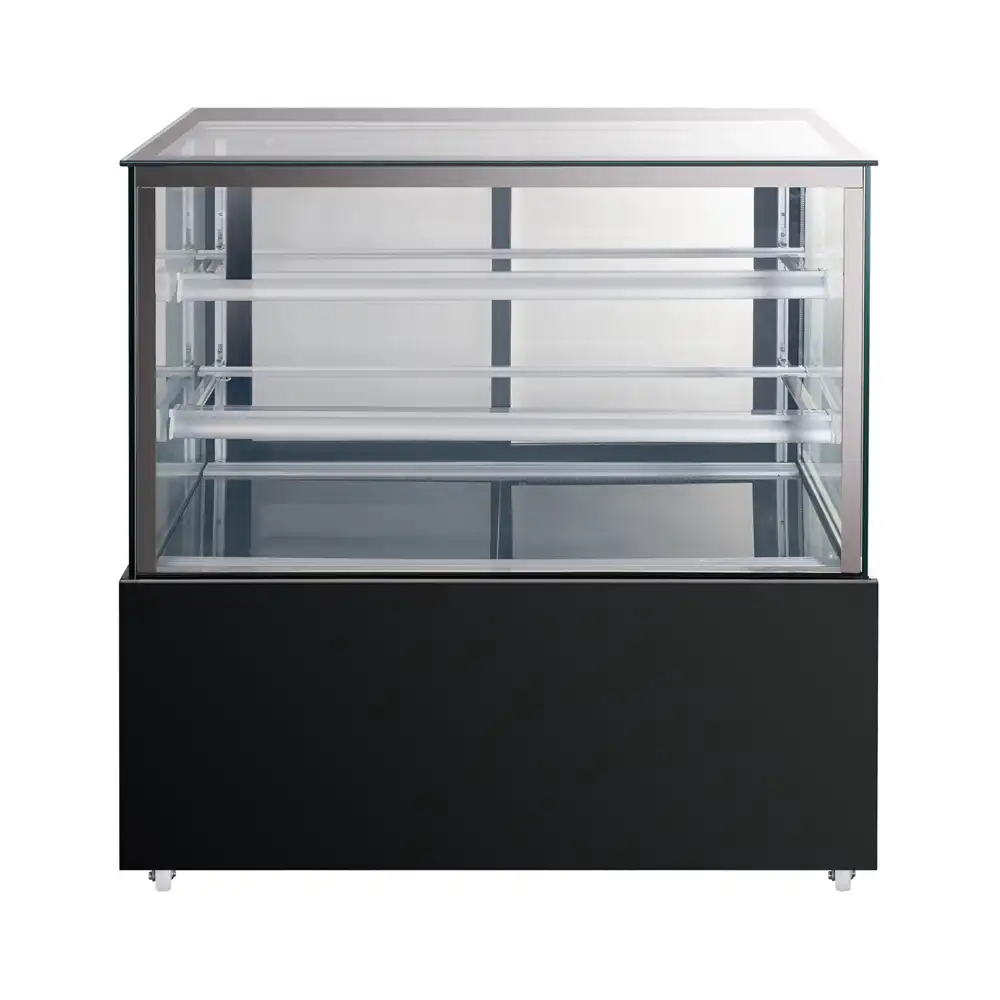
Glass door merchandisers are often specified by appearance alone, but door count and glass type change the whole unit. <Choosing the Best Commercial Reach In Fridge for Your Restaurant explains how interior lighting, shelf placement, and door selection affect a restaurant’s buying decision.
Condensation Control Around LED Display Frames
Moisture forms where the door seal, glass edge, and metal frame meet. LED light bars can either reduce that moisture or make it worse, depending on how the frame is heated. Some cabinets use the LED module as a partial anti-sweat source. That works only when the light is on and only when the frame has a low thermal resistance path. In a high-humidity bar or an outdoor event environment, the LED alone cannot stop condensation from forming at the coldest edge of the glass.
How does door heating interact with LED light bars?
Door heating and LED lighting operate on different circuits. The anti-sweat circuit runs continuously around the door frame, while the LED driver may dim or switch off with the door light switch. If the two circuits share a common frame extrusion, the thermal load is combined, and a failed driver can leave the frame colder and wetter. During cabinet development, we prefer separate circuits with independent protection. That way a lighting fault does not remove the anti-sweat function.
If your bar program includes high-humidity locations or glass doors beyond standard width, it is worth confirming the door frame heating load and the LED driver current before you finalize the bill of materials. Send your cabinet drawings and door width to Sales@hzcamay.com, and we will check the thermal match.
Service Life and Replacement of Bar Fridge LED Modules
Most LED failures in bar fridges are not chip failures. They happen at the connector, the driver, or the hinge harness. Because the door opens and closes hundreds of times in a shift, the wiring at the hinge flexes constantly. The LED strip inside the cabinet sees much less mechanical stress. That is why we ask service teams to inspect the harness before they replace a light bar, especially if the failure appears on one door but not the others.
What should a service team check before replacing an LED module?
Check the driver output first, then the connector at the hinge, then the seal around the door frame. A driver that has drifted out of specification can damage a new LED module within weeks. If the replacement strip is brighter or dimmer than the original, that is a sign of a different constant-current setting. We keep the driver and LED module as a matched set in our bar fridge programs because mixing suppliers creates warranty conflicts.
Door frame moisture and gasket wear are not only cosmetic issues in glass door cabinets. <Essential Maintenance Tips for Commercial Reach In Refrigerators covers gasket inspection and door alignment steps that keep chill cabinets from developing condensation around the lit frame.
Specifying LED Displays in a Commercial Bar Fridge Program
Teams that inherit bar fridge cabinets from several suppliers usually carry too many LED lighting variants. A mixed fleet means more driver part numbers, more service stock, and longer downtime when a door light fails. We see this in multi-market programs where different voltages and glass packages were ordered without a shared electrical architecture. When we quote a bar fridge program at Camay, we ask for the door width, glass type, target product temperature, and ambient conditions before locking the LED layout. Send your part number and quantity to Sales@hzcamay.com or call +8618157202219, and we will confirm the LED configuration against the cabinet’s thermal load before you commit.
Common Questions About Commercial Bar Fridge LED Displays
Do LED displays shorten bar fridge compressor life?
No. LED displays do not shorten compressor life by themselves, but a poorly specified lighting circuit adds continuous heat inside the cabinet. That extra heat reduces the reserve capacity available for high-ambient days. Over time, a compressor that runs near its limit in a 38°C kitchen works harder than one in a cooler bar. The real risk is not the LED chip; it is a driver mounted inside the door frame without ventilation, which can push additional heat into the cabinet and raise evaporator coil temperatures.
Can any constant-current LED driver be used as a replacement?
A common assumption is that any constant-current driver will work, but bar fridge LED drivers are not interchangeable without checking the current setpoint, output voltage range, and connector polarity. A driver with the wrong current can overdrive the LED strip and cause early failure. The replacement should match the original manufacturer’s part number or a confirmed alternate from the same cabinet brand. Using a generic driver may work for a few days, then the new module fails at the same solder joints.
What glass door specification works best with LED lighting?
It depends on the door type and the ambient dew point. For indoor bars, a double glass door with low-emissivity coating works well when paired with a diffused LED array. For high-humidity or outdoor serving areas, the door frame needs an anti-sweat circuit that operates independently of the LED circuit. The glass spec should be evaluated with the lighting layout and the cabinet’s target product temperature; specifying one without the other leads to reflection lines or frame condensation.
Why do LED lights fail even when the fridge itself is fine?
In warranty returns we have reviewed, the LED module was rarely the root cause. Most failures trace back to moisture entry at the connector, a damaged hinge harness, or a driver that was replaced with an off-spec part. The fridge continues cooling properly, so the cabinet itself appears fine while the door light fails. Before ordering another strip, check the seal, the hinge harness, and the driver output. If your program runs several bar fridge models across different markets, share your door sizes and electrical requirements at Sales@hzcamay.com and we will confirm a serviceable LED configuration for the fleet.
If you’re interested, check out these related articles:
Essential Maintenance Tips for Your Commercial Chef Base Refrigerator
How to Choose the Best Chef Base Refrigerator for Your Kitchen
Boost Kitchen Efficiency Workflow Optimization with Chef Base Fridges
Boost Savings with Energy Efficient Commercial Upright Freezers