

On a busy pizza line, the cutting board is a working surface as important as the refrigerated rail beneath it. The material you choose affects knife life, sanitation compliance, prep speed, and how well the board fits the pan rail without blocking airflow. This guide evaluates the main commercial cutting board materials against food safety standards, typical pizza station tasks, and the physical design of refrigerated pizza prep tables.
Why Cutting Board Material Matters on a Pizza Prep Table
Cutting boards in commercial kitchens face repeated slicing, moisture, fats, tomato acids, and frequent wash-downs. A material that scores deeply can trap food particles where sanitizer may not reach, raising cross-contact risk. The FDA Food Code sets the operational threshold: boards that can no longer be effectively cleaned and sanitized because of cuts and grooves must be resurfaced or discarded [1].
From a maintenance perspective, board material also affects knife retention. Very hard surfaces dull blades faster, while excessively soft surfaces groove quickly. The real trade-off is not a general “wood versus plastic” debate; it is how quickly the surface declines under the specific cutting tasks performed on the pizza station.
How Food Safety Rules Frame Material Choice
Food-contact surfaces must meet material suitability rules. NSF/ANSI 51 evaluates materials used in food equipment for safety and suitability, and most health departments expect commercial equipment to be listed or certified for its intended food zone [2]. The Food Code separately requires cutting surfaces to be smooth and maintainable [1].
USDA food safety guidance recommends separate boards for raw meat, poultry, seafood, and ready-to-eat items [3]. The World Health Organization’s Five Keys to Safer Food also frames clean surfaces and separation as core controls [4].
That means the right cutting board material is not only smooth when new. It must remain smooth, cleanable, and identifiable after repeated cutting, and it must fit into a color-coded station scheme when the menu includes raw proteins.
Wood, Plastic, Composite, and Rubber: A Practical Material Breakdown
| Material | Strengths | Limitations | Best Use on a Pizza Line |
|---|---|---|---|
| Hard maple or birch wood | Gentle on knives; stable when sealed | Porous seams; can warp if waterlogged; requires hand washing and oiling | Dough portioning or finished slicing, when separated from raw protein tasks |
| High-density polyethylene (HDPE) | Nonporous; easy to color-code; chemical and dish machine resistant | Scores over time; thin boards can warp with heat | Topping prep and raw protein separation |
| Rubber or composite board | Dense; knife-friendly; often resurfaceable | Heavier; higher upfront cost | High-volume slicing where edge retention matters |
| Bamboo, glass, stone, or tempered glass | Bamboo may look attractive; glass and stone are hard | Bamboo can split; glass and stone damage knives and are generally unsafe for production cutting | Generally avoid on a commercial pizza line |
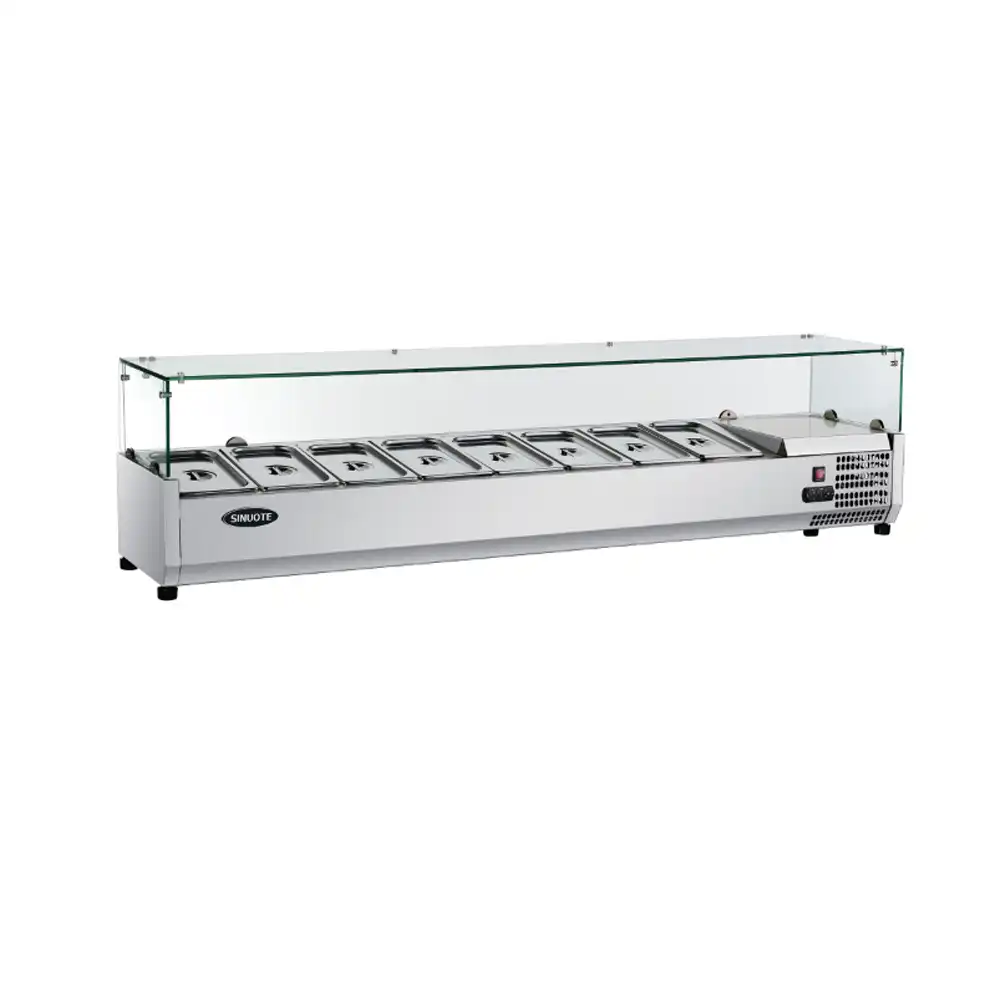
On a refrigerated pizza prep table, choose a board that tolerates rail contact and frequent sanitizer. A board placed directly on a stainless rail should not absorb condensation. HDPE and rubber composites generally perform better in this environment than unfinished wood.
Material Selection by Pizza Station Workflow
Start with the actual tasks, not the material specification alone. Dough opening is sticky but lower risk in terms of protein cross-contact. Toppings can be dry, acidic, or wet, and raw protein may enter the line if the menu includes chicken, seafood, or other animal proteins.
Use separate boards by task, or at minimum by risk class. A common setup is color-coded HDPE boards for raw protein and produce, with a dedicated board for finished slicing. In our OEM and ODM projects with central kitchens, we have seen lines reduce board rotation time after moving to color-coded HDPE boards sized for the rail, but the final setup should follow your health authority’s requirements for the menu and jurisdiction.
When the prep table workflow changes, the board configuration usually needs to change too. <Choosing the Best Commercial Reach In Fridge for Your Restaurant> covers how to match refrigerated storage to a restaurant’s production flow and menu.
Sizing, Fit, and Rail Integration
Cutting board dimensions should be determined by the rail opening, not by a generic board rack. Many commercial pizza prep tables use a shallow refrigerated rail for GN pans. For example, the Camay VRX395 pizza table series is 395 mm deep with GN 1/3 pan openings. If a board spans the rail completely, it can block airflow, trap heat, and make ingredient access slower. Use a board that sits beside the rail or bridges only as needed while keeping pan lids operational.
Board thickness also affects ergonomics. Common commercial boards run roughly 12 mm to 19 mm, but the final height should keep the prep plane manageable during a long rush. A board that is too thick can raise the work surface enough to increase shoulder fatigue.
Board depth, rail clearance, and worktop height all need to work together, otherwise the board blocks airflow or creates an awkward prep angle. <Optimizing Kitchen Efficiency with Integrated Worktop Refrigeration> covers how integrated worktop refrigeration supports faster prep and better space use.
Cleaning, Sanitizing, and Replacement Thresholds
Pizza stations need wash-rinse-sanitize-air-dry cycles between tasks. Use an EPA-registered sanitizer at the correct concentration. High-heat dish machines are acceptable when the board is rated for machine use. Wood and bamboo generally require hand washing and periodic board oil, while HDPE and rubber composites tolerate dish machines and chemical sanitizing more readily [2][3].
Inspect boards daily under bright light. If a groove is deep enough to catch a fingernail and cannot be removed by light sanding or resurfacing, rotate the board out [1]. Set a replacement trigger rather than relying only on a calendar. In high-volume pizza production, a thin HDPE board may only last a season, while a thick rubber composite can serve much longer. The material rule remains the same: when the board cannot be effectively cleaned, it is no longer a food-contact surface [1].
Cutting board replacement is part of a broader sanitation cadence for the cold line. <Essential Maintenance Tips for Commercial Reach In Refrigerators> covers cleaning routines and component checks that keep refrigerated prep equipment food-safe.
Buying and Specification Checklist
- Select material by task and sanitation method, not price alone.
- Require NSF/ANSI 51 listing or equivalent for food zone materials.
- Use color-coded HDPE boards for raw protein and ready-to-eat separation.
- Confirm board dimensions against pizza table rail depth; avoid blocking airflow.
- Check thickness and weight for ergonomics and line speed.
- Confirm dishwasher or chemical sanitizer compatibility before purchasing.
- Budget for replacement cycles, not one-time purchase.
- Verify edge profile: rounded or beveled edges reduce chipping.
Need help matching cutting boards to a new or existing pizza prep table? Contact our equipment engineering team at Sales@hzcamay.com or +8618157202219 with your rail dimensions, menu tasks, and pan configuration, and we will help you narrow the material and sizing options before you buy.
Specify Your Pizza Prep Table for Better Board Integration
The best cutting board material is only as good as the table supporting it. ZHEJIANG KAIMEI CATERING EQUIPMENT CO., LTD (Camay) manufactures refrigerated pizza prep tables, worktop refrigeration, and tailored OEM/ODM solutions for pizza and central kitchen operations. If you are specifying a new line or replacing existing prep tables, contact us at Sales@hzcamay.com or call +8618157202219 to discuss rail dimensions, pan configurations, and material compatibility.
FAQ
Which cutting board material is best for a refrigerated pizza prep table?
For most production pizza stations, HDPE is the easiest to sanitize and color-code. Rubber or composite boards are stronger when knife edge retention and high-volume slicing matter. The right choice is the board that matches the task, fits the rail, and remains cleanable [1][2].
Are wood boards acceptable in a commercial pizza kitchen?
Wood boards can be acceptable if the surface remains smooth, sealed, and dedicated to low-risk tasks, but wood is harder to sanitize after repeated scoring. Many operators keep wood boards for dough or finishing only and use separate synthetic boards for raw proteins and wet toppings [1][3].
How often should pizza station cutting boards be replaced?
Replace or resurface a board when cuts and grooves become too deep to clean effectively. There is no single calendar rule because material and volume differ, but visual inspection should be part of the daily closing procedure [1].
Can HDPE cutting boards go through a commercial dishwasher?
Many HDPE boards are dishwasher-safe when the manufacturer rates them for machine use and the board thickness is not too thin. Wood, bamboo, and some composites should generally be hand washed and air-dried [2][3].
References
[1] U.S. Food and Drug Administration. Food Code 2022, Section 4-101.17, “Cutting Surfaces.” https://www.fda.gov/food/fda-food-code/food-code-2022
[2] NSF International. ANSI/NSF 51: Food Equipment Materials. https://www.nsf.org/
[3] U.S. Department of Agriculture, Food Safety and Inspection Service. “Cutting Boards and Food Safety.” https://www.fsis.usda.gov/
[4] World Health Organization. Five Keys to Safer Food. https://www.who.int/publications/i/item/9789241594639
If you’re interested, check out these related articles:
Ultimate Buyers Guide for Commercial Reach In Refrigerators
Essential Commercial Chef Base Fridge Installation Tips
Boost Kitchen Efficiency Workflow Optimization with Chef Base Fridges