

In a busy restaurant kitchen, every step a cook takes away from their station costs time and concentration during service. Chef base refrigerator combinations address this directly: they put refrigerated storage beneath the work surface at each cooking station, eliminating the constant trips to a walk-in cooler that break workflow. After 26 years in commercial refrigeration manufacturing, I have seen how the right combination reshapes a kitchen line — not by adding more equipment, but by placing cold storage exactly where hands reach for it. The configuration that actually works depends on your menu structure, your station layout, and the physical space you have, not on a generic checklist of equipment.
How Chef Base Refrigeration Shapes Kitchen Workflow
A chef base is a refrigerated cabinet that doubles as a work surface, typically placed directly at the cooking line. Unlike a standard undercounter refrigerator, a chef base is engineered to support the weight of countertop equipment and withstand the radiant heat from nearby grills and fryers. The top is a heavy-duty stainless steel work surface, and the refrigerated compartment underneath holds the ingredients that station needs most: proteins, sauces, dairy, prepped vegetables.
What makes a chef base different from simply putting a reach-in cooler nearby is distance. A cooler five steps away might not sound like much, but over a six-hour service those steps multiply into significant lost time and attention. When the cook can open a drawer directly in front of them, grab what they need, and keep working without turning away from the line, the difference shows in ticket times and consistency.
In our manufacturing work with kitchens across different markets, we consistently see that kitchens with chef base units at each hot station run with fewer unnecessary movements during peak periods. The workflow improvement is most noticeable in kitchens doing 150 or more covers per service, where the accumulated time savings from reduced walking distance directly affects throughput.
Mapping Station Requirements for Chef Base Placement
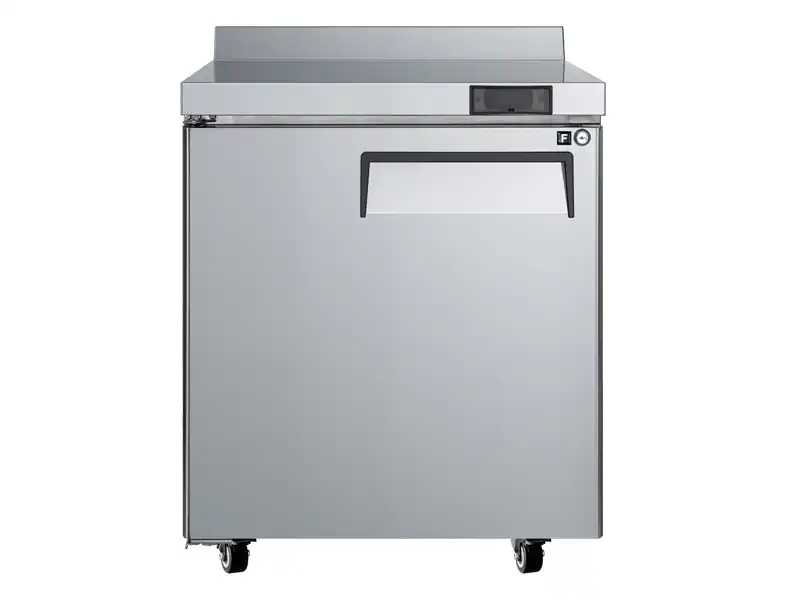
Not every station benefits equally from a chef base. The decision starts with mapping what each station actually needs within arm’s reach during service.
| Station | Refrigeration Need | Recommended Chef Base Type |
|---|---|---|
| Grill/Sauté | Proteins, compound butters, marinades | 60-inch or larger, drawer configuration |
| Pantry/Cold | Dressings, prepped greens, garnishes | 48-inch, door or drawer with pan organization |
| Fry | Battered items, sauces, slaw bases | 36 to 48-inch, door configuration |
| Expediting | Plating components, butter, garnishes | 36-inch compact unit |
The grill station typically demands the largest chef base because it handles the widest variety of refrigerated proteins. A 60-inch unit like the Camay MAR-60A provides 117 liters of refrigerated capacity beneath a work surface that can support countertop equipment: salamanders, induction units, or plate warmers.
Pantry and cold stations need organized access to multiple small containers rather than bulk storage. Here, drawer configurations with GN pan compatibility let cooks see and reach every ingredient without shuffling containers. The difference between a drawer and a door matters more than most buyers realize: drawers keep cold air in better when opened, and they provide direct overhead visibility into the contents.
Equipment Pairings That Build Complete Line Configurations
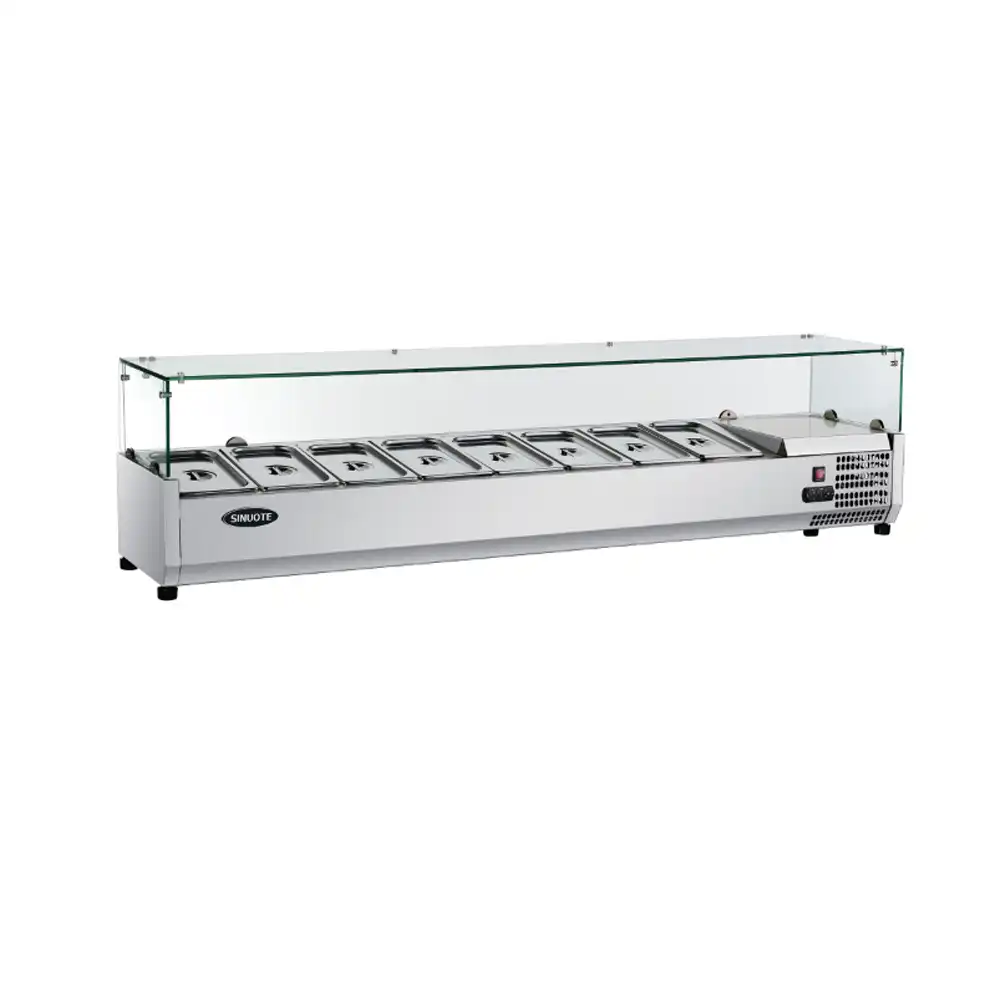
A chef base rarely operates alone. The most effective kitchen lines combine chef bases with complementary refrigeration to create a complete cold storage zone at each station cluster.
The most common pairing is a chef base with an undercounter refrigerator or freezer. The chef base holds immediate-use ingredients while the adjacent undercounter holds backup stock. This means the cook never runs out of a protein mid-rush because the backup is two steps away rather than in the walk-in.
Another pairing we frequently see specified is a chef base with a prep table refrigerator at the pantry station. The prep table upper rail holds garnishes and dressings at serving temperature, while the chef base underneath stores backup containers and prepped components. This configuration is particularly effective in kitchens doing high-volume salad and appetizer service.
| Pairing | Best For | Workflow Benefit |
|---|---|---|
| Chef Base + Undercounter Refrigerator | Hot line backup storage | Eliminates walk-in trips during service |
| Chef Base + Prep Table | Pantry and cold station | Single-station access to all garnishes and backups |
| Chef Base + Worktop Freezer | Fry station | Frozen-to-fryer workflow without walking |
| Two Chef Bases (mirrored) | Island cooking suite | Dual-sided access for multiple cooks |
If your kitchen serves a menu that requires rapid temperature transitions — par-cooked items that need refrigeration between stages — the chef base paired with a worktop freezer creates a self-contained zone where everything from frozen storage to final plate-up happens within arm’s reach.
In kitchens where multiple cooks share a central island suite, mirrored chef bases on opposite sides of the island give each cook their own refrigerated access point. This prevents the bottleneck of two cooks reaching into the same unit during service, a real problem in busy kitchens that is often overlooked during equipment specification.
If your kitchen layout involves an island cooking suite or a multi-cook line, the pairing strategy gets more complex and is worth confirming before you commit to equipment dimensions. We regularly help partners work through these configurations: reach out at Sales@hzcamay.com with your kitchen dimensions and station plan.
Space Planning for Practical Kitchen Layouts
Physical dimensions dictate what combinations are possible. A chef base adds depth to a kitchen line that an open worktable does not: typically 840 mm (33 inches) deep for a standard unit. In tight kitchens, this depth must be accounted for in the aisle width behind the unit.
The minimum clearance behind a chef base is 900 mm (36 inches) for single-cook stations, and 1200 mm (48 inches) for pass-through stations where cooks work back-to-back. These are not theoretical numbers. They come from observing how cooks actually move: stepping back from a hot surface, pivoting to reach lower shelves, or passing plates to the pass.
For narrow galley kitchens, we recommend a single line of chef base units against the back wall with the cooking suite on the front line. This keeps the cold storage accessible without blocking the primary cook path. The cook pivots 180 degrees from range to refrigeration — not ideal, but workable when space is constrained.
L-shaped and U-shaped kitchens offer more flexibility. In these layouts, chef bases can be positioned at the junction points of the L or U where multiple stations converge, serving as a shared cold resource for two adjacent stations. A 60-inch chef base at an L-corner gives both the grill cook and the sauté cook access without either leaving their primary position.
Selecting Durable Chef Base Combinations
What separates a chef base that lasts ten years from one that needs replacement in three comes down to materials and construction. The work surface must be heavy-gauge stainless steel, not just a stainless veneer over a weaker substrate. In our manufacturing, we use full stainless steel construction inside and out because the interior takes as much abuse as the exterior from pans, sheet trays, and constant cleaning.
The compressor is the other critical component. Commercial kitchens operate in ambient temperatures above 38°C (100°F) near the line, and the refrigeration system must maintain 0.5°C to 5°C (33°F to 41°F) internal temperature under that heat load. Cubigel compressors paired with R290 refrigerant are a reliable combination for this environment. R290 has better thermodynamic properties for high-ambient operation than older refrigerants, and the compressor is built for continuous commercial duty.
The Camay MAR-60A chef base uses this compressor-refrigerant pairing with polyurethane and cyclopentane CFC-free insulation for thermal retention. The unit carries ETL, DOE, and ENERGY STAR certifications, which matter for both safety compliance and energy cost calculations.
| Selection Factor | What to Check | Why It Matters |
|---|---|---|
| Work surface gauge | 18-gauge minimum stainless steel | Resists warping from heat and weight |
| Insulation type | Polyurethane, CFC-free, full-foamed | Maintains temperature with less compressor cycling |
| Compressor brand | Cubigel, Embraco, or equivalent commercial-grade | Designed for continuous operation, not intermittent use |
| Certification mix | ETL Safety plus ETL Sanitation (or NSF) plus ENERGY STAR | Third-party verification of safety, sanitation, and efficiency claims |
| Casters vs. legs | 4-inch casters with locks | Enables cleaning access behind and under the unit |
A final consideration that often gets missed: the gasket and hinge design. A self-closing door with a removable gasket makes daily cleaning practical. If the gasket is permanently sealed, it becomes a sanitation liability over time because staff cannot properly clean behind it. This is a small detail with a significant cumulative effect on both food safety compliance and long-term maintenance costs.
Configuring a kitchen line is a physical decision with operational consequences that last the life of the equipment. The right chef base combination reduces unnecessary movement, keeps cold storage at the point of use, and holds up under the heat and weight demands of a commercial line. The wrong configuration forces your team to work around it every single service. Based on two decades in this industry, I would say the most common mistake is not the equipment itself but the failure to map actual cook movements before specifying units. If you are planning a new line or retrofitting an existing kitchen, we can help you evaluate the combination that matches your menu and your space. Send your kitchen layout and station requirements to Sales@hzcamay.com or call +86 181 5720 2219, and we will work through the configuration with you.
Common Questions About Chef Base Refrigeration
What is the difference between a chef base and a worktop refrigerator?
A chef base is built specifically for the cooking line: the work surface is heavy-gauge stainless steel engineered to handle weight and radiant heat from adjacent cooking equipment. A worktop refrigerator provides a prep surface but is not designed for the thermal and structural demands of a hot line. Chef bases also typically sit lower — around 680 mm (26 to 27 inches) high — because they are designed to align with a standard 34-inch cooking suite when you add countertop equipment on top. A worktop refrigerator sits at standard counter height and is better suited for prep areas and cold stations where proximity to cooking equipment is not a factor.
Can one chef base serve two stations in a small kitchen?
It depends on the station layout and the chef base configuration. If two cooks work adjacent stations and the chef base has doors on both sides, it can serve both — but only if the work surface is wide enough that both cooks can access their respective sections without reaching across each other. A 60-inch unit placed between two stations works for this; a 36-inch unit does not. The limitation is less about refrigeration capacity and more about physical access during simultaneous use. When two cooks need the same ingredients at the same time, a single unit creates a bottleneck.
How much clearance does a chef base need for proper ventilation and maintenance access?
In kitchens we have supplied, the practical minimum is 100 mm (4 inches) from the back wall for condenser airflow, and at least 900 mm (36 inches) of clear aisle space in front for the cook to work. The back clearance is non-negotiable: a ventilated cooling system pulls air across the condenser, and if that airflow is choked by pushing the unit flush against a wall, the compressor runs hotter and cycles longer. For cleaning access, casters make the difference. A unit on 4-inch casters can be rolled out for deep cleaning behind and beneath, which is something health inspectors look for during inspections.
Are chef bases a worthwhile investment for a kitchen doing under 100 covers a night?
Smaller kitchens often assume chef bases are only for high-volume operations, but the honest answer is that it depends on menu complexity, not just cover count. A 60-seat restaurant doing a composed tasting menu with multiple plates per course may benefit more from chef base refrigeration than a 120-seat pizza joint that needs one pizza prep table. The calculation should be based on how many refrigerated ingredients your cooks need to access per plate, and how far they currently walk to get them. For smaller kitchens, a single 48-inch chef base at the hot line often replaces both a worktable and a nearby reach-in, actually freeing up floor space rather than consuming it. If your team takes more than three steps to reach cold storage from the primary cooking position, a chef base will likely pay for itself in labour efficiency within the first year. Share your menu and kitchen dimensions at Sales@hzcamay.com or call +86 181 5720 2219, and we can help you evaluate whether a chef base fits your operation.
If you’re interested, check out these related articles:
How to Choose the Best Chef Base Refrigerator for Your Kitchen
Boost Kitchen Efficiency Workflow Optimization with Chef Base Fridges
Upright Freezer vs Refrigerator Key Differences Explained
Boost Savings with Energy Efficient Commercial Upright Freezers