
The difference between a bar that handles a Friday rush without a hiccup and one where every ticket turns into a bottleneck rarely comes from the bartender’s speed alone. It comes from how the refrigeration is arranged behind them. A back bar layout that puts every bottle within reach without forcing extra steps or interruptions is a direct contributor to revenue, yet most articles on back bar refrigeration stop at recommending a cooler size. In two decades of manufacturing and working with partners on bar projects, I’ve found that the real gain is in the relationship between unit placement, door orientation, and the compression of movement between the back bar and the service well. This article examines the layout decisions that actually reduce seconds per drink, not just keep bottles cold.
Why Back Bar Refrigeration Layout Directly Controls Service Speed
A bartender making a mixed drink might move between the well, a back bar cooler, a garnish rail, and a glassware station in under ten seconds. If the back bar fridge forces a turn, a crouch, or a walk around a corner, those seconds compound. In a bar doing two hundred drinks an hour, even half a second lost per drink means an extra set of hands, a longer wait for customers, and fewer rounds rung before close. Back bar refrigeration layouts that compress these movements let one bartender handle a station that would otherwise need two.
The principle is straightforward but often overlooked during fit-out. The cooler must serve as an extension of the bartender’s immediate work zone, not a storage area they have to visit. When I evaluate a bar layout for our OEM and ODM partners, I ask two questions: how many hand movements separate the bartender from the most-ordered bottle, and how many times does that chain of movements force them to break eye contact with the guest. If the answers are more than three and more than one, the back bar refrigeration layout is working against service speed.
Choosing the Right Back Bar Refrigerator Type for Your Bar’s Workflow
Not all back bar refrigeration does the same job. A solid door unit between a bartender and their bottles adds a full hand motion every time a drink is ordered—reach, open, grab, close, return. A glass door unit turns that into reach, open (if needed), grab. For speed, a sliding glass door cooler eliminates the door swing clearance entirely, which matters in narrow bars where the bartender’s back is against the well. In bars under twelve feet in depth, sliding doors save about two square feet of standing room compared to swing doors, and that space often becomes the difference between a comfortable service position and constant bumping.
| Refrigerator Type | Best For | Layout Consideration |
|---|---|---|
| Solid door undercounter | Back bars with limited width, high-security needs | Requires clear door swing; full-size bottles stored low may slow retrieval |
| Glass door back bar cooler | Display-driven bars, fast service where labels need visibility | LED lighting improves identification speed; door gasket wear reduces efficiency |
| Sliding door cooler | Narrow bars, tight service alleys | No swing clearance; ensure track stays clean to prevent jamming |
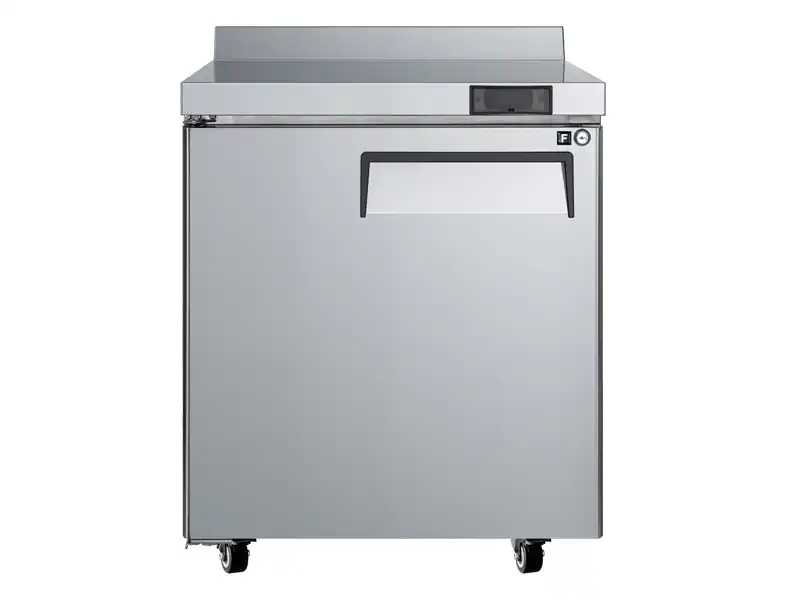
| Worktop refrigerated cabinet | Bars where back bar doubles as prep station | Stainless steel top holds garnishes; unit depth must match bar depth to avoid overhang |
For many partners, I recommend a combination: a low-height worktop refrigerated cabinet directly behind the bartender for high-volume spirits and mixers, flanked by taller glass door coolers for craft beers and display. This reduces bending while keeping the well-organized bar in sight of customers. One of our Camay worktop models, for example, uses a ventilated cooling system and a one-piece stainless top with a drip-resistant V-edge, which means it can sit directly in the service path without creating a spill hazard.
Positioning Back Bar Units to Eliminate Wasted Steps
Placement matters as much as the unit itself. I’ve walked through bars where a high-performing undercounter back bar fridge was installed thirty inches to the left of the service well because the drain location dictated it. That thirty inches equals two extra steps per drink, multiplied by a few hundred drinks, and by the end of a shift the bartender has walked an extra half-mile. The back bar refrigeration layout must be planned around the bartender’s dominant hand and the well configuration, not the nearest utility connection.
Start by mapping the drink menu by volume. The top-twenty-percent of bottles by sales—usually a handful of well spirits, a couple of house wines, and the most-ordered beers—should occupy the center column of the back bar, directly behind the well. Use the left and right columns for slower movers and backup stock. This creates a “heat map” that minimizes lateral movement. If the back bar is more than eight feet wide, segment it into two stations with duplicate high-movers so two bartenders can work without crossing paths.
For bars with an ice well in front and a back bar behind, the ideal sequence is: well, then a narrow drainboard, then the back bar cooler positioned so the bartender can pivot on the back foot without shifting weight. That pivot should cover everything needed for eighty percent of drink builds. If it doesn’t, the layout isn’t done.
Maintaining Temperature Stability Without Slowing Down Service
Door openings per hour in a busy bar can exceed three hundred. Every opening pulls warm air across the bottles, and if the recovery time is slow, the refrigerator’s compressor runs longer and the temperature creeps up. A layout that groups bottles by frequency of use helps, but the real protection is a cooling system that recovers quickly and maintains even temperature across all shelves. In our undercounter back bar units, a ventilated refrigeration system with automatic defrost and polyurethane insulation keeps the temperature steady between 0.5°C and 5°C even during peak demand.
Another detail that matters but rarely appears in buy guides: the shelf configuration. Fixed-wire shelves trap cold air differently than adjustable solid shelves, and if the bottles block the airflow, you get warm spots. For bars that stock effervescent wines or certain craft beers by the bottle, a two-degree fluctuation can change the pour. We run our back bar cabinets with fan-assisted cold air circulation to hold temperatures within a narrow band from the top shelf to the bottom. This consistency means the bartender doesn’t have to guess which bottle is properly chilled or rearrange stock mid-shift.
Practical Layout Configurations for Different Bar Formats
A long, narrow bar, a U-shaped hotel bar, and a freestanding island bar each need a different back bar refrigeration approach. The common mistake is treating all layouts the same and ordering uniform equipment.
In a narrow alley bar, depth is the first constraint. The back bar unit should be no deeper than twenty-four to twenty-seven inches from the back wall, leaving at least thirty inches of workspace for the bartender. An undercounter refrigerator with a worktop surface can double as the pass-through counter, eliminating the need for separate furniture. Our MTR-48 two-door undercounter, for example, is under thirty-one inches deep, which works in spaces that can’t accommodate a full-size reach-in.
For a hotel bar with multiple service points, the back bar layout should be repeatable. Each station benefits from an identical arrangement of glass door coolers and undercounter storage so that a bartender moving between stations on a busy night doesn’t have to re-learn where anything lives. Standardization also simplifies training, which matters in seasonal operations where staff turnover is high.
An island bar, where the back bar is in the center, requires all-around access. Glass door units with low-profile door handles that don’t catch on aprons or clothing are essential. Placing a refrigerated worktop at the center service position, surrounded by ice bins and speed rails, turns the island into a self-contained station where the bartender never has to turn their back on guests.
Common Questions About Back Bar Refrigeration Layout
How Much Refrigeration Capacity Does a Back Bar Actually Need?
Capacity depends on bottle turnover, not just linear feet. A high-volume cocktail bar might need 12–15 cubic feet of refrigerated space behind the bar for spirits, mixers, and wines, while a craft beer taproom might only need 8–10 cubic feet for backup cans and bottles. Calculate by stacking the maximum number of bottles you need cold at peak, not by how much the cabinet can hold. Overcrowding chokes airflow and forces the unit to work harder. For any bar doing over 200 covers a night, I generally recommend a combination of a 13 cubic-foot back bar cooler for display and a 7–10 cubic-foot undercounter fridge for backup, which keeps the display looking full without stuffing it.
Sliding Doors or Swing Doors—Which Causes Fewer Service Interruptions?
It depends on the bartender’s stance, not the door mechanism. In a bar where the bartender works with their back to the cooler and reaches behind, a sliding door saves the clearance needed to stand while the door is open. In a bar where the cooler is at the bartender’s side, a swing door that opens away from the main work path is just as fast. I’ve timed both in actual service simulations, and the difference is under half a second per opening if the swing door is adjusted correctly. The real advantage of sliding doors is in bars under forty-eight inches of aisle width.
Can a Back Bar Refrigerator Also Serve as a Prep Counter?
Yes, if the unit is designed for it. A worktop refrigerated back bar unit with a stainless steel top and a raised drip edge can hold a cutting board, garnishes, and a small juicer. But the compressor generates heat, so the top should not be used for temperature-sensitive ingredients like butter or chocolate. And if the unit is under forty inches wide, the usable prep surface shrinks quickly. In compact bars, we often integrate a small worktop fridge directly into the back bar line, which gives bartenders a place to make quick garnishes without leaving the station. If your bar layout relies on this dual use, it is worth confirming the unit’s top load rating and heat dissipation before finalizing your order—reach out at Sales@hzcamay.com or +8618157202219 with your dimensions and we can help you match a unit to your specific layout.
If you’re interested, check out these related articles:
Essential Commercial Chef Base Fridge Installation Tips
Boost Kitchen Efficiency Workflow Optimization with Chef Base Fridges
Upright Freezer vs Refrigerator Key Differences Explained
Boost Savings with Energy Efficient Commercial Upright Freezers