

Condensation on a refrigerated display door is not just a cleaning annoyance. It hides the product, slows customers, and increases the number of times staff open doors to confirm stock, verify labels, or show items to a buyer. In a bakery case, deli merchandiser, or grab-and-go cooler, a fogged surface directly works against the purpose of the equipment.
Why Condensation Forms on Display Refrigerator Doors
In refrigerated display equipment, condensation appears when the glass surface temperature drops below the dew point of the surrounding room air [1]. A single-pane door at refrigerated holding temperature is often cold enough for that to happen even in moderately humid front-of-house spaces. Kitchens, bakeries, delis, and bars nearly always have higher humidity than a standard retail sales floor, so the problem is common.
Fogged glass creates more than a cleaning task. It blocks color, shape, and brand packaging. Staff respond by opening doors to check stock, confirm labels, or show products to customers. Every extra opening pulls humid room air into the cabinet. The refrigeration system must then remove that moisture, and the compressor runs longer. Condensation also increases the risk of water droplets near door gaskets and, in low-temperature cases, frost or ice build-up on the frame.
How Anti-Fog Technology Works
Anti-fog performance is not a single product feature. It is a combination of glass assembly, door frame design, control logic, and airflow management.
Multi-pane glass with low-emissivity coatings. A double- or triple-pane door uses an insulating air gap or gas fill to keep the room-side pane warmer than a single-pane door would be. When the room-side surface sits closer to room temperature, it stays above the dew point more often [2]. Low-e coatings further manage thermal transfer through the glass.
Heated glass and door frame heaters. Electrical heating elements warm the visible glass or the frame just enough to suppress condensation. The most effective versions are modulated, not simply on/off. A dew-point sensor or humidity feedback loop tells the controller when surface heating is actually required.
Thermal breaks and gaskets. Conductive cold bridges around the door edge create narrow zones where condensation forms first. Thermal-break frames and properly seated gaskets reduce those cold bridges and keep humid air from reaching the inner pane.
Air curtains and cabinet airflow. Some display cases direct a controlled air stream across the door surface or between glass layers. The airflow breaks up the moist boundary layer that would otherwise settle as condensation.
| Approach | What it does | Main trade-off |
|---|---|---|
| Multi-pane low-e glass | Raises room-side surface temperature | Higher initial cost |
| Heated glass or door frame | Adds just enough heat above dew point | Energy use if uncontrolled |
| Air curtain / airflow control | Removes the humid boundary layer | Must not disturb cabinet temperature zones |
| Dew-point controller logic | Powers heating only when needed | Requires sensor calibration and commissioning |
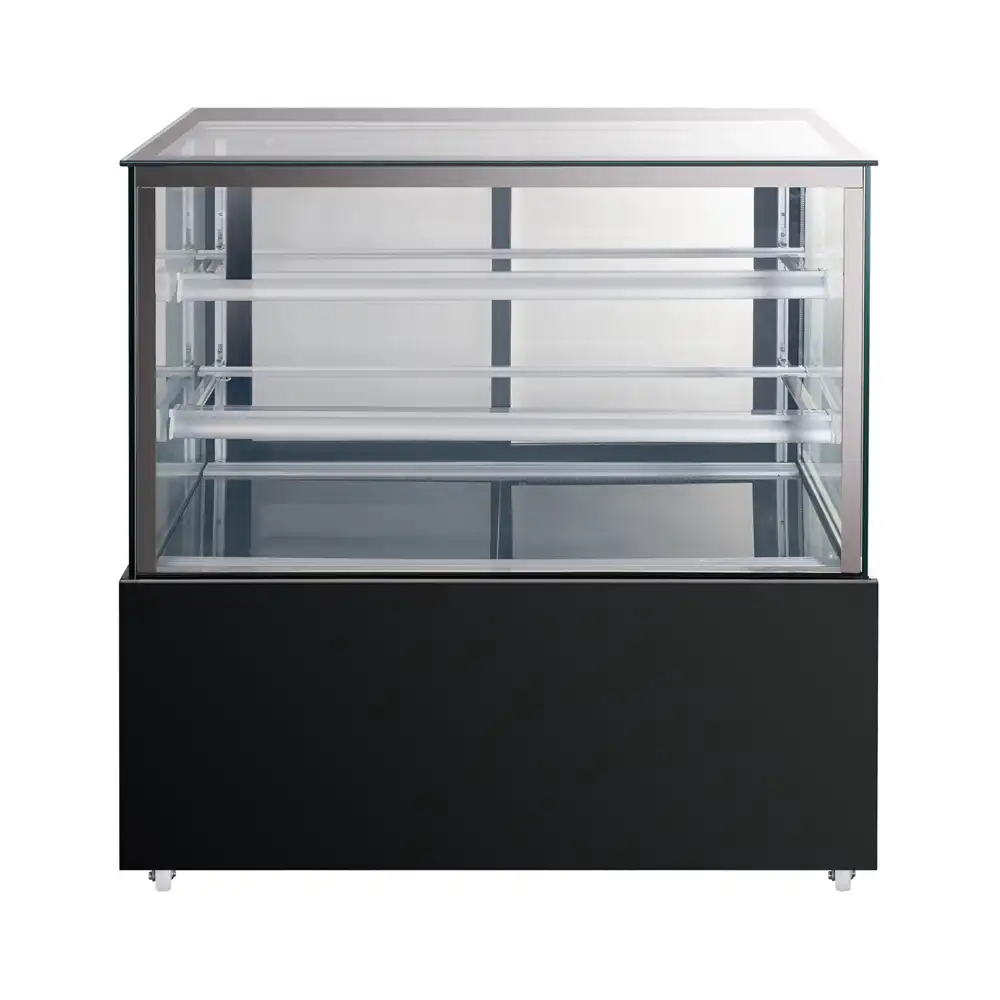
For European-style bakery and patisserie cabinets, the visual standard is particularly high. Customers buy with their eyes, and glass that constantly fogs under bakery humidity undermines the case. Equipment designed to the ISO 23953-2 classification must be evaluated with the correct cabinet type, ambient condition, and test method in mind [2]. Glass and door heater behavior are part of that evaluation.
Food Safety and Display Temperature Stability
Anti-fog technology supports food safety mostly indirectly. The U.S. Food and Drug Administration Food Code requires refrigerated display equipment to maintain time/temperature control for safety food at 5°C (41°F) or below [3]. A fogged door makes operators open the case more often. Each opening lets warm air enter and can push cabinet temperatures upward. If a display case cannot be visually checked with the doors closed, staff behavior changes in ways that make compliance harder.
NSF/ANSI 7 provides sanitary and performance requirements for commercial refrigerators and freezers [4]. Display equipment should be selected with the intended food type, holding temperature, and ambient conditions in mind. Interior condensation must drain properly, and food-contact surfaces must be cleanable. Anti-fog features should never be a substitute for the basic controls: gaskets, door closers, drains, and temperature monitoring.
Matching Anti-Fog Features to the Application
Different applications justify different anti-fog designs.
- Bakery and pastry cases: Curved glass, multi-pane low-e doors, and gentle air circulation matter because shoppers evaluate texture and color at close range.
- Grab-and-go coolers: Door-opening frequency is high, so air curtains and fast temperature recovery matter as much as glass heating. Condensation control must work with self-closing doors that are adjusted correctly.
- Beverage merchandisers: Glass clarity sells in low light. LED interior lighting and clean door surfaces help only if the door remains condensation-free.
- Low-temperature or freezer merchandisers: Door frame heating is often as important as heated glass because frost forms first around gaskets and frame edges.
Glass doors, temperature class, and door-opening patterns all change the case-selection decision. <Ultimate Buyers Guide for Commercial Reach In Refrigerators> covers the specification points that shape long-term ownership.
Purchasing Questions to Ask About Anti-Fog Systems
Request the following before comparing models:
- Is the door assembly single-pane, double-pane, or triple-pane low-e?
- Is the anti-fog heater controlled by dew-point feedback or does it run on a fixed schedule?
- What are the heater wattage and control settings at the specified ambient condition?
- Does the cabinet match the required temperature class and display cabinet standard for your product [2]?
- Are gaskets, door hinges, and heater elements serviceable from the front?
- What is included in the published daily energy consumption value under standard test conditions?
The anti-fog system can only perform as well as the door around it. During commissioning, check that doors close squarely, that the gasket touches the frame evenly, and that the case is not pointed at a loading door, steamer, or dish pit. These are the conditions that determine whether humidity stays on the outside.
Door seals, hinge tension, and daily cleaning habits directly affect how well anti-fog systems hold up. <Essential Maintenance Tips for Commercial Reach In Refrigerators> covers the field checks that help keep doors aligned and gaskets sealing properly.
Need help specifying an anti-fog display case for a high-humidity line or storefront? Send the cabinet temperature class, door-opening frequency, and room humidity to Sales@hzcamay.com. A focused inquiry is far better than a general catalogue request when the goal is product visibility without added energy cost.
Energy Trade-Offs and Smarter Control
Heated glass and door frame heaters add electrical load, but their effect on total energy use depends on control. If a heater runs continuously in a cool, dry sales floor, it wastes energy and adds unnecessary cabinet load. But if a dew-point controller pulses the heater only when surface temperatures approach condensation conditions, the energy impact is far smaller [5]. In low-temperature cases, anti-fog and anti-sweat heaters may still consume a meaningful share of daily energy because the glass surface must be kept much warmer than the frozen air inside.
ENERGY STAR criteria for commercial refrigerators and freezers set maximum daily energy consumption levels based on volume and product temperature [5]. Although the standard does not separately regulate anti-fog systems, door heaters and fan energy are included in the measured daily energy use. That gives manufacturers a reason to design anti-fog control as an energy-management feature rather than a fixed heat load.
For foodservice operators, the comparison should not simply be “anti-fog heating adds watts.” A clear glass door reduces door openings, shortens selection time, and protects temperature stability. The operational savings from fewer door openings may offset a properly controlled heater in high-traffic sites. This trade-off matters most in grab-and-go coolers and busy service lines, where door-open minutes are the larger driver of energy use.
Door heater controls are part of a broader commercial refrigeration energy strategy. <Boost Savings with Energy Efficient Commercial Upright Freezers> covers how case selection and operating patterns influence daily energy consumption.
Specify Display Cases With the Right Anti-Fog Performance
Anti-fog decisions are specification decisions, not afterthoughts. The correct solution depends on room dew point, cabinet temperature class, door glass assembly, and door-opening frequency. A case that keeps glass clear in a wine shop may struggle next to a steamer or a dish pit.
At Zhejiang Kaimei Catering Equipment Co., Ltd, we approach display refrigeration as a system: cabinet structure, glass and door heating, airflow, and controller logic must be matched to the application. Our team can review your operating conditions and recommend a factory-built configuration rather than a one-size-fits-all option. Include door dimensions, ambient temperature and humidity range, target product temperature, and expected door-opening frequency in your inquiry. Contact us at Sales@hzcamay.com or call +8618157202219.
Frequently Asked Questions
Why does my display refrigerator fog up even after cleaning the glass?
Cleaning removes residue but does not change the glass surface temperature. If the door surface is below the room dew point and humid air reaches it, condensation returns [1].
Is anti-fog technology only available on glass-door display cases?
No. Similar heating and airflow principles are used on glass lids, service counters, and pass-through displays. Solid-door cabinets generally do not need anti-fog because product visibility is not part of the door function.
Can anti-fog glass completely stop condensation?
Under the conditions for which it is specified, anti-fog glass can reduce condensation to a level that is no longer visible. However, no system eliminates condensation in every possible environment. If a door is held open, a gasket is damaged, or the room dew point is extreme, some moisture may still form [1].
Does a door heater make the display case run hotter?
The heater is typically on the room side of the glass or in the frame and is designed to raise surface temperature slightly, not to warm the stored product. The refrigeration system continues to hold food at the set temperature.
How do I know if my anti-fog system is wasting energy?
Check whether the heater is controlled by a dew-point sensor or a fixed schedule, and compare energy use before and after gasket and door alignment corrections. A qualified technician can measure heater duty cycle and confirm that the cabinet still holds temperature [5].
References
[1] ASHRAE, “Psychrometrics,” in ASHRAE Handbook—Fundamentals, Atlanta, GA, USA: ASHRAE, 2021.
[2] ISO 23953-2:2015, Refrigerated Display Cabinets — Part 2: Classification, Requirements and Test Conditions, 2015.
[3] U.S. Food and Drug Administration, Food Code 2022, Section 3-501.16, 2022.
[4] NSF International, NSF/ANSI 7: Commercial Refrigerators and Freezers, Ann Arbor, MI, USA, 2021.
[5] U.S. Environmental Protection Agency, “ENERGY STAR Commercial Refrigerators & Freezers Key Product Criteria,” 2023.
If you’re interested, check out these related articles:
Essential Maintenance Tips for Commercial Reach In Refrigerators
Chef Base Fridge vs Undercounter Fridge Which Is Best for Your Kitchen
Optimizing Kitchen Efficiency with Integrated Worktop Refrigeration
Boost Kitchen Efficiency Workflow Optimization with Chef Base Fridges