
The refrigeration cycle is the same in both configurations: refrigerant absorbs heat from the cabinet, travels to the compressor, and releases that heat through a condenser. The difference is how the condenser rejects heat. Air-cooled systems push it into the surrounding room air. Water-cooled systems transfer it into a water stream that carries it away. That single distinction changes installation requirements, operating cost, site suitability, and long-term maintenance.
For most small and mid-size commercial kitchens, air-cooled equipment is the default because it is simpler to install and operate. Water-cooled equipment becomes worth the extra complexity when ambient conditions, water infrastructure, equipment location, or high cooling loads make air-cooled performance unstable or impractical. This comparison explains how to make that decision without relying on equipment marketing generalities.
How Air-Cooled Condensing Works
An air-cooled condenser uses one or more fans to draw ambient air across a finned coil. The hot refrigerant gas enters the coil, loses heat to the air, and condenses into a liquid before continuing through the expansion device and evaporator. In self-contained commercial refrigeration equipment such as reach-in refrigerators, chef bases, prep tables, and many ice machines, the condenser is built into the cabinet or located directly behind the unit.
The main advantage is autonomy. The unit only needs electrical power and enough clearance around the condenser intake and discharge. There is no water connection, no drain for condenser water, and no separate cooling tower. Installation is faster, and the system is easier to relocate when a kitchen changes its layout. For a café, small restaurant, or convenience store, this is often the most practical route.
The limitation is environmental sensitivity. Heat rejection depends on the temperature of the air entering the condenser. In a hot kitchen, on a rooftop exposed to direct sun, or in a tight equipment room with poor ventilation, condensing pressure rises. The compressor must work harder, which increases energy consumption and can reduce cooling capacity or shorten component life. The equipment also adds heat and fan noise to the surrounding space, which is acceptable in many back-of-house areas but less welcome near dining rooms or compact service counters.
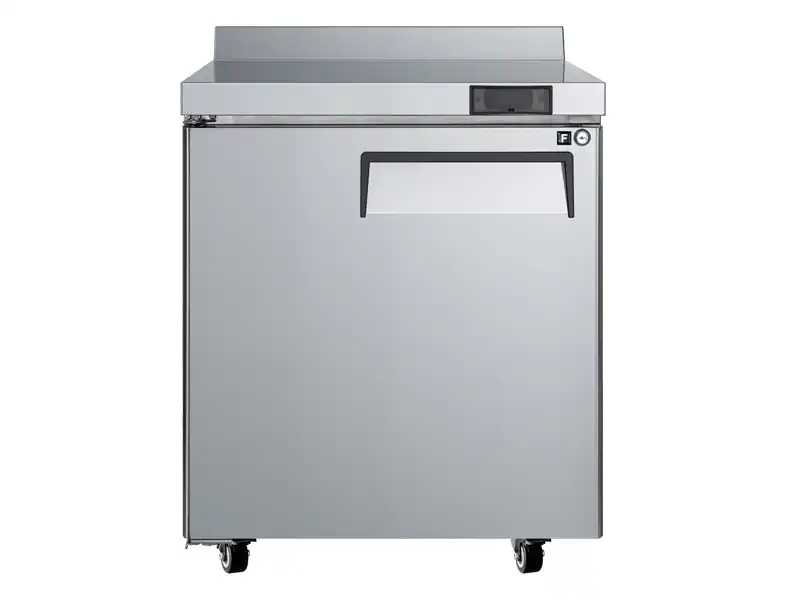
Proper clearance is not a formality. An air-cooled condenser needs enough open space to avoid recirculating hot discharge air. If two units are placed closely together, one can pull hot exhaust from another, raising both condensing temperatures. In operational terms, that means checking the manufacturer’s clearance specification before final placement, not after.
How Water-Cooled Condensing Works
A water-cooled condenser uses water instead of air as the heat sink. Refrigerant travels through one side of a coaxial, tube-in-tube, or shell-and-tube heat exchanger while water flows through the other. The water absorbs heat from the refrigerant and then leaves the condenser at a higher temperature. From there, the water either goes to a cooling tower, an open water loop, a closed-loop chiller, or in some cases directly to a waste line.
Because water has higher thermal conductivity and specific heat than air, water-cooled condensing can maintain lower and more stable head pressure even when the surrounding air is hot or the condenser is located in an enclosed space. For kitchens in tropical climates, basements, or buildings where outside air supply is restricted, this stability can keep compressor temperatures down and hold cooling capacity predictable.
The trade-off is mechanical and regulatory complexity. Water-cooled systems require a reliable water supply, adequate pressure, and usually some form of water treatment to prevent scale, corrosion, and biological growth. Open systems that discharge water continuously face stricter local code requirements and higher water and sewer costs than closed-loop systems. Closed-loop systems solve many water-use concerns but add pumps, cooling towers, or chillers that must be maintained and monitored.
Water quality also matters more than equipment buyers often expect. Hard water can form scale on the condenser water side, gradually reducing heat transfer. A thin scale layer may look harmless, but it acts as insulation. Over time, head pressure increases and energy savings disappear unless the system is descaled according to a maintenance schedule.
Side-by-Side Comparison
The choice usually comes down to site conditions and lifecycle cost, not a simple claim that one technology is superior.
| Factor | Air-Cooled | Water-Cooled |
|---|---|---|
| Installation complexity | Lower; electrical only | Higher; water supply, drainage, cooling loop |
| Sensitivity to hot environments | Higher; loses efficiency as ambient temperature rises | Lower; waste heat is carried away by water |
| Water consumption | None for condensing | Depends on loop design |
| Indoor heat rejection | Adds heat and fan noise to the kitchen | Less indoor heat release in many configurations |
| Maintenance focus | Coil cleaning, condenser fan, airflow | Water treatment, scale control, pump/tower |
| Typical best fit | Small-to-mid self-contained units | Large central plants, constrained equipment rooms, heat-recovery applications |
This comparison is a starting point, not a selection table. A reach-in refrigerator with a proper built-in air-cooled condenser may work well in a hot kitchen if the manufacturer designed the cabinet for that climate class. A water-cooled ice machine may make sense in a bar with no space for ventilation but poor water quality could erase the benefit.
For a deeper look at how condensing choices affect a reach-in purchase, <Ultimate Buyers Guide for Commercial Reach In Refrigerators> covers capacity, door configuration, and system selection from a buyer’s perspective.
If you are narrowing down specific models for a restaurant, <Choosing the Best Commercial Reach In Fridge for Your Restaurant> explains how cabinet placement, airflow, and compressor location affect real-world performance.
When energy cost is a priority, <Boost Savings with Energy Efficient Commercial Upright Freezers> examines how condenser and insulation choices influence long-term operating expense.
When Air-Cooled Is Usually the Better Fit
Air-cooled refrigeration is generally the right starting point for a kitchen that has adequate ventilation, moderate indoor temperatures, and no existing water loop for process cooling. It fits the standard preparation line where reach-ins, undercounters, prep tables, and chef bases sit in conditioned or naturally ventilated spaces. The initial cost is usually lower, the installation schedule is shorter, and the service path is simpler because the condenser is part of the appliance rather than part of a building system.
Maintenance is more predictable because the critical tasks are visible: clean the condenser coil, keep filters clear, replace worn fan motors, and maintain airflow. In a high-volume kitchen, that still requires a cleaning schedule, but it does not require water treatment records or cooling tower oversight.
Air-cooled units are also easier to compare at specification stage. The energy performance and clearance requirements are published by the manufacturer, and a buyer can verify the unit against the climate class where it will operate. If the equipment room is not enclosed and the building has adequate air exchange, air-cooled is usually the lower-risk choice.
One practical exception is rooftop installation in a sunny climate. The condenser may see air temperatures far above the kitchen’s internal temperature. In that case, the equipment must be selected for the actual ambient conditions at the condenser inlet, not for the temperature inside the dining room.
When Water-Cooled Earns Its Higher Complexity
Water-cooled condensing becomes the stronger option when air-cooled condensing is physically or economically constrained. A central production kitchen with large walk-in coolers and freezers may use a remote water-cooled rack because heat rejection must occur away from occupied areas without long refrigerant lines losing efficiency. A hotel equipment room in a basement with no access to outside air may require water-cooled machines to avoid hot, noisy operation in a confined space.
Heat recovery is another driver. In facilities that already use hot water for sanitation, cleaning, or building heating, a water-cooled condenser can be part of an integrated heat-recovery strategy. The heat that would otherwise be wasted to kitchen air becomes a useful byproduct. This is more common in large-scale food processing, hospital kitchens, and central commissaries than in small restaurants.
Water-cooled operation can also reduce compressor peak pressure and improve performance in very hot, humid conditions where air-cooled condensers struggle to shed heat efficiently. ASHRAE refrigeration guidance notes that condenser selection must account for annual weather profiles, not only design-day extremes, because part-load behavior changes with ambient conditions [1]. In high ambient temperature zones, a water-cooled system may maintain stable capacity when an air-cooled unit would lose cooling output during the hottest service hours.
The caution is that water is not a one-time purchase. It is a utility with quality, treatment, discharge, and conservation obligations. The U.S. Department of Energy’s commercial refrigeration equipment standards treat system efficiency within a broader energy and water-use framework, so a water-cooled configuration must be evaluated for total resource consumption, not compressor energy alone [2].
In one OEM project for a tropical hotel kitchen, the equipment room had no practical outside-air ducting. A water-cooled ice machine was specified because the stable head pressure kept ice output steady during peak check-in and banquet periods. The decision worked because the building already had a treated closed-loop water system. Without that infrastructure, the same choice would have added unacceptable cost.
The Real Decision Drivers
Buyers should evaluate four factors before choosing a condensing method: ambient conditions, water availability and cost, maintenance capability, and total lifecycle energy.
First, measure the actual environment where the condenser will operate. An air-cooled unit in a well-ventilated kitchen is a different machine from the same model in a hot, enclosed corner. Document the highest likely condenser inlet temperature and whether airflow can be maintained during peak hours.
Second, calculate water use. A closed-loop system uses little makeup water but adds electrical load for pumps and cooling towers. An open loop can use significant water and may be restricted by local code. If water is scarce or expensive, the energy efficiency advantage of water-cooled condensing may be outweighed by water treatment and sewer charges.
Third, be honest about service capability. Air-cooled condenser cleaning is simple enough for kitchen staff after training. Water-cooled maintenance requires mechanical knowledge, water treatment logs, and sometimes specialized contractors. A facility without that support should not add water-cooled equipment just because a specification sheet lists a lower compressor energy figure.
Fourth, compare lifecycle cost in the local market. Energy models and component selections should reflect the complete system, including condenser fans, water pumps, cooling towers, and maintenance labor where applicable. Do not compare only the compressor label. The appropriate reference is total heat rejection under site conditions, which ASHRAE methods help define through condenser load and ambient design data [1].
For a specific equipment room, an engineer should also confirm whether the building management system can monitor water temperature, pressure, and flow. If the condenser is water-cooled but no one watches the water loop, a small failure can become a large repair before the refrigeration system shows a visible problem.
Specification Support
If you are comparing air-cooled and water-cooled configurations for a new kitchen, central production space, or equipment refresh, send your site constraints and cooling-load profile to Sales@hzcamay.com or call +86 181 5720 2219. We can review the available condenser options, climate-class requirements, and maintenance practicalities before you lock the specification. The goal is to match the condenser to the site, not to keep the decision abstract.
Frequently Asked Questions
Which system is cheaper to operate?
Air-cooled equipment often has lower first cost and no water bill, but it can consume more compressor energy in a hot environment. Water-cooled equipment can run at lower head pressure and reduce compressor work, but it adds water, pump, and treatment costs. The answer depends on local ambient temperature, water rates, and whether the building already has a closed-loop water system.
Can water-cooled refrigeration be used in a small restaurant?
It can, but it is rarely necessary. A small restaurant with a normal back-of-house ventilation path will usually be better served by air-cooled self-contained equipment. Water-cooled becomes more relevant when the equipment room is enclosed, the climate is very hot, or the building already operates a treated water loop.
Is air-cooled refrigeration safe in a hot kitchen?
It can be safe and effective if the unit is selected for the actual climate class and installed with enough clearance for condenser airflow. Problems arise when hot discharge air is recirculated or when a unit rated for a moderate environment is placed in an unconditioned or poorly ventilated space.
What is the most common maintenance mistake with air-cooled condensers?
Ignoring the condenser coil until the unit starts short-cycling or losing temperature. Dust, grease, and flour can build up on the coil surface. A routine cleaning schedule based on kitchen conditions is more reliable than waiting for a performance warning.
References
[1] ASHRAE, ASHRAE Handbook—Refrigeration, American Society of Heating, Refrigerating and Air-Conditioning Engineers, Atlanta, GA, USA, current edition, condenser selection and system design chapters.
[2] U.S. Department of Energy, “Energy Conservation Standards for Commercial Refrigeration Equipment,” Federal Register, U.S. Government Publishing Office, Washington, DC, USA, current rulemaking and equipment efficiency references.
If you’re interested, check out these related articles:
Choosing the Best Commercial Reach In Fridge for Your Restaurant
Essential Maintenance Tips for Your Commercial Chef Base Refrigerator
Essential Commercial Chef Base Fridge Installation Tips
Boost Kitchen Efficiency Workflow Optimization with Chef Base Fridges
Boost Savings with Energy Efficient Commercial Upright Freezers