
Grab-and-go refrigeration rarely fails because the compressor wears out on paper. It fails because the cabinet cannot recover after a restock surge, the door gasket stops sealing, or the airflow pattern leaves one shelf warm while the rest looks normal. That is why I put recovery performance, door hardware, and modular sizing ahead of cosmetic LED upgrades. For convenience store and airport operators, the only specification that matters on a busy afternoon is that every sandwich, dairy cup, and bottled drink stays inside the temperature band while customers keep opening the door. This article explains what to check before a unit earns that space.
Why Does Grab-and-Go Refrigeration Behave Differently in Airports and C-Stores?
Airport terminals and convenience stores both sell from a small footprint, but the traffic pattern is not the same. A convenience store sees steady door cycles all afternoon. An airport location sees long quiet periods, then a gate announcement releases a queue that opens the same cabinet every few seconds for thirty minutes. The refrigeration system has to remove warm humid air from the cabinet interior, not just cool the product.
Glass door display cabinets are common in both settings because the customer needs to see the product before reaching for it. The tradeoff is that every door opening spills cold air and pulls in ambient air. If the door does not close by itself or the gasket has worn flat, the evaporator runs longer and the cabinet may still show an acceptable air temperature while the milk cartons at the front edge start to climb. That is why I treat grab-and-go cabinets as a different thermal duty than back-of-house reach-ins. Camay builds these units with self-closing doors and lock and key because the door seal is a wear part, not a permanent feature.
Which Grab-and-Go Cabinet Configuration Handles Self-Service Best?
Most sites need at least two cabinet types. A glass door merchandiser handles the customer-facing impulse food and drinks. A solid door undercounter or reach-in handles backup stock, dairy, and slower-moving SKUs so the front unit does not get restocked from the customer side. Refrigerated worktops make sense when sandwiches, wraps, or salads are assembled at the counter and then moved into a display case.
| Configuration | Best role in a grab-and-go line | Typical temperature | Example Camay model | What to verify |
|---|---|---|---|---|
| Glass door display cabinet | Customer-facing packaged food and drinks | 0°C to 10°C | DBG0.6L1A | Door gasket, shelf spacing, front visibility |
| Solid door undercounter refrigerator | Backup stock and dairy under the counter | 0.5°C to 5°C | MTR-72 | Compressor ventilation, lock and key, shelf load |
| Refrigerated worktop or chef base | Sandwich, wrap, and salad assembly | 0.5°C to 5°C | MAR-60A | Worktop edge, casters, pan capacity |
| Compact freezer display case | Frozen snacks and ice cream near the register | -25°C to -15°C | MWTF-27-L | Defrost type and door seal |
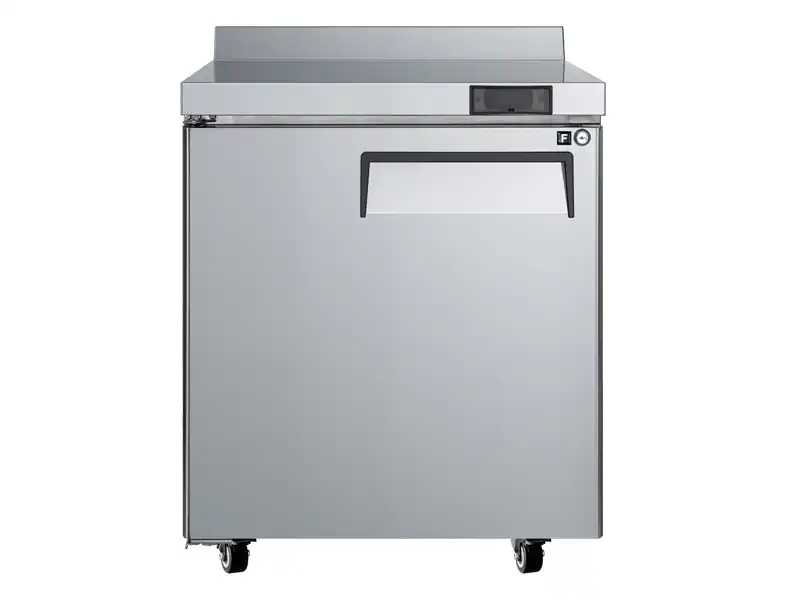
One mistake I see in airport kiosks is putting all products into one wide display case without separating temperature zones. Packaged salads, dairy drinks, and chocolate do not all need the same shelf temperature, but they are often sold side by side. A drawer-style undercounter behind the counter can hold the products you restock first, while the glass door cabinet stays closed more often.
If the cabinet also has to cover back-of-house storage, <Choosing the Best Commercial Reach In Fridge for Your Restaurant> covers why shelf depth and compressor placement change recovery after a large restock.
How Do You Keep Temperature Stable When Doors Open Constantly?
Door hardware is more important than most buyers assume. A self-closing door with a clean gasket prevents the slow temperature creep that shortens shelf life. The Camay MTR-72 undercounter refrigerator uses a removable gasket and round-corner shelves because gaskets are service parts, not permanent features. When I review a cabinet for a front-of-house location, I look at how easy it is to swap the gasket and how well the door cam holds the door closed.
Refrigerant and insulation also matter. R290 refrigerant and polyurethane/cyclopentane foamed insulation lower heat gain into the cabinet. Ventilated cooling spreads cold air across shelves, but it will not outperform a door that stays open. Automatic defrost keeps frost from building up in humid terminals, and a smart digital controller can show when the cabinet is holding setpoint.
If your grab-and-go mix includes dairy, sandwiches, and fresh cut fruit in one cabinet, confirm the airflow pattern before finalizing the layout. A unit that holds bottled drinks cold can still leave a top shelf of yogurt too warm. Send your product mix and shelf-load profile to Sales@hzcamay.com or call +8618157202219 and we can check which setup holds everything under 5°C during your peak restocking windows.
For sites that keep frozen grab-and-go items alongside refrigerated drinks, <Upright Freezer vs Refrigerator Key Differences Explained> covers why a single cabinet cannot serve both temperature bands without running one zone too warm or too cold.
What Should You Check Before Positioning Grab-and-Go Cases?
Placement changes how hard the refrigeration system has to work. A glass door case next to a west-facing window in an airport can be subjected to solar heat even if the terminal air is conditioned. A case in a kiosk corner can lose airflow if the condenser side is blocked. I ask concession operators to check the unit’s ambient temperature rating and side clearance before they build the counter around it.
Camay cabinets are rated for 38°C and 53% humidity, which matters more in an enclosed kiosk than in a large store. For counter zones, a compact display case with optional casters can be tested at different spots. Once the position proves out, fixed legs or a built-in cabinet surround reduce movement. The lock and key are useful in airport locations after hours.
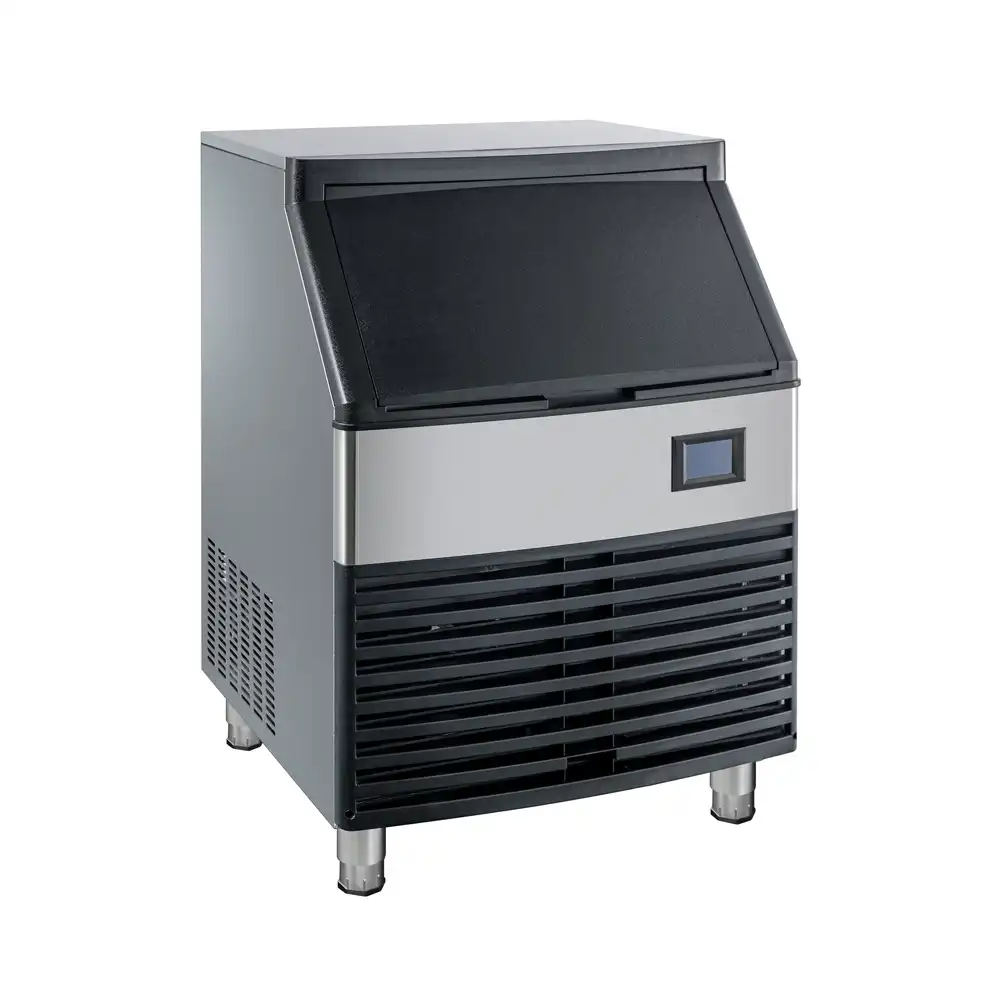
Cold beverage sets that rely on self-service ice can use a cube ice machine like the FB210A, which produces 100 kg in 24 hours and stores 45 kg. The ice machine should sit near the cold drink counter, not at the end of the line where the front air intake can pull in dust.
If the front counter includes fresh sandwich assembly, <Optimizing Kitchen Efficiency with Integrated Worktop Refrigeration> covers how a refrigerated worktop reduces the distance between storage and the serving point.
How Should You Start Your Grab-and-Go Refrigeration Specification?
Start with the product mix, peak restocking pattern, and available counter and storage depth. A clear specification can be checked against the cabinet’s temperature band, door type, voltage, and ambient rating. If the site mixes prep with self-service, include a worktop or chef base as part of the line rather than treating it as a separate purchase.
Send your cabinet opening dimensions, product mix, and peak volume to Sales@hzcamay.com or call +8618157202219. We can confirm whether a stock model fits or whether an OEM/ODM adjustment makes the installation simpler. At Camay, we manufacture the cabinet and the compressor package, so the specification conversation can go straight to airflow, shelf depth, and certification rather than waiting on a trading company.
What Else Should Operators Ask About Grab-and-Go Refrigeration?
How long should a grab-and-go cabinet take to recover after restocking?
Recovery depends more on airflow, door sealing, and shelf loading than on a single advertised time. A cabinet that was holding 0.5°C to 5°C before restocking should return to setpoint without frost forming on the evaporator or warm spots on the front shelf. If the door gasket is intact and the product load is not blocking the air path, the cabinet should recover during the next natural break in traffic. If it cannot recover until the store closes, the unit is undersized for the opening frequency or the airflow is restricted.
Can one display unit handle both dairy and packaged snacks safely?
A common mistake is to assume that because a cabinet keeps bottled drinks cold, every shelf is fine for dairy. Dairy needs to stay at or below 5°C, while some packaged snacks can tolerate a wider range. The issue is shelf position and airflow, not only the controller setting. A top shelf near the evaporator discharge may run colder, while a bottom shelf near the door may run warmer. Use a glass door cabinet for dairy and place faster-moving snacks where temperature drift is less risky, or split the product into two cabinets if the mix is large.
What is the difference between a solid door and glass door case for grab-and-go?
It depends on who opens the door. A glass door is better for customer-facing grab-and-go because it lets buyers see the product and reduces unnecessary door openings. A solid door is better for backup inventory behind the counter because it blocks light and heat gain, and often costs less to run in a back-of-house position. If the unit sits in direct sunlight or near a hot kitchen pass, a solid door may hold temperature better even though it gives up product visibility.
Does airport or convenience store location change the maintenance schedule?
In projects we have supplied for airport and c-store operators, the maintenance interval depends more on cleaning access and dust than on the type of customer traffic. A cabinet next to a busy terminal entrance can pull in more dust than a back-aisle unit, so the condenser and gasket need more frequent checks. We usually recommend a monthly gasket inspection and quarterly condenser cleaning for front-of-house units. Share your cabinet dimensions and product mix with Sales@hzcamay.com and we can confirm whether the door swing, airflow, and shelf configuration will work before you finalize the layout.
If you’re interested, check out these related articles:
Boost Kitchen Efficiency Workflow Optimization with Chef Base Fridges
Chef Base Fridge vs Undercounter Fridge Which Is Best for Your Kitchen
Optimizing Kitchen Efficiency with Integrated Worktop Refrigeration
How to Choose the Best Chef Base Refrigerator for Your Kitchen
Ultimate Buyers Guide for Commercial Reach In Refrigerators