

The failure that shuts down a kitchen line is rarely the compressor itself. It is the heat load around a standard reach in refrigerator that was never designed to sit under hot equipment. After 26 years in commercial refrigeration manufacturing, I have seen the same pattern repeat across export projects: a restaurant buys a capable reach in, places it under a griddle or next to fryers, and then blames the cabinet when temperatures drift. A dedicated chef base exists for that specific condition. It puts storage, work surface, and heat resistant construction at the point of use, and it changes the failure math from reactive repair to stable production.
Heat Problems in Standard Reach In Refrigerators
A chef base belongs in that space because it is designed around the heat load. A reach in refrigerator gives you volume, but it is not built for the thermal environment around a grill station. The compressor is usually placed near the floor or rear, where hot air and grease laden dust collect. Door openings are tall and frequent. Every time the door opens, cold air leaves quickly, and the system has to pull down again. At a workstation where pans, griddles, and plates sit on top, the cabinet also has to deal with radiant heat coming from the surface above and from the equipment beside it.
The result is not a sudden stop. It is a slow failure pattern: compressor runtime increases, coil temperatures climb, and eventually the cabinet cannot hold 0.5°C to 5°C. Kitchens often notice it first in product quality, not in a fault code.
| Installation factor | Standard reach in | Dedicated chef base |
|---|---|---|
| Top surface | Not always built as a load bearing worktop | Stainless worktop carries prep and staging |
| Door pattern | Frequent tall door swings | Drawers or shorter doors limit cold air loss |
| Thermal load | Ambient rating may not include hot pans above | Designed for under counter use near hot equipment |
| Airflow route | Rear or side condenser can become blocked | Accessible condenser path keeps hot air moving |
| Failure signal | Gradual temperature drift during peak | More reserve under controlled duty |
Dedicated Chef Base Advantages at Hot Stations
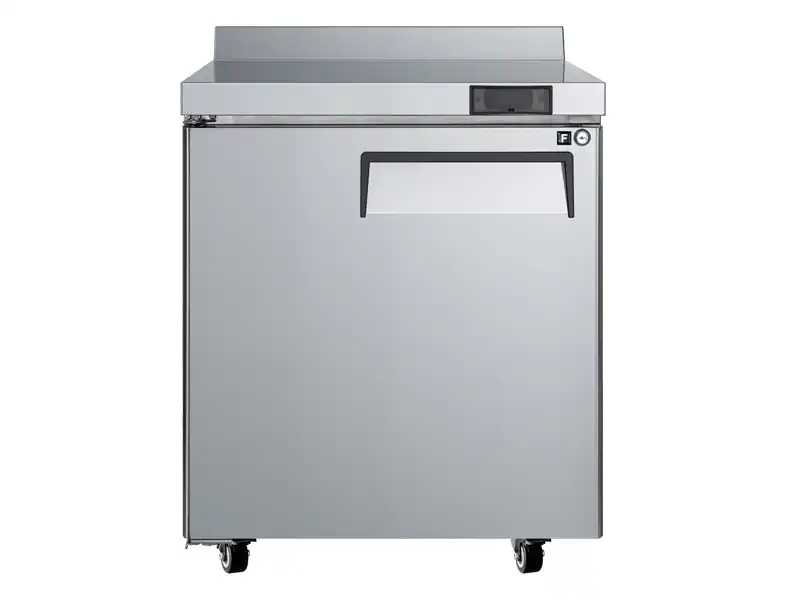
A dedicated chef base changes the physical placement of refrigeration. The cabinet is low enough to sit under a hot worktop or cooking line, and the compressor circuit is arranged for that duty instead of for a tall storage cabinet. Because the top is a stainless work surface, it can carry hot pans and staging containers without becoming an accidental storage shelf.
A dedicated chef base is not simply a reach in with a lower height, <Chef Base Fridge vs Undercounter Fridge Which Is Best for Your Kitchen> covers why the top rail, storage layout, and compressor placement are different decisions than undercounter storage, and why choosing the wrong category affects more than just footprint.
In our manufacturing work, the buyer question that matters is not only temperature range but where the load is taken. A chef base has shorter door or drawer openings, so the cold air stays closer to where it is needed. That matters during a four hour service window, when a tall cabinet can lose its reserve every time someone reaches for a second pan. The MAR-60A chef base, for example, combines a one piece stainless worktop with a 0.5°C to 5°C cabinet and a drip resistant V edge.
Specs That Determine Heat Tolerance in a Chef Base
Heat tolerance in a chef base is not a single number. It is the result of several specifications working together, and a buyer should read them before comparing prices.
Climate Class and Ambient Temperature
Climate class describes the ambient conditions a cabinet is designed to handle. Our documentation for the professional worktop and undercounter lines lists climate type ST~T and ambient temperature 38°C with 53% humidity. I treat that as the starting point for a hot line, not the final answer. If a kitchen is enclosed, if the pass area holds heat after rush, or if the equipment cluster is tight, the installation has to be checked against that rating.
Condenser and Defrost Behavior
A ventilated system and automatic defrost matter more in a hot zone than in a cold storage room. The condenser needs an unobstructed path, and the defrost cycle should restore the cabinet without leaving frost that blocks airflow. The MAR-60A runs R290 and a ventilated cooling system. Polyurethane and cyclopentane foam without CFC is the insulation I look for because it slows heat gain through the walls when the surrounding air is hot.
The specification details that determine heat tolerance are easy to overlook in a price sheet, <How to Choose the Best Chef Base Refrigerator for Your Kitchen> covers the selection sequence we use with export buyers, from ambient operating range to pan rail depth and door configuration.
Operational Boundaries to Confirm Before Buying
Operational boundaries decide whether a chef base will actually perform on site. I ask buyers to confirm these points before locking a model because they cannot be fixed by a stronger compressor.
Clearance and Airflow
Most hot station failures originate in missing clearance. A chef base may be rated for a warm room, but if the condenser inlet is pressed against a wall or blocked by a neighboring appliance, the rating does not matter. I ask for side, rear, and top clearances before quoting. That single check removes more warranty problems than any other part of the conversation.
Maintenance access is part of heat performance, <Essential Maintenance Tips for Your Commercial Chef Base Refrigerator> covers the condenser access and gasket checks that keep a hot station cabinet within its rated range.
If your line has multiple appliances in a confined pass, share the rough layout before you finalize the model number. We can confirm whether the condenser path and door swing fit your station. Send the floor plan to Sales@hzcamay.com.
Pan Rail and Door Cycles
Decide the pan rail configuration and whether drawers or doors are needed before you buy. A busy grill station opens the cabinet far more often than a prep kitchen. Drawers lose less cold air than doors in that pattern, but they also add cost and change cleaning access. I ask buyers to walk through the service sequence: how often staff will turn, lift, and reach during the rush, and where empty pans will be staged.
The Direct Path to a Heat Safe Chef Base Specification
Most hot line failures I see in export projects come from the same mismatch: a buyer chooses a cabinet based on capacity and price, then places it into a thermal environment the cabinet was never intended to handle. The fix starts before any purchase. Define the surface duty, pan rail layout, ambient range, and clearance. Then match the cabinet to those numbers.
Camay builds the chef base line for exactly that conversation. Send your station dimensions, expected ambient temperature, and pan rail requirements to Sales@hzcamay.com or call +8618157202219, and we will confirm the model configuration that fits before you order.
What Buyers Ask Before Specifying a Heat Safe Chef Base
Can a standard undercounter refrigerator work under a hot counter?
A standard undercounter refrigerator can work under a hot counter only when the ambient temperature and airflow match the cabinet rating. The reason I start with a dedicated chef base is the work surface and the shorter opening pattern. A reach in or undercounter unit under a griddle also has to absorb radiant heat from above, which many standard designs were never tested for. If the station is used for hot pans or continuous plating, I would not treat the undercounter as a direct substitute.
Does heat resistance mean the cabinet can sit tight against the wall?
A common misunderstanding is that a heat resistant chef base needs no clearance. The opposite is true. Heat resistant design may buy more reserve under load, but the condenser still needs a clear inlet and outlet path. When the unit is pushed against a rear wall or boxed in by other appliances, recirculated hot air raises head pressure and shortens compressor life. I would rather leave a few centimeters of clearance and hide the gap than risk a slow failure during service.
Is a higher ambient rating the only spec that matters?
It depends on the station, but the ambient rating is only one variable. If the cabinet handles high ambient but has poor condenser access or long door openings, it still runs hot during peak service. The defrost design, insulation density, pan rail layout, and door configuration all influence how the unit behaves when hot pans sit above it. I treat the ambient rating as a threshold, not the full selection logic. A buyer should check the complete duty cycle, not a single climate class note.
What information should I send before buying?
In the export projects I have quoted, the fastest accurate quotes come from three pieces of information: expected ambient temperature around the station, the cooking equipment beside and above the unit, and the pan rail or drawer layout. With those details, we can verify clearance, airflow, and door swing before you commit to a model. Send your requirements to Sales@hzcamay.com and we will confirm the matching cabinet and clearances before you place the order.
If you’re interested, check out these related articles:
Optimizing Kitchen Efficiency with Integrated Worktop Refrigeration
Heavy Duty Chef Base Refrigeration for Efficient Commercial Kitchens
Choosing the Best Commercial Reach In Fridge for Your Restaurant
Chef Base Fridge vs Undercounter Fridge Which Is Best for Your Kitchen