

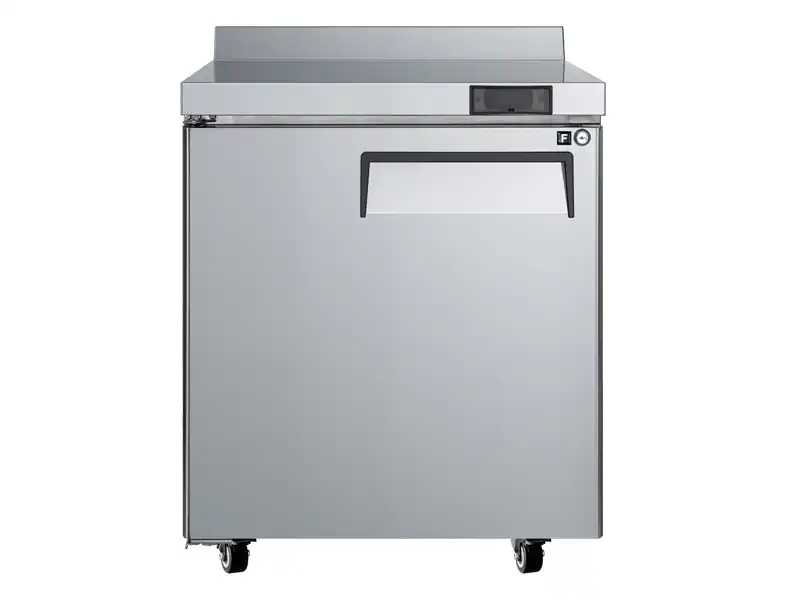
A chef base at the grill station is not extra cold storage. It is the refrigeration and work surface that keeps raw proteins, marinades, and cold pans within arm’s reach while the line stays closed. Grill station workflow improves when cooks stop walking to a walk-in after every ticket and start working from a refrigerated cabinet positioned directly under the plating area. In our OEM and ODM production support, we see the same layout mistake repeated: cold storage sits across the kitchen, and the grill line pays for it in ticket time and temperature drift.
Point-of-Use Refrigeration Removes the Main Grill Station Bottleneck
The slowest part of a grill station is rarely the grill. It is the restock loop. A cook working saute or chargrill may leave the line repeatedly for raw proteins, cold sauces, or backup pans. Each trip moves a body through cross traffic, opens a walk-in or reach-in door, and breaks the cook’s rhythm. During that time the grill surface keeps working, but the cook is not there to manage carryover heat. The result is slower ticket times and more uneven firing.
Putting a refrigerated chef base below the worktop removes that loop. The cook turns, opens a drawer or door, swaps a hotel pan, and returns to the grill without stepping away. The unit stays within the 33°F to 41°F range required for cold holding, so the second and third pans hold temperature instead of sitting on a prep table. We have seen high-volume burger and steak stations shorten restocking trips after moving point-of-use refrigeration into the line.
The distinction matters. A standard undercounter fridge stores, but it does not always work as a prep surface. A chef base is built to carry weight on top, absorb the routine abuse of plating, and hold cold air below. That combination is what actually shifts the workflow, not just the location of the cold box.
When a grill line has to cross the kitchen for cold items, the loss is not just seconds per trip. <Boost Kitchen Efficiency Workflow Optimization with Chef Base Fridges> covers how point-of-use refrigeration closes the gap between cold storage and the pass, and why that shift matters most during a rush when door openings multiply.
A Chef Base Changes More Than Storage at the Grill Line
A chef base reorders the sequence of work at the station. Without one, a cook might pull proteins, turn to season, turn again to plate, and then leave the station to return unused portions to cold holding. With a chef base below the counter, the cold holding is already inside the same footprint. The top becomes a landing zone for plated orders, the drawers keep the next course of proteins staged, and the cook’s movement stays inside a two-step arc.
| Task | With walk-in or remote refrigeration | With point-of-use chef base |
|---|---|---|
| Restocking protein | Leave station, walk to cold room, open door, return | Turn, open drawer, swap pan |
| Holding during idle | Pans sit on counter or ice, temperature drifts | Pans return to sealed refrigerated cavity |
| Plating surface | Cook uses grill side shelf or pass area | Worktop becomes pass-through for plated items |
| Spill control | Liquid runs toward seams and gaskets | One-piece V edge directs spills away from door gaskets |
That spill control point matters more than it sounds. Grill stations produce fat, marinade, and meat juices hour after hour. Any seam between the worktop and the door opening becomes a path for liquid to reach gaskets, where it collects grime and weakens the seal. A one-piece top with a drip-resistant edge changes cleanup from a scrape-and-wipe job to a fast wipe across a continuous surface.
The cook also stops double-handling food. Raw product stays in its cold pan until it reaches the grill, and the empty pan goes straight back into the drawer. That is a small change per order, but over a full service it becomes many fewer trips to a cold room. The workflow gain comes from not treating cold storage as a separate destination.
Matching Chef Base Capacity and Installation Clearances Prevents Mid-Shift Breakdowns
Capacity drives restock frequency. If the refrigerated space under the worktop is too small, the cook still walks to a remote refrigerator when the line runs through its mise en place. Too large, and the unit wastes floor space and pushes the station out of position. The right calculation starts with the menu: how many raw protein pans, sauce inserts, and staged backups does the station need between restocks? The Camay MAR-60A carries 117 liters in a 60.4-inch-wide cabinet. That width keeps the top aligned with the pass while giving a two-door or drawer layout enough pan space.
Cold holding at the grill is also a heat-load problem. Radiant heat from a chargrill or flattop raises the surface temperature around the cabinet, and every door opening lets in air. The refrigeration system has to recover quickly or the cavity climbs above 41°F. For that reason, the compressor and airflow design matter more than the shelf count. A ventilated system with automatic defrost and R290 refrigerant can pull down the cabinet after repeated openings, but only if it has clearance to discharge heat. Installers who bury the back of the unit against a wall or crowd it beside a fryer make every recovery cycle harder.
That leads to the installation half of the decision. Door or drawer swing should follow the cook’s direction toward the pass, not open into the line. Casters help during deep cleaning, but they must lock. If the unit sits near a heat source, leave the side clearance specified by the manufacturer and keep the condensing coil accessible. We treat these as planning checks, not afterthoughts. A missized cabinet or a blocked coil can erase the workflow gain from the first day; the line still moves, but the cold holding starts fighting the room.
If your grill station has a narrow pass, an existing low-height counter line, or a cook who works from left to right, confirm the door swing, clearance, and pan split before finalizing the layout. Send your line width, menu, and peak cover count to Sales@hzcamay.com and we can check the configuration against the install space.
Capacity alone does not tell you whether a unit will survive the heat and weight of a grill station. <Heavy Duty Chef Base Refrigeration for Efficient Commercial Kitchens> covers the construction and cooling reserve that separate a storage fridge from a true worktop chef base on the hot line.
Camay Chef Base Specifications for High-Temperature Grill Stations
When a grill station runs a chef base, these are the specifications we tell partners to check first. Temperature range must stay between 0.5°C and 5°C, not just at a single sensor but after repeated door openings. The worktop has to handle protein trays, plates, and the occasional dropped tool without denting. Mobility helps during sanitation, but the unit must not walk when a cook leans against it. And the refrigerant should match current energy and certification expectations.
| Specification | Detail |
| Model | MAR-60A |
| Refrigerated capacity | 117 L / 4.13 cu ft |
| Internal temperature | 0.5°C to 5°C / 33°F to 41°F |
| Refrigerant and cooling | R290, ventilated, automatic defrost |
| Worktop and mobility | One-piece stainless V edge, 4-inch casters |
Those numbers matter because the cabinet sits under a working top. 117 liters is enough for a tight protein and sauce setup without turning the station into a walk-in replacement. The 33°F to 41°F band keeps the line off the danger zone if a pan is returned late. R290 runs with less refrigerant charge than older HFC systems, and the ventilated coil pulls temperature down after each drawer cycle. Certification is the last piece: ETL, DOE, and ENERGY STAR make it easier to pass local code and export checks. For a partner sourcing across regions, that documentation avoids a second qualification round on every project.
A three-door reach-in or a split drawer line changes how the same capacity is accessed during service. <How to Choose the Best Chef Base Refrigerator for Your Kitchen> covers the door, drawer, and pan layout questions that should be settled before the unit reaches the dock.
The Next Step Is a Specification Check, Not a Catalogue Search
Most grill stations do not need a long catalogue search. They need the right width, the right drawer or door split, the right temperature recovery, and enough clearance to keep the compressor breathing. When any one of those is wrong, the line still has cold storage, but the workflow gain disappears. The pass stays cluttered and the cook still walks.
A practical next step is to send the actual station dimensions and menu pattern to our engineering team. Include the open line width, the side clearance available against adjacent equipment, the number of raw protein pans staged per shift, and the planned left-to-right or right-to-left workflow. From that we can confirm whether the Camay MAR-60A configuration fits without blocking the pass and whether a drawer or door arrangement avoids cross traffic. Send the details to Sales@hzcamay.com or call +8618157202219 to confirm stock and lead time for the export or local project.
Grill Station Operators Ask Specific Questions Before Specifying a Chef Base
How much refrigerator capacity does a grill station chef base need?
The capacity that works depends on how many pans the line stages between restocks. For many single grill stations, a cabinet like the MAR-60A with 117 liters holds the raw proteins, marinades, and backup inserts a cook uses during a service period without becoming a second cold room. Smaller stations can step down if the prep team restocks every hour. Larger double-grill lines may need two units or a wider chef base with split doors. The deciding factor is restock frequency: if a cook leaves the line more than twice an hour for cold product, the undercounter is too small. Share your pan count and cover volume to confirm the right capacity.
Many operators assume any stainless undercounter fridge works as a chef base
That assumption usually fails at the worktop. A true chef base has a one-piece surface engineered for plating weight and a sealed edge that keeps spills out of the door gaskets. The refrigeration is in the same cabinet, but the top surface is the reason it belongs at a grill line. A standard undercounter fridge may not handle the same point load from sheet pans and trays, and its gaskets will fail sooner when fat and marinade sit at the door edge. For a station where cooks plate directly over the cold holding, choose a cabinet with a drip-resistant V edge and a top built for continuous use. Ask for the top construction before comparing shelf counts.
Whether drawers or doors are better depends on the cook’s direction and the menu
Doors work when the station stores full-size hotel pans and the cook mostly swaps full pans. Drawers work when the line runs multiple proteins in smaller pans, because the cook can open one drawer at a time and keep the other product sealed. For a left-to-right assembly path, configure the opening toward the pass. If the station gets restocked from the back, right-hinge or left-hinge doors should open away from the restock route. We try to pin this down before quoting, since changing hinge sides after installation can mean reworking the line. Send a quick sketch with the pass side marked and we can confirm which arrangement avoids cross traffic.
In projects we have worked on, the biggest workflow gain came from one placement change
Putting the chef base between the grill and the pass removed most of the walking. We also saw a secondary gain at close: the V edge keeps liquid from reaching gaskets, so sanitation takes less time and the seal lasts longer. That pattern holds in busy stations more than in low-volume setups, because the volume of door openings and spills is higher. One recurring mistake is buying more width than the line can accommodate, which forces the pass to narrow or the cook to sidestep. Measure the open pass and mark the cook’s movement before selecting a width. Share your menu, pass width, and left-to-right flow and we can confirm the chef base placement before you commit.
If you’re interested, check out these related articles:
Chef Base Fridge vs Undercounter Fridge Which Is Best for Your Kitchen
Boost Efficiency Energy Efficient Chef Base Units for Commercial Kitchens