

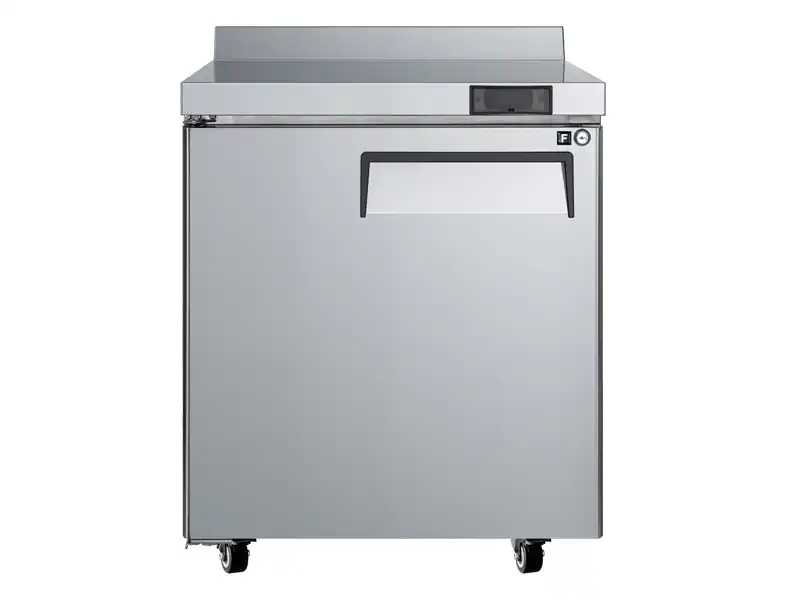
A refrigerator on castors seems like a simple upgrade until you watch a unit that wasn’t engineered for mobility develop door misalignment and compressor vibration after a few months of daily repositioning. The benefit is real: you can move the workstation to support different service periods or pull it out for deep cleaning in seconds. But the longevity difference between a unit built from the start as a mobile workstation and one that simply had wheels bolted onto a standard frame is substantial. I’ve walked through enough factory repair logs over 26 years to know that castor-related failures almost always trace back to the base frame, the castor mounting, or how the cooling system handles movement stress.
Why Commercial Kitchens Are Moving to Castor-Equipped Refrigerators
The space underneath a fixed worktop refrigerator typically becomes a collection point for debris that nobody addresses until a health inspection forces the issue. With a castor-mounted unit, one person can roll it away from the wall, clean the floor, and push it back in under a minute. That alone reduces the kind of hidden sanitation risk that accumulates in busy kitchens.
Beyond cleaning, the operational flexibility is what changes the math. A prep station that can be repositioned during lunch service removes cross-traffic bottlenecks between the line and the pass. A catering kitchen that hosts banquets in different halls can wheel its refrigerated worktops directly to the event space instead of ferrying ingredients in pans. In hotel kitchens we supply, the same castor-equipped chef base units get used as a fixed cold-holding station during breakfast and then relocated to a completely different setup for evening banquet prep. That kind of layout reconfiguration simply isn’t possible with stationary equipment without investing in duplicate units.
Not every unit in a kitchen needs castors, but when the work surface also holds temperature-sensitive ingredients, the ability to reposition without emptying the cabinet keeps the cold chain intact and saves labor. It’s also worth considering that floor space in many operations becomes a premium during peak hours. Rolling a seldom-used prep fridge into a corner opens up square footage that matters.
Engineering Factors That Determine a Mobile Refrigerator’s Lifespan
A refrigerator cabinet designed for stationary installation experiences primarily vertical static loads. Put that same cabinet on castors and you introduce twisting forces every time it rolls over a floor joint or threshold. The engineering difference between a unit that tolerates that for a decade and one that fails in under a year comes down to three structural details.
Frame Reinforcement and Vibration Control
The bottom frame needs a reinforcing plate or welded-in cross channels that distribute the load from the castor mounting points into the cabinet structure. Without it, the constant flex concentrates stress at the screw holes and eventually the sheet metal begins to crack. In units we build for castor installation, the base receives an additional 2 mm thick steel plate with captive nuts for the castor bolts. That plate extends under the compressor compartment as well, where vibration already demands a rigid mount.
Compressor vibration is a separate problem. A compressor mounted on a rigid frame transmits those oscillations through the castors into the floor and back into the cabinet. The damping mounts need to be stiffer than in a stationary unit because excessive play can cause the compressor to shift during movement. We use larger-diameter rubber grommets with a higher durometer rating on castor-ready models, and the copper discharge line gets an extra loop to absorb flex without work-hardening.
How Movement Affects Insulation and Sealing
Foamed-in-place polyurethane insulation is standard in commercial refrigeration, but a cabinet that gets rolled repeatedly subjects the panel joints to shear forces. If the inner liner and outer skin aren’t bonded to the insulation foam across the entire surface, small separations create thermal bridges. Over time, condensation forms inside the panel, the foam saturates, and cooling efficiency degrades.
The manufacturing step that matters here is the foaming jig pressure. If the panels are clamped correctly during the injection process, the foam expands and bonds both skins under compression, forming a monolithic structure. A kitchen operator won’t see this on a specification sheet, but it’s the difference between a unit that maintains its insulation performance after five years of daily movement and one that develops soft spots.
Door alignment is another wear point. Self-closing hinges rely on gravity and a slight rearward tilt. On a mobile unit, the floor isn’t always perfectly level, so the hinges need to tolerate a degree of misalignment without letting the door sag open. We test all castor-equipped units by rolling them over a 3 mm floor differential twenty times and checking door seal compression afterward. If the gasket loses contact across more than 20% of its perimeter, the hinge design gets revised.
| Durability Factor | Stationary Unit | Castor-Ready Unit |
|---|---|---|
| Base frame | Standard sheet metal folded edges | Reinforced plate with welded cross channels |
| Compressor mounts | Standard rubber grommets | Higher-durometer grommets, bracing brackets |
| Panel joint bonding | Foam adhesion sufficient for static load | Full-bond foaming under jig pressure to resist shear |
| Hinge tolerance | Level-surface-only design | Tested for 3 mm floor differential without door drift |
| Castor mounting | Not applicable | Captive nuts in steel plate, anti-vibration washers |
Frame design gets less discussion than compressor specs, but <Heavy Duty Chef Base Refrigeration for Efficient Commercial Kitchens> explains why reinforced base structures are a prerequisite for any refrigeration worktop that will see constant movement and heavy pan loads. The engineering tolerances that hold up under those conditions are the same ones that prevent castor-induced frame cracking.
How Mobility Changes Kitchen Workflow and Staff Efficiency
When a refrigerated prep table can move, the layout stops being a fixed blueprint and becomes an operational tool. In some OEM projects I’ve worked on, the customer ordered undercounter refrigerators with castors specifically to create a modular hot and cold line that could be reconfigured between breakfast and dinner service. The same sixteen-foot run of equipment that served omelets in the morning became a chilled seafood station by evening, all without additional capital expenditure.
The labor savings are measurable even in smaller operations. A chef working a sauté station who can pull a chilled ingredient drawer within arm’s reach reduces steps that add up over a twelve-hour shift. In a shared commissary kitchen, different tenants can roll their dedicated refrigeration into their prep area at the start of their shift and return it to a common cold-holding zone afterward. That kind of workflow would be impractical with hard-plumbed, stationary units.
There’s also a safety dimension. Fixed refrigerators often create narrow corridors that force staff to squeeze past each other with hot pans. Opening up those pathways by repositioning equipment even a few inches reduces the kind of incidental contact injuries that don’t get reported but affect morale and speed.
For kitchens that already use integrated worktop refrigeration, <Optimizing Kitchen Efficiency with Integrated Worktop Refrigeration> covers how castor-equipped worktops can be rotated seasonally to match menu changes without the expense of a full kitchen renovation. The ability to run different prep zone configurations for summer versus winter menus often justifies the incremental cost of castors within the first year.
If you’re planning a kitchen remodel and want to understand how castor-equipped refrigeration could reduce walking distances in your specific layout, our engineering team can review a floor plan and suggest unit placements that shorten the most common staff movements. Reach out at Sales@hzcamay.com with your dimensions and we’ll map the workflow gains.
Selecting the Right Castors and Load Capacity for Your Unit
The castor is not a universal part. Choosing the wrong diameter, material, or load rating leads to floor damage, difficult rolling, or outright failure.
Load rating. Each caster must support at least one-third of the fully loaded unit weight. A Camay MTR-60 undercounter refrigerator weighs about 94 kg empty and can hold over 200 kg of product. Distributing that across four castors means each needs a minimum rating of roughly 100 kg to maintain a safety margin. Manufacturers typically provide both static and dynamic load ratings; the dynamic rating is the governing number because the load shifts during movement.
Caster diameter. Small castors concentrate floor pressure and struggle on grout lines or uneven tile. A 50 mm diameter is a practical minimum for tile floors; 75 mm is better for concrete with expansion joints. Larger diameters also reduce rolling effort, which matters when a staff member pushes the unit several times a day.
Wheel material. Polyurethane wheels are the best general-purpose choice. They carry high loads, resist most kitchen chemicals, and protect tile floors better than hard rubber. Natural rubber grips well but can flatten under sustained heavy load. Nylon wheels are durable but unforgiving on tile and generate noise.
Locking mechanism. A castor with only a wheel brake can still swivel, which means the unit can shift sideways even when the brake is engaged. A total-lock castor that locks both the wheel and the swivel bearing is worth the extra cost. On heavy units, we recommend at least two diagonally opposite castors with total lock.
Floor compatibility. Before ordering, verify the floor material and surface flatness. Castor-equipped units on sheet vinyl with a soft underlayment will create ruts. Over time, those ruts make the unit harder to move and compromise the door seal by introducing a permanent tilt.
Selecting a castor-ready chef base means evaluating these details upfront. <How to Choose the Best Chef Base Refrigerator for Your Kitchen> walks through the load-bearing considerations that apply equally to castor mounting: the frame structure must be verified for the additional stress of mobility, especially when moving the unit with full drawers of heavy proteins.
Load Rating and Floor Compatibility
Misjudging load distribution is the most common cause of early castor failure. The assumption is that total weight divided by four is a safe per-castor load, but that ignores the impact loading when a unit rolls over a threshold and momentarily loads just two castors. A safer rule is to specify castors rated for at least half the total loaded weight as the individual capacity, or to confirm with the manufacturer that the frame’s mount points have been tested for overload.
Floor drains and slopes create an additional complication. Even a 1% slope, common in commercial kitchen floors, shifts the weight distribution toward the downhill castors. If the unit will spend most of its time on a sloped surface, the downhill-side castors should be selected with higher load ratings and total-lock brakes.
Installation and Maintenance Considerations for Movable Refrigeration
Once the unit is on site, a few installation disciplines extend service life dramatically.
Leveling. After positioning the unit in its intended working location, check the door alignment. If the door doesn’t close firmly and register a consistent gasket seal, adjust the floor area or use leveling shims under the castors. A door that leaves even a 2 mm gap increases compressor runtime by 15 to 20 percent because cold air leaks continuously.
Power cord management. A trailing cord on a movable unit is a trip hazard and a potential damage point. Use a retractable cord reel mounted to the unit or a nearby wall, or route the cord under a protective cable cover if the unit will move along a defined path. The plug connection should be easily accessible so staff can disconnect before moving—this avoids the common mistake of pulling on the cord to move the unit.
Castor inspection routine. Once a month, check that the mounting bolts haven’t loosened. The combination of vibration and floor impact can slowly back out bolts even when nylon lock nuts are used. Remove debris from the wheel treads and check that the swivel bearings still rotate freely. If a castor develops a flat spot, replace it immediately; a non-rolling wheel changes the load distribution and overstresses the adjacent castors.
Floor protection. If the unit travels over the same path multiple times daily, consider applying a thin sheet of stainless steel or polycarbonate floor protection along that route. The upfront cost is modest compared to replacing cracked quarry tile.
Real-World Applications and Making the Switch
Banquet and catering operations were the earliest adopters of castor-equipped refrigeration, and they remain the clearest case for the investment. When a hotel kitchen services a ballroom that’s 100 meters from the main cold room, wheeling a fully loaded chef base to a temporary satellite prep area eliminates trips and keeps food at safe temperatures throughout service. The Camay MAR-60A chef base, with its one-piece stainless worktop and 4-inch castors, handles that kind of daily repositioning without developing frame stress.
Ghost kitchens and shared commissary spaces also benefit disproportionately. Tenants who rent space by the hour often need to bring their own refrigeration into a prep bay and remove it afterward. A castor-equipped undercounter refrigerator with a locking door and a sealed electrical connection lets operators set up and break down in minutes while keeping their inventory secure between shifts.
For permanent restaurant kitchens, the decision usually hinges on whether the layout will change seasonally or for special events. If so, adding castors to a single worktop or chef base creates flexibility without committing the entire equipment line to mobility. The incremental cost of factory-installed castors on a unit like the Camay MTR-60 is a fraction of what a reconfiguration would cost later.
If you’re evaluating whether a mobile refrigeration setup makes sense for your operation, start with the floor and the frame. We regularly help partners confirm load ratings and suggest reinforcement options based on their specific models. Send your floor type and the weight of your typical storage load to Sales@hzcamay.com or call +8618157202219, and we’ll walk through the engineering requirements together. A refrigerator that moves should be built to move—not just converted to move.
Common Questions About Refrigerators on Castors
Can I add castors to my existing undercounter refrigerator?
That depends entirely on whether the base frame was designed to accept castor mounting. A standard undercounter unit typically has a thin-gauge bottom panel and may not have threaded inserts or reinforced points for bolts. Drilling into an unreinforced panel concentrates stress and can crack the metal over time. If the manufacturer offers a factory castor option for that model, retrofitting is possible but should be done with the manufacturer’s specified kit. Without that, the unit’s warranty may be voided. Before modifying a cabinet, confirm with us whether your model’s frame can support the additional stress—contact us with the serial number and we’ll check the original engineering specifications.
How much extra maintenance do castor-equipped refrigerators really need?
Mostly visual inspection and bolt tightening. The additional tasks beyond a stationary unit are: checking castor bolts monthly, removing accumulated debris from wheel treads, and confirming the locking brakes still engage firmly. The cleaning access advantage often offsets this because staff are more likely to clean behind and beneath a unit they can move easily, which reduces condenser dust buildup and improves thermal performance. The only maintenance surprise we see in the field is that kitchen staff sometimes use the unit as a step stool because it feels solid, which it isn’t designed to handle—a point worth including in training.
Can I use a refrigerator on castors on a tiled floor without cracking it?
With the right castor selection, yes. Polyurethane wheels with a diameter of at least 50 mm distribute the load enough to protect standard quarry tile, provided the floor was installed properly without hollow spots. Avoid rolling the unit over individual loose tiles, and never push it at high speed across grout lines. If the floor has significant undulations, larger-diameter castors or a steel floor track are advisable. The weight of a fully loaded unit on four small rigid casters can concentrate enough pressure to crack even industrial tile, so wheel specification and floor assessment go hand in hand.
Do the locking brakes on castors make the unit completely stationary?
They prevent rolling, but the unit can still shift a few millimeters if someone leans against it heavily. Total-lock castors that lock both the wheel and the swivel bearing reduce this lateral movement, but they don’t anchor the unit to the floor. In applications where absolute stability is required—like a glazing station where precise hand movement matters—it’s better to position the unit on a level surface and, if needed, use rubber anti-vibration pads under the castors to increase friction. The brakes are designed to hold the unit in place during normal use, not to eliminate all movement.
What’s the biggest mistake I can avoid when specifying a mobile refrigerator?
Assuming any unit with castors will hold up. The specification sheet should list the per-castor load rating, the frame reinforcement method, and the floor surface it’s tested for. A unit that rolls easily in the showroom may develop door alignment problems within weeks on a real kitchen floor if the frame wasn’t designed for the stress. Ask the manufacturer for the load rating per caster and whether the unit was tested on a surface that simulates your floor condition. If your current kitchen has a slope or old grout lines, mention those details when you inquire—we often adjust castor size and type based on floor condition to avoid long-term regrets. Share your floor specs with us at Sales@hzcamay.com and we’ll help you spec the right configuration from the start.
If you’re interested, check out these related articles:
Essential Maintenance Tips for Your Commercial Chef Base Refrigerator
Boost Efficiency Energy Efficient Chef Base Units for Commercial Kitchens
Essential Commercial Chef Base Fridge Installation Tips
Boost Kitchen Efficiency Workflow Optimization with Chef Base Fridges