
A pizza prep table’s rail design determines how many toppings a cook can reach without moving their feet and how fast they can build pies during a rush. The choice between a raised rail and a flat top is not cosmetic. It directly shapes throughput, ingredient recovery, and how the table integrates with the rest of the kitchen. In 26 years of building and shipping commercial refrigeration equipment for pizzerias, we have seen operators get this wrong because the spec sheet hides the raw ergonomic difference: raised rails prioritize capacity and speed for high-volume lines, while flat tops favor visibility, cleanability, and open-kitchen aesthetics. The right answer depends on your pizza volume, your physical layout, and whether the table faces customers.
How Rail Design Affects Pizza Throughput
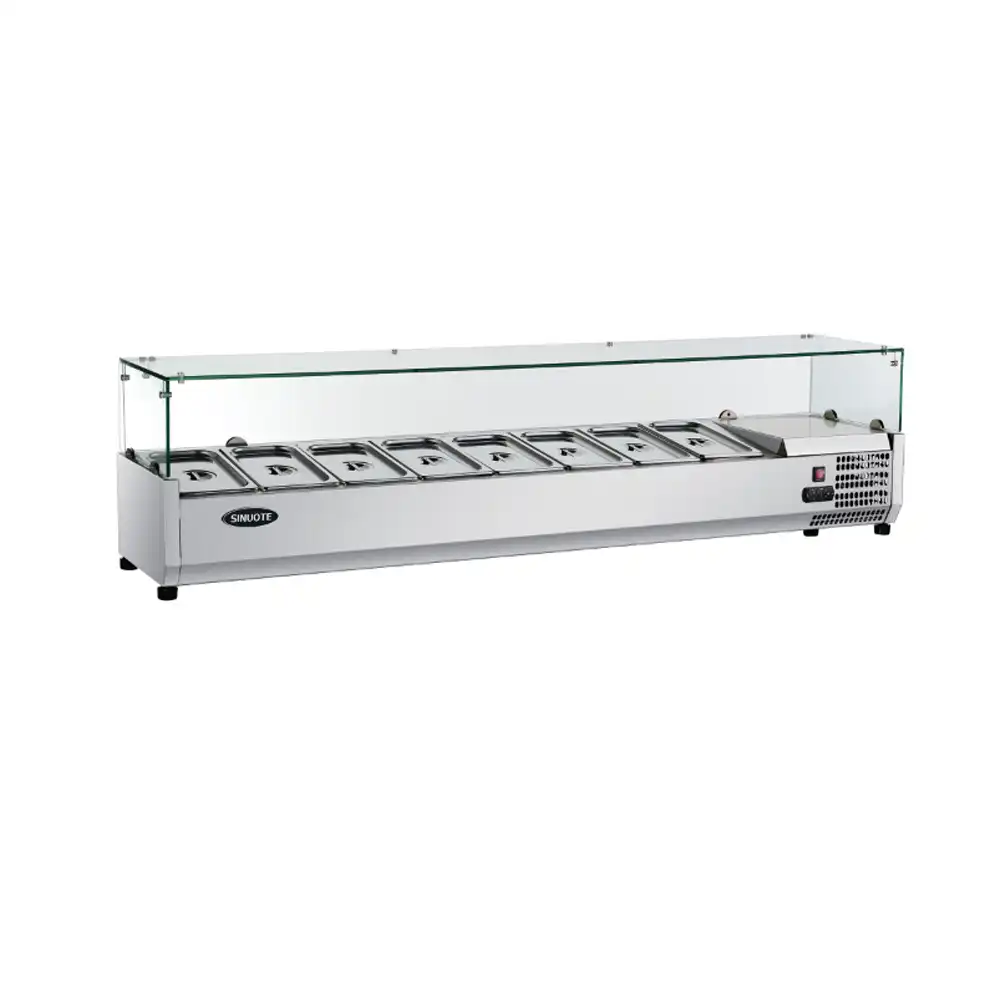
A raised rail sits 3–6 inches above the worktop surface, creating a recessed basin for ingredient pans. The cook reaches over the rail to scoop toppings. This upward lip effectively extends the refrigerated ingredient zone without consuming the flat work area. For a high-volume pizzeria, that means more SKUs within arm’s reach: a standard 60-inch table with a raised rail can hold four to six additional GN 1/3 pans compared to its flat-top equivalent because the pan rail real estate sits above the deck rather than beside it.
The trade-off is a slightly higher reach angle. For a cook under 5’6″, repeatedly dipping over a 6-inch rail during a four-hour dinner shift can load the shoulders. In our manufacturing plant, we test workflow simulations with different table heights and rail profiles, and we have found that raising the table deck from a standard 34-inch height to 36 inches largely neutralizes the reach disadvantage for shorter staff while preserving the pan-capacity benefit. If you are spec’ing raised-rail tables for a line that runs at 90–120 pies per hour, that additional pan inventory often saves a mid-rush replenishment stop—one less interruption buys you 30–40 extra pizzas per shift.
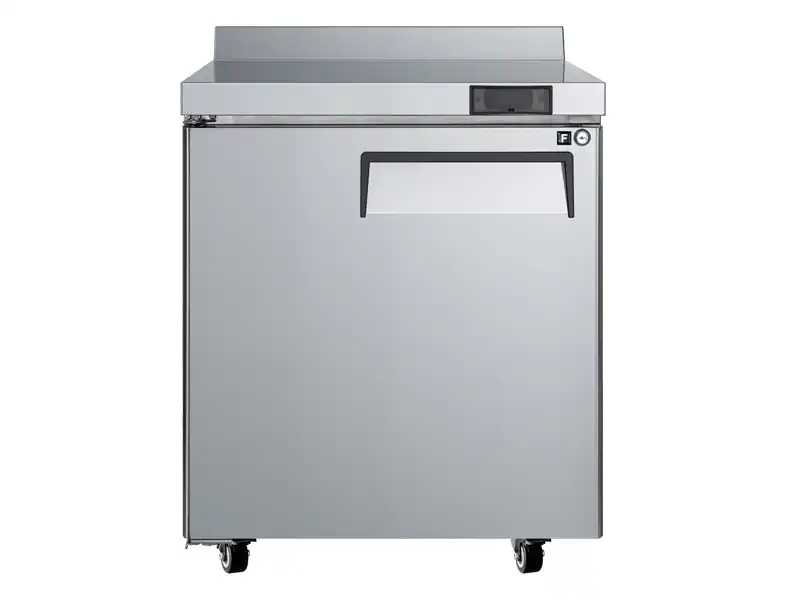
Flat-top tables keep the rail flush with the work surface. The ingredient pans sit flush inside cutouts, and the deck height is uniform. This configuration reduces reach effort and allows the cook to scrape stray cheese or sausage directly back into the pan with a bench knife because there is no lip to block the motion. That lean workflow matters in an open kitchen where every second of ingredient waste and every motion is visible to the customer.
Flat-top tables optimize for visibility and lean motion. <Optimizing Kitchen Efficiency with Integrated Worktop Refrigeration> examines how flush-deck designs reduce cross-contamination risk and speed up cleaning between rush periods, which is important when the prep line sits in view of the dining room.
Refrigeration Differences That Change Ingredient Shelf Location
Both raised-rail and flat-top pizza tables use forced-air cooling, but the cold air path differs. In a raised-rail table, the evaporator fan pushes chilled air through a duct that runs behind the rail, with vents positioned to blow across the bottoms of the ingredient pans. Because the pans sit above the main cold compartment, they rely on conductive cooling from the rail’s ducted air and direct contact with the cold pan sleeves. The lower cabinet, typically a standard reach-in section, cools separately via air circulating through the evaporator housing.
Flat-top tables simplify the air path. The entire cabinet, including the well that holds the ingredient pans, shares the same cooled volume. Cold air floods from the evaporator into the cabinet and rises through the pan cutouts. This creates a more even temperature gradient from the cabinet floor to the top pan rail, but it also means that opening the lower door for dough retrieval dumps cold air from both the cabinet and the rail zone simultaneously.
In a raised-rail design, the rail’s pan temperature typically runs 3–5°F warmer than the lower cabinet because the rail is farther from the evaporator and partially sealed. This slight temperature split is usually acceptable for most toppings—cheese, pepperoni, olives—but becomes a concern if you store high-moisture grated cheese or seafood toppings in the rail during slow periods. We recommend verifying rail pan temperature with a probe during commissioning, especially on tables installed near hot make line equipment or under heat lamps.
Flat-top tables tend to hold pan rail temperatures closer to the cabinet setpoint of 33–35°F because the pans sit directly in the main refrigerated envelope. The trade-off: each time the door opens, warm air infiltrates the rail pans faster than it does on a raised-rail design, which means flat-top tables benefit more from self-closing doors and door-in-place discipline during rush. Our Camay models across both rail styles use R290 refrigerant and polyurethane/cyclopentane foam insulation to keep recovery times short, but the physical layout still dictates how quickly the rail zone drops back to safe holding temperature after the door closes.
Comparing Raised Rail and Flat Top Pizza Tables
A direct specification comparison helps purchasing teams see where the two designs diverge beyond the rail profile.
| Feature | Raised Rail Pizza Table | Flat Top Pizza Table |
|---|---|---|
| Pan rail position | 3–6 inches above work surface | Flush with work surface |
| Ingredient pan count (60-inch deck) | Typically 10–12 GN 1/3 pans | Typically 6–8 GN 1/3 pans |
| Rail temperature recovery | 15–20 minutes after door open | 10–15 minutes after door open |
| Reach ergonomics | Higher reach; works best with 36-inch deck height or taller cooks | Lower reach; comfortable for most cook heights at standard 34-inch deck |
| Cleaning effort | Lip traps flour and debris; rail must be wiped from both sides | Smooth surface; swept directly into pans or trash |
| Best suited for | High-volume production, large menu, limited line width | Open kitchens, fast-casual, single-cook stations |
| Worst-case failure | Shoulder fatigue in shorter staff, ingredient spoilage at rail edge if airflow partially blocked by overpacked pans | Overfilled pans broken by door slams, slower recovery when door is left open during rush |
Neither design is universally superior. The decision hinges on what your line’s bottleneck really is: the speed at which a cook can access a specific topping, or the speed at which the kitchen can replenish pans without compromising temperature.
Customization Options That Tailor the Table to Your Pizza Operation
Pizza tables are not off-the-shelf commodities. Over two decades of OEM and ODM manufacturing, we have configured tables for pizzerias with exacting requirements that generic catalogs do not address. The most impactful customization points center on pan layout, rail height, and the marriage of the prep table to a coordinated refrigeration line.
Pan well configuration is the first decision. Standard tables come punched for GN 1/3 pans, but that size makes sense only if your topping usage rate matches the pan volume. A high-volume pepperoni station might need a full GN 1/6 pan well to hold more pepperoni without increasing the station footprint, while an artichoke heart or anchovy station that moves 10 servings per day might need only a 1/9 insert to avoid wasting rail space. We have built tables with mixed pan well sizes on the same rail so that the operator’s fastest-moving toppings get the largest cavities. On a raised-rail design, this customization can add two to three pan positions without lengthening the table.
Rail height itself is adjustable on many Camay models. A standard 4-inch rail works for most kitchens, but we have shipped tables with shallow 2-inch rails to open-kitchen concepts that want the ingredient display more visible to customers, and deep 6-inch rails to high-volume delivery-only operations that cannot risk a pan sliding out during a fast scoop. This is a functional decision, not an aesthetic one: too low and a cook’s quick scoop sends mozzarella onto the floor; too high and the rail blocks the cook’s sightline to the cutting station behind them.
The third customization that often gets overlooked is base configuration. Many pizzerias run a continuous line where the pizza prep table sits adjacent to a chef base or an undercounter refrigerator that supports the same cook. We manufacture matching chef bases—such as the Camay 60-inch Countertop Refrigerated Chef Base—that share the same deck height, finish, and castor dimension as the pizza table, so the cook can slide a fully dressed pie from the prep station to the hot line without a change in surface elevation. This integrated approach reduces motion waste and keeps the ingredient flow linear: cold prep on the left, hot finish on the right, and no step in between.
When a seamless work line matters for speed, <Boost Kitchen Efficiency Workflow Optimization with Chef Base Fridges> explores how matching the height and edge profile of adjacent refrigeration units removes the small but cumulative motion delays that eat into peak-hour throughput.
What Pizza Operators Frequently Ask About Rail Design
Which rail design holds temperature better during a Friday night rush?
Neither design holds temperature better by default. Raised-rail tables isolate the rail pan zone from the lower cabinet, so door openings affect rail temperature less immediately, but the rail itself runs slightly warmer. Flat-top tables flood the entire cabinet with cold air, which gives more consistent pan temperatures when the door stays closed, but a door left open during a rush hits the rail zone harder. The deciding factor is door discipline: if your cooks are trained to close doors between dough pulls, a flat-top table recovers faster than a raised rail because the entire air volume is involved in cooling. If the door stays open, the raised rail’s partial air seal buys more time before toppings cross 41°F.
Are raised rail tables harder to clean at the end of the night?
Yes, because the rail lip creates a crevice where flour and cheese dust collect. On a flat top, a bench scraper clears the entire surface in one pass. On a raised rail, the cook must wipe the lip face facing the worktop and the inside face of the rail separately. However, the extra 90–120 seconds of closing cleaning is usually not the reason to avoid a raised rail—throughput gain during service dwarfs the cleaning time cost. If sanitation speed is a priority, specify tables with a removable rail cover that pulls off for deep cleaning, which we offer as a factory option on larger runs.
Can I mix raised rail and flat top tables on the same pizza line?
Common practice in high-volume pizzerias with multiple stations. The primary topping station, where the line leader builds the base and spreads cheese, gets the raised rail because this station consumes ingredients fastest and needs the largest pan inventory. The finishing station, where fresh basil, specialty cheeses, or post-bake garnishes are applied, often uses a flat top because the topping turnover is lower and the cook values the clear line of sight to the oven. Running both on the same line requires careful deck height matching. If the raised rail table uses a 36-inch deck and the flat top uses 34 inches, the difference becomes a tripping hazard and a motion break that disrupts flow. We strongly recommend standardizing deck heights across all stations on a single cook line, even if that means raising the flat-top table with taller castors or integral legs.
How do I size the pan rail for a menu with 30 different toppings?
Most pizzerias with 30-plus toppings do not need 30 active pan positions during service. Categorize toppings into high-, medium-, and low-velocity SKUs. High-velocity toppings (mozzarella, pepperoni, sausage) get their own dedicated full-size pans on the rail. Medium-velocity toppings (onions, green peppers, olives) can be paired in divided pan inserts. Low-velocity toppings (artichokes, anchovies, truffle oil) stay in the lower reach-in cabinet and are pulled up only when ordered. This three-tier system lets a 60-inch raised-rail table support a 30-topping menu comfortably with 10–12 pan positions, while a flat top may need a second satellite table or a topping caddy placed nearby. We have designed mixed-insert rail layouts for operators who know their sales mix precisely, and the conversation usually starts with a spreadsheet of topping usage rates per week.
If your pizza volume is climbing and you are unsure whether a raised rail or flat top will hold up under the load, share your peak-hour pie count and current line dimensions with us. We can confirm whether a standard configuration fits or whether a mixed-rail build makes more sense for your back-of-house. Reach our engineering team at Sales@hzcamay.com or call +8618157202219 to discuss your requirements.
If you’re interested, check out these related articles:
Ultimate Buyers Guide for Commercial Reach In Refrigerators
Essential Maintenance Tips for Commercial Reach In Refrigerators
Boost Kitchen Efficiency Workflow Optimization with Chef Base Fridges
Boost Efficiency Energy Efficient Chef Base Units for Commercial Kitchens