
A salad bar that moves customers quickly during the lunch rush depends less on how you arrange the lettuce and more on the refrigeration equipment layout that supports your staff. I’ve walked production lines for commercial refrigeration equipment for over twenty years, and the kitchens that get speed right treat their salad station as an engineered workflow, not a garnish display. The faster the service, the more the choice of undercounter units, prep table pan depth, and temperature stability directly cuts the seconds that add up to long lines. This article explains how selecting and positioning the right refrigerated equipment turns a slow salad bar into a throughput machine.
Where the Real Slowdown Happens
Most advice about salad bar speed focuses on which bin the tomatoes go in, but that ignores the two biggest hidden drags: restocking trips and temperature recovery. When a shallow hotel pan runs dry, a cook walks to a distant reach-in refrigerator, loses 20–30 seconds, and the line stops. When a lidless pan sits on a table without active cold air circulation, the ingredients warm up by a few degrees within thirty minutes, forcing the staff to replace pans early before the customer even notices—another interruption.
The fix is not a different arrangement of the same pans; it is refrigeration that keeps the ingredients where the staff needs them and holds the temperature without constant adjustment. In my experience with Camay’s OEM manufacturing, kitchens that reduce walking distance and cold-holding failure cut salad bar throughput time by a measurable 15–20 percent during peak hour.
Speed at the salad bar starts with equipment that keeps ingredients at the point of use. <Optimizing Kitchen Efficiency with Integrated Worktop Refrigeration> covers how combining work surfaces with high-capacity refrigeration lets staff prep, store, and serve from one position, saving the two to three trips per hour that kill momentum.
Choosing a Refrigerated Prep Table That Moves with Your Staff
Not all salad prep tables are built for speed. The two features that determine how fast a team can work are pan compatibility and cold-air recovery. A table designed around GN 1/3 or 1/6 pans lets you pre-portion ingredients in standardized containers so the morning prep team loads them quickly and the line staff swaps empty pans in a single motion. The Camay MSR-48M salad prep table, for example, uses a ventilated cooling system with automatic defrost and a temperature band of 0.5°C to 5°C (33°F to 41°F), which is tight enough to hold cut greens, dressings, and proteins without the compressor cycling into a warm zone every time a lid is opened. That matters: if the air temperature spikes three degrees after a pan refill, recovery time eats into service speed.
A table that accepts deep pans also helps. A 100mm-deep pan holds enough product for an hour of lunch service in a 50-seat restaurant, so the staff refills during natural lulls rather than on demand. The difference between six refills per hour and two is often the difference between a line that keeps moving and one that stalls.
Positioning the Salad Station to Cut Steps
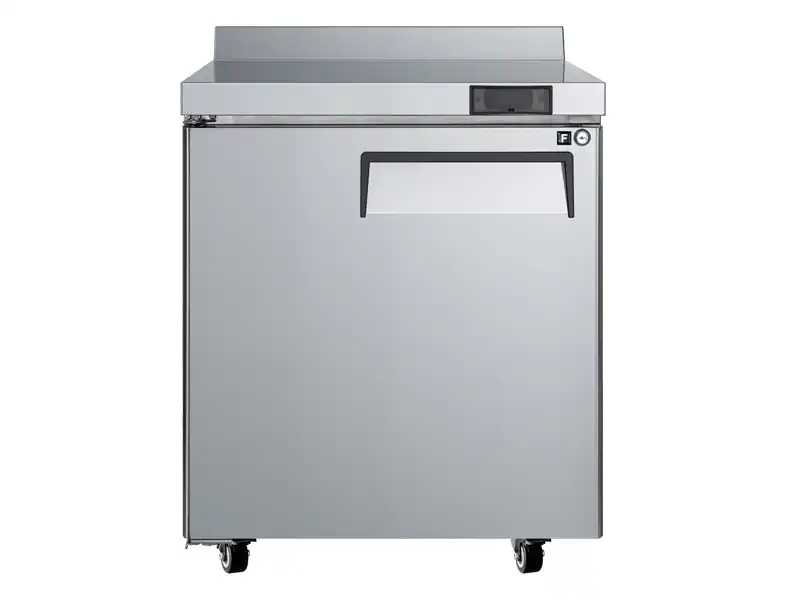
The distance between the salad bar and the backup refrigeration dictates how fast a missing ingredient gets restocked. The ideal layout puts a chef base refrigerator or an undercounter unit directly under the salad counter so the line cook can reach down for extra containers without leaving the station. The Camay MAR-60A 60-inch countertop refrigerated chef base, with 117 liters of capacity and a flush-integrated worktop with a drip-resistant V edge, keeps backup ingredients at the same 0.5°C to 5°C zone literally within arm’s reach. In kitchens I’ve advised, switching from a reach-in cooler ten feet away to an undercounter chef base under the salad station cut restocking time by two-thirds.
When choosing between an undercounter fridge and a chef base, the decision affects how your crew moves. <Chef Base Fridge vs Undercounter Fridge Which Is Best for Your Kitchen> explains the workflow differences in detail, and why a chef base’s solid worktop handles the weight of multiple pan changes better than a standard undercounter unit.
If your salad bar is positioned against a wall, a split configuration with a chef base on one side and a reach-in refrigerated worktop on the opposite side can create a two-sider workflow where the staff never cross paths and the line never stops. The fewer staff steps, the faster the customer moves.
Organizing Ingredients for Single-Motion Access
Once the right refrigeration is in place, the organization of pans inside the cold well becomes a speed lever, not a design choice. The rule I’ve seen work in high-volume buffet settings is simple: high-demand ingredients go within a 45-degree reach cone of the server’s dominant hand, and low-demand garnishes fill the perimeter. With a table like the Camay MSR-48M, which holds multiple GN pans in a top rail, grouping proteins and cheeses together, greens and dressings together, and keeping wet ingredients away from dry croutons prevents cross-contamination and reduces the “where is it?” pause that slows new staff.
A second speed trick is loading each pan with the amount that gets used in exactly 30 minutes of peak service. That number is surprisingly easy to calculate: if you sell 40 salads per hour and each gets 50 grams of diced chicken, you need 2 kilograms of chicken per hour, spread across four pans of 500 grams each. Pre-portioning to that interval means the staff swaps pans on a predictable rhythm, not when the pan is empty. This approach reduces the number of pan replacements per shift and lets the team stay in a flow state.
If you’re running more than 200 covers per day at the salad bar, it’s worth confirming the pan capacity and cold-recovery specs of your current prep table against actual demand. An equipment mismatch here costs you more in service delays than the price difference between a standard unit and one engineered for high-volume work. For a no-obligation spec check, send your service numbers to Sales@hzcamay.com and we’ll verify whether your setup can hold temperature at your peak throughput.
Keeping Temperatures Flat During Rush Hour
Temperature dips are a speed problem masquerading as a food safety issue. When a ventilated refrigeration system pulls warm ambient air every time a lid opens, the evaporator coil works harder and the compressor runs longer, and for a few minutes the pan contents sit above the target zone. If the staff reacts by topping off with ice or swapping pans early, the line slows. The better answer is a prep table with a fan-assisted cold air curtain that keeps the top rail consistently cool even with the lids open. The MSR-48M’s air cooling system and polyurethane/cyclopentane insulation are designed exactly for this: the unit maintains temperature stability without ice baths, so staff focus on serving, not compensating for cold loss.
Regular cleaning of the condenser coil also prevents thermal drift that leads to panic changes. I recommend a quick coil vacuum once a month in high-grease environments, which takes two minutes and reduces compressor strain. If the coil is buried behind a fixed panel, it doesn’t get cleaned. The MSR-48M, like all Camay worktop models, uses a removable gasket and accessible coil design so the task is short enough to actually happen.
Even the best-organized salad bar loses speed if the equipment isn’t maintained. <Essential Maintenance Tips for Your Commercial Chef Base Refrigerator> covers the cleaning and inspection steps that prevent the slow, creeping temperature loss staff don’t notice until the line is backed up.
Building a Salad Bar That Scales from One Shift to Three
Speed gains only stick if they hold up across multiple shifts. That means the equipment layout must make sense for the morning prep team putting away deliveries and the evening crew breaking down the station. Using the same standard GN pans across all refrigerated units—the salad table, the undercounter backup, and the walk-in—means the prep team stacks directly into the rails and no one decants and rewraps. In many kitchens, that single standardization removes twenty minutes of double-handling per day.
The chef base or worktop unit should also sit on casters rather than fixed legs or stainless steel cladding, because a unit that can be pulled out for deep cleaning every quarter will maintain its cold-keeping performance longer. All Camay units, including the MAR-60A and MTR-72 undercounter refrigerators, ship with casters as standard or optional, which makes deep cleaning practical under the tightest schedules.
Questions Kitchens Ask About Salad Bar Speed
How do I calculate the right size refrigerated prep table for my salad bar?
Start with the peak hour number: how many individual salads or plates you serve, multiplied by the average weight of each ingredient per serving. That gives you the total mass of perishable food that must stay cold and accessible. Then pick a table with enough pan capacity and cold-holding volume to cover that mass without refilling. A 13-cuft table like the MSR-48M holds roughly 300–350 servings of prepped ingredients, which covers most 60–80 seat restaurants through a lunch peak.
Does the compressor location affect how fast the staff can work?
Yes, more than most operators expect. Top-mounted compressor units often vent heat upward into the kitchen, which makes the area around the server warmer and can affect the temperature of uncovered pans. Bottom-mounted units with front air intake and side exhaust keep the air curtain cooler and more stable. The Camay worktop line uses ventilated cooling with a front-facing intake design to direct hot air away from the food zone.
Can I use a regular refrigerated prep table for a high-turnover salad bar?
Technically yes, but a table without forced-air circulation and tight temperature recovery will require more manual intervention from staff—adding ice, rotating pans, checking probes—which all add seconds per transaction. A table built with a heavy-duty compressor and efficient insulation pays for itself in speed gains within a few months of consistent busy service.
Should the salad bar refrigeration be on a separate circuit from the kitchen line?
If the salad bar runs three or more door units on one wall, dedicating a circuit prevents a tripped breaker from taking down the entire cold station. It is also worth confirming whether your local electrical code requires GFCI protection for equipment with compressors near a wet prep area. If your build-out involves multiple pieces of plug-in refrigeration, contact us at Sales@hzcamay.com and we can help you size the electrical load based on the specific models you select—getting this wrong is one of the more common installation issues I’ve seen slow down a kitchen opening.
Are there layout configurations that work for a salad bar that shares a wall with a grill station?
Keep the salad refrigeration at least four feet from any direct radiant heat source such as a broiler or fryer. Use a solid stainless steel divider panel if the distance is closer, and orient the salad prep table so the cold air curtain faces away from the heat. A side-by-side configuration with a chef base acting as a thermal buffer between the hot and cold zones works well. If heat bleed is still a concern after a week of use, we can recommend a model with a slightly oversized compressor to handle the ambient load—send a photo of your floor plan to Sales@hzcamay.com and we’ll review the setup with you.
If the salad bar in your kitchen is slowing down service, the organization of the seafood, dressings, and greens probably is not the real problem. The distance your staff walks to restock a pan, the seconds lost to temperature recovery, and the number of times a pan change interrupts the line are all equipment layout decisions first. I’ve seen kitchens with the same menu but different fridge configurations serve 30 to 40 more customers per lunch hour, simply because the equipment supported a faster, smoother workflow. Our engineering team at ZHEJIANG KAIMEI CATERING EQUIPMENT CO., LTD has spent 26 years designing refrigeration that solves exactly these throughput bottlenecks. If you want to adapt your salad bar to deliver faster service, send us your daily covers and a floor layout to Sales@hzcamay.com or call +86 181 5720 2219, and we’ll specify the equipment combination that cuts the wasted steps and keeps your line moving.
If you’re interested, check out these related articles:
Chef Base Fridge vs Undercounter Fridge Which Is Best for Your Kitchen
Upright Freezer vs Refrigerator Key Differences Explained
Ultimate Buyers Guide for Commercial Reach In Refrigerators
Optimizing Kitchen Efficiency with Integrated Worktop Refrigeration
Boost Kitchen Efficiency Workflow Optimization with Chef Base Fridges