

When you’re working behind a bar with less than a meter of clearance, the difference between a door that slides and one that swings out isn’t just a design preference—it’s the difference between a smooth service and a bruised hip. I’ve seen this play out in OEM projects for bars and restaurants across multiple markets: floor plans that look tight on paper become real obstacles once the undercounter units are in place and staff are moving at speed. The door type you choose directly shapes daily workflow, access speed, and how long the equipment holds up.
How Door Choice Affects Your Bar’s Workflow
Most bar operators focus on capacity and temperature control, and that’s completely understandable. But the door mechanism determines how much usable space you actually have on the floor. In a narrow bar, every centimetre of clearance is accounted for. A swing door needs room to open—typically 24 to 30 inches of unobstructed space in front of the unit, depending on the door width. If your walkway is 36 inches wide, a swing door leaves barely a foot to squeeze past. Staff then have to maneuver around an open door while carrying bottles, which is a spill risk and a constant productivity drain.
Sliding doors eliminate that clearance requirement. The door moves within the unit’s own footprint, so you can place a sliding-door undercounter refrigerator flush against the wall or another fixture. This is why we’ve seen a steady increase in demand for sliding-door models in OEM projects targeting small-format bars, hotel minibar setups, and even café back counters. The trade-off is that sliding doors only expose about half the interior at any one time. If your staff needs to grab multiple items quickly, they might be opening both sides repeatedly. That’s not a dealbreaker, but it’s a real operational difference that a spec sheet won’t tell you.
Sliding Doors vs. Swing Doors: A Practical Comparison
Both designs have clear strengths and weaknesses, and they show up in specific ways that matter after months of daily use.
| Feature | Swing Door | Sliding Door |
|---|---|---|
| Clearance required | 24–30 inches in front | None; door moves within cabinet |
| Access width | Full width of compartment | Approximately half of compartment |
| Opening speed | Quick, one-hand pull | Slower; often requires two hands |
| Cleaning (door mechanism) | Wipe hinges; no rail debris | Rail traps dust and spills; needs regular cleaning |
| Self-closing option | Common, via spring hinge | Rare; typically manual close |
| Durability (heavy use) | Heavy-duty hinges tested for cycles | Tracks can bend; quality of rail material matters |
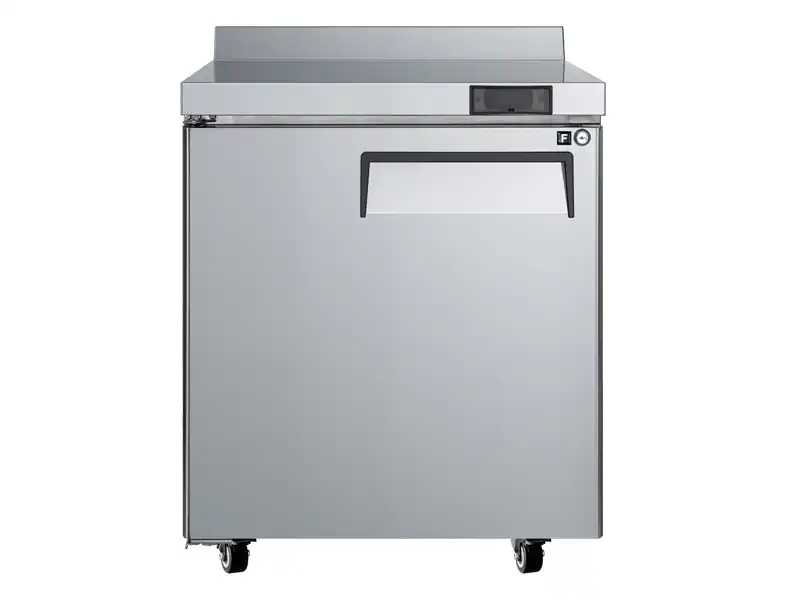
The table confirms what most bar owners already suspect: swing doors win on access and speed, sliding doors on space saving. But these differences compound in real-world use. I recall a small wine bar that swapped a swing-door back bar cooler for a sliding-door unit because the bartender kept hitting the open door during peak hours. The new unit solved the space problem instantly, then created a different one: the lower rail collected lime juice and sugar by closing time and needed a dedicated cleaning step. That’s the kind of trade-off you only notice after living with the equipment.
Placement Considerations for Narrow Bars
The door type also dictates where you can place the refrigerator. With a swing door, you must account for the door swing arc in addition to the unit’s footprint. Reversible hinges are common on commercial units—our MTR series undercounter refrigerators, for instance, allow left or right hinge mounting—but you still need that swing space on whichever side you choose. In a bar, that often means giving up a cabinet location or forcing an awkward traffic pattern around the open door.
Sliding-door units dodge that problem. You can push them against a wall or under a counter with zero door clearance. But many sliding-door models have a taller profile because the track mechanism takes up vertical space above the compartment. If your installation is under a low countertop, measure both the unit height and the overhead clearance for the sliding track. We’ve had project partners order sliding-door units only to find the top track binds against the underside of their bar top. That’s a preventable mistake that a quick clearance check would have caught.
(If your bar layout is tight on space and you’re evaluating between door types, send your floor dimensions to Sales@hzcamay.com and we’ll help you map out the right undercounter unit placement—before you commit to a purchase.)
What to Look for in a Bar Refrigerator Door
The door type isn’t the only variable. Build quality determines whether the door works smoothly for three years or ten. For swing doors, look for commercial-grade hinges made of stainless steel with a self-closing mechanism. A self-closing door cuts the risk of leaving the unit ajar, which directly impacts energy consumption in a busy bar. Our solid-door undercounter refrigerators use self-closing designs and come with a lock and key—important if you store high-value stock like premium spirits.
For sliding doors, inspect the rail material and its mounting. Aluminum rails can bend if hit by a keg or a case of bottles. Stainless steel rails are stronger but still need regular cleaning so the door doesn’t stiffen. The best sliding-door designs use a removable lower track and ball-bearing rollers for smooth motion. Also check that the door seal remains consistent when the door slides shut; a slightly warped track can create a gap that causes cold air loss and higher energy bills.
When a unit gets down to freezer temperatures, the door mechanism matters even more. Frost build-up can jam sliding rails if the seal isn’t perfect. For sub-zero applications, we generally recommend swing doors with heated seals to prevent freeze-up, because a door that won’t close after a busy shift becomes a food safety issue fast.
Maintenance and Long-Term Durability
Both door types need upkeep, but the routines are different. Swing doors require periodic hinge lubrication and gasket inspection. The gasket around the door frame is the quiet hero of efficiency—if it tears or loses its magnetic grip, cold air leaks and the compressor works harder than necessary. Most gaskets are replaceable, and in high-use environments they should be changed every couple of years.
Sliding doors demand a simpler but more frequent habit: daily rail cleaning. Wipe the lower track at the end of every shift, particularly if the unit sits under a tap system where spills are almost guaranteed. I’ve seen a popular draft station positioned directly above a slide-door cooler; within one weekend the track became sticky enough that staff had to yank the door open. A few seconds of wiping between shifts would have prevented the gradual warping that eventually required a new rail. On the positive side, sliding doors have fewer moving parts than a spring-hinge assembly, so there’s less to break over time—provided the rail stays straight and clean.
Choosing the Right Door for Your Bar Layout
If the bar has less than 30 inches of working clearance in front of the undercounter position, sliding doors are the practical choice. The risk of a swinging door becoming a hazard in that space isn’t worth the slightly faster access. But in setups where you have at least 36 inches, swing doors give you quicker full access and tend to be easier to keep clean over the long run. In either case, the door is only as reliable as the material and assembly behind it. Cheap hinges or thin-gauge rails fail early, and a door that won’t close properly turns a $1,500 refrigerator into an ongoing headache.
Over the years, we’ve configured units for bars ranging from high-volume nightclubs to small hotel lobby bars. The right answer always depends on the specific clearance measurements, staff movement patterns, and what you’re storing. If you’re finalizing a bar layout with tight dimensions, we can go over your floor plan together—just send your dimensions and daily capacity needs to Sales@hzcamay.com or call +86 181 5720 2219.
Common Questions About Bar Refrigeration Doors
Do sliding doors require more maintenance than swing doors?
Not necessarily, but the maintenance is different. Sliding doors need the track wiped down daily to prevent debris build-up; if that’s done, the mechanism is fairly simple and long-lasting. Swing doors need less daily attention but require periodic hinge lubrication and gasket replacement. Over five years, the total maintenance effort ends up similar for both types if the unit is built well. The deciding factor is whether your staff will actually clean a track every night—if not, a swing door might be more forgiving in a busy bar.
Can I reverse the swing direction on a commercial refrigerator door?
Yes, on most commercial undercounter units the hinges are field-reversible. Our MTR series refrigerators, for instance, come with reversible doors that can be set to open from the left or right depending on your bar layout. This is useful when the unit sits against a wall, because you can orient the door to avoid blocking the main walkway. Always check the specification or ask the manufacturer before assuming; not every economy model supports it.
What’s the minimum clearance for a swing door refrigerator in a bar?
Plan for at least 24 inches of unobstructed floor space in front of the unit, but 30 inches is more practical if staff are frequently opening the door during service. That clearance isn’t just about the door’s radius—it’s about having room to crouch and reach inside without twisting your back against a wall or another piece of equipment. If the walkway in front is only 36 inches total, that leaves a narrow 6-inch gap while the door is open, which is a tight squeeze and a real bottleneck. In those cases a sliding door removes the problem entirely.
Are sliding door undercounter refrigerators as energy efficient as swing door models?
They can be, but the seal design matters more than the door type. A sliding door that closes flush with a consistent gasket pressure is just as efficient as a swing door with a tight magnetic seal. The efficiency difference shows up when the track gets dirty and the door doesn’t close fully, because cold air seeps out and the compressor cycles on more often. For that reason, restaurants that don’t have a strong closing checklist sometimes do better with a self-closing swing door—the spring takes care of sealing every time without relying on staff. If your bar practices a strict end-of-shift cleaning routine, a sliding door won’t cost you more in electricity. To get the exact energy consumption numbers for your layout, send your configuration details to our team and we’ll recommend the best option.
If you’re interested, check out these related articles:
Essential Maintenance Tips for Commercial Reach In Refrigerators
Ultimate Buyers Guide for Commercial Reach In Refrigerators
Boost Savings with Energy Efficient Commercial Upright Freezers
Essential Commercial Chef Base Fridge Installation Tips