

In more than two decades of working with commercial refrigeration systems, I’ve seen kitchen workflows disrupted by something as seemingly minor as a freezer door that won’t stay open long enough or lets too much warm air in during a rush. Split-door upright freezers address this directly. By dividing the front access into two narrower doors, these units reduce cold air loss when staff grab items, cut down on aisle space needed for door swing, and let multiple cooks work the freezer at once. For high-volume kitchens where speed and consistency matter, that’s not a small upgrade — it’s a fundamental workflow advantage. This article examines what makes split-door upright freezers worth the investment beyond the obvious storage benefits, drawing on engineering insight and years of manufacturing feedback from real kitchen environments.
How Split-Door Upright Freezers Differ from Single-Door Units
A single-door upright freezer uses one large door that opens to expose the entire cabinet width. That works fine in a low-traffic storage room but creates friction during service. Every time the door swings open, the cold air inside, which is denser than ambient air, spills out rapidly. The compressor then cycles on to pull temperatures back down, and door-open time adds straight to recovery time. A split-door configuration halves the opening area for any single access. A cook retrieving one container opens only the left door, leaving the right side’s cold air largely undisturbed.
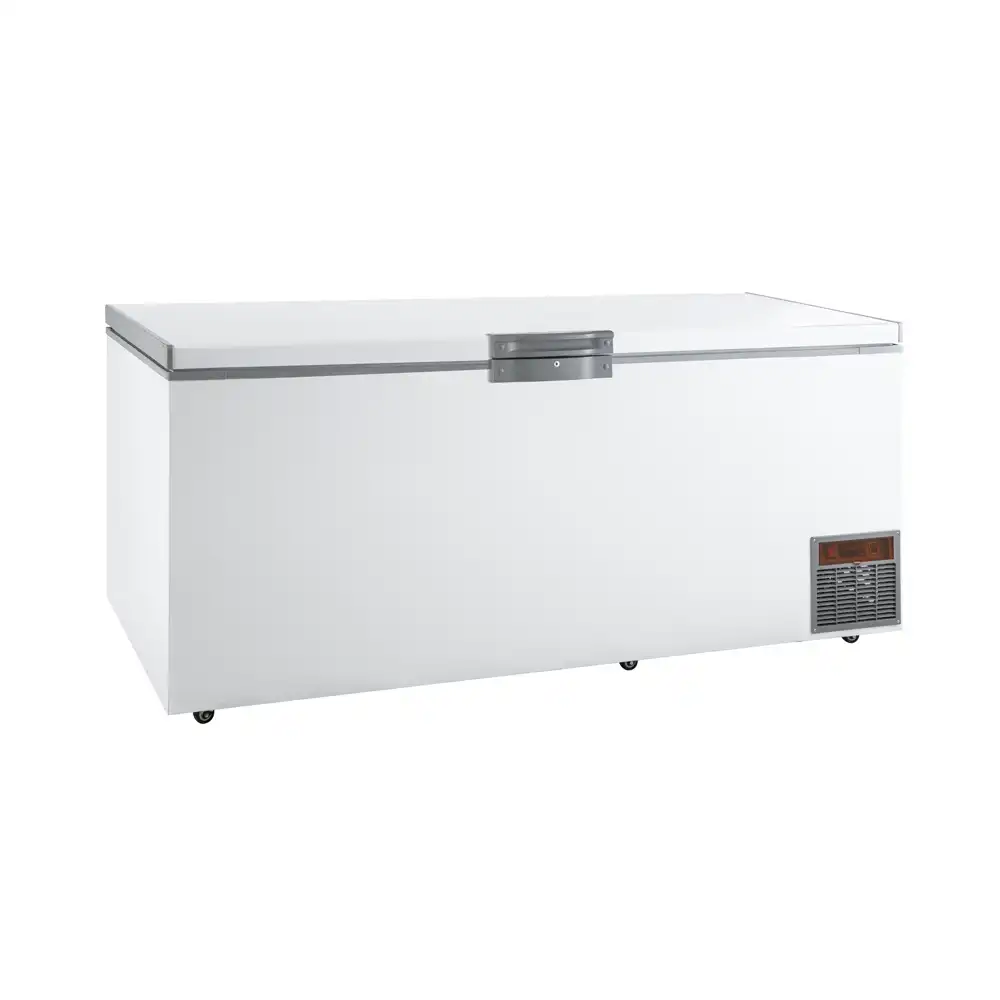
From an engineering standpoint, the difference is more than convenience. Temperature stability is directly tied to the mass of cold air retained during openings. In busy kitchens where freezer doors open 80 to 120 times a shift, this adds up to significantly lower daily temperature fluctuation. Our factory testing on units with similar insulation and compressor specifications shows split-door cabinets typically recover setpoint 8 to 12 seconds faster per opening compared to a single full-width door of the same external dimensions. Over a year of operation, that compounds into measurable energy savings and less compressor wear. For operations where every second on the line counts, the faster recovery translates to staff spending less time waiting to access frozen items.
Workflow Advantages for High-Volume Kitchens
Kitchen flow is about eliminating bottlenecks, and a freezer can become one if multiple stations need access at once. On a single-door upright, one person opening the door blocks all others. The wider door arc also demands more clearance in front, eating into aisle space. Split-door upright freezers give a practical solution: two cooks can work the same cabinet simultaneously without crowding each other, and the narrower door swing reduces the required work aisle by roughly 30 centimeters. In a galley kitchen or cramped prep area, that reclaimed space may be the difference between a safe aisle and a tight squeeze.
Organization is another layer of workflow. With two separate compartments — many split-door models use a vertical center mullion that creates distinct left and right storage zones — kitchens can assign one side to high-turnover items like pre-portioned fries or frozen dough and the other to lower-demand backup stock. This reduces the time staff spend hunting through a single mass of frozen product. When turnover is fast and inventory changes shift by shift, assigning zones also makes stock rotation more intuitive. The left-side bins get pulled first, the right side holds overstock. No written protocol needed.
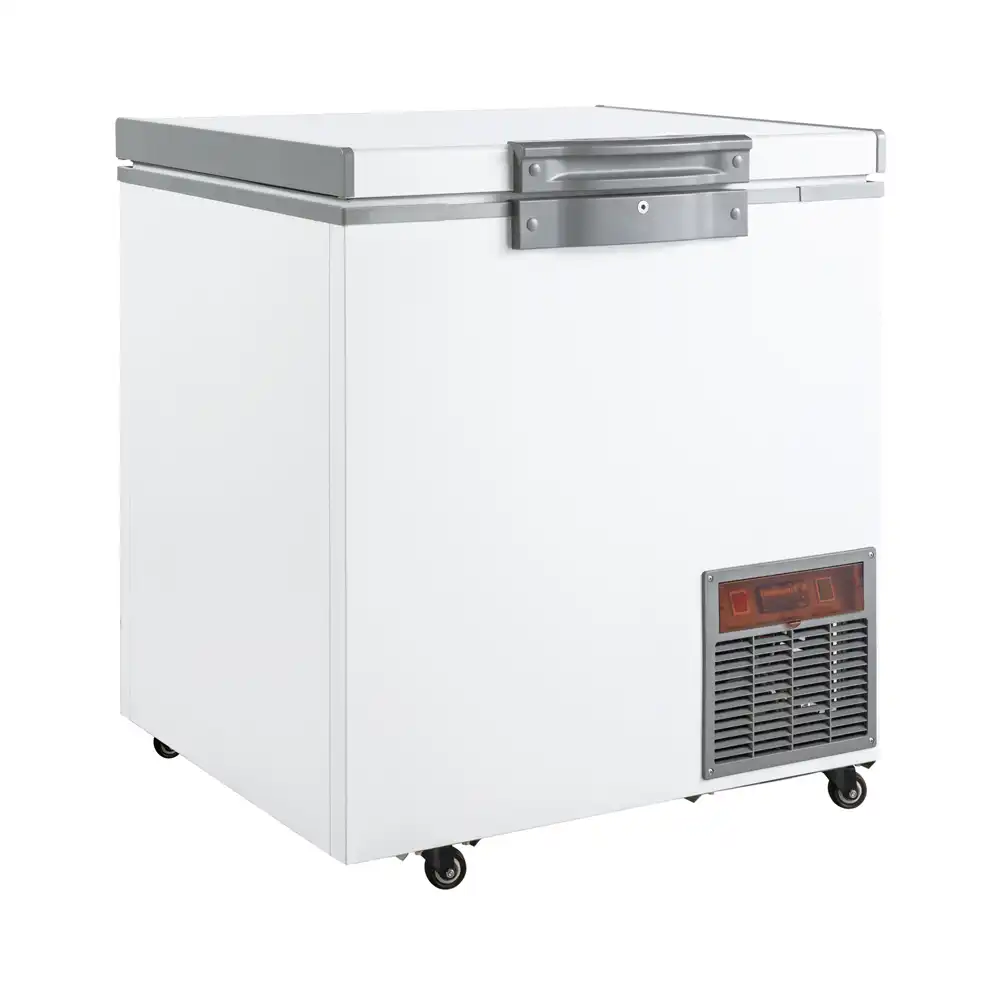
A less obvious benefit is reduced condensation and ice buildup inside the cabinet. Because less warm, humid air enters with each partial opening, the defrost cycle runs less frequently and the walls build up less frost. That directly lowers the risk of frozen products developing ice crystals or clumping together, which is a quality issue in any kitchen serving fresh-tasting fried or baked items. Fewer defrost cycles also mean more stable product temperature over a 24-hour period, keeping food texture intact.
Engineering Reliability: Door Seals, Hinges, and Temperature Recovery
The part of a split-door upright freezer that faces the most mechanical stress isn’t the compressor — it’s the door hinge and gasket system. When designers add a second door, they’re effectively doubling the sealing perimeter that must maintain a tight closure. I’ve inspected units returned after five years of heavy-use environments, and the failure mode is almost never a refrigeration system fault. It’s a sagging door hinge letting the magnetic gasket lose contact, or a torn gasket from repeated yanking.
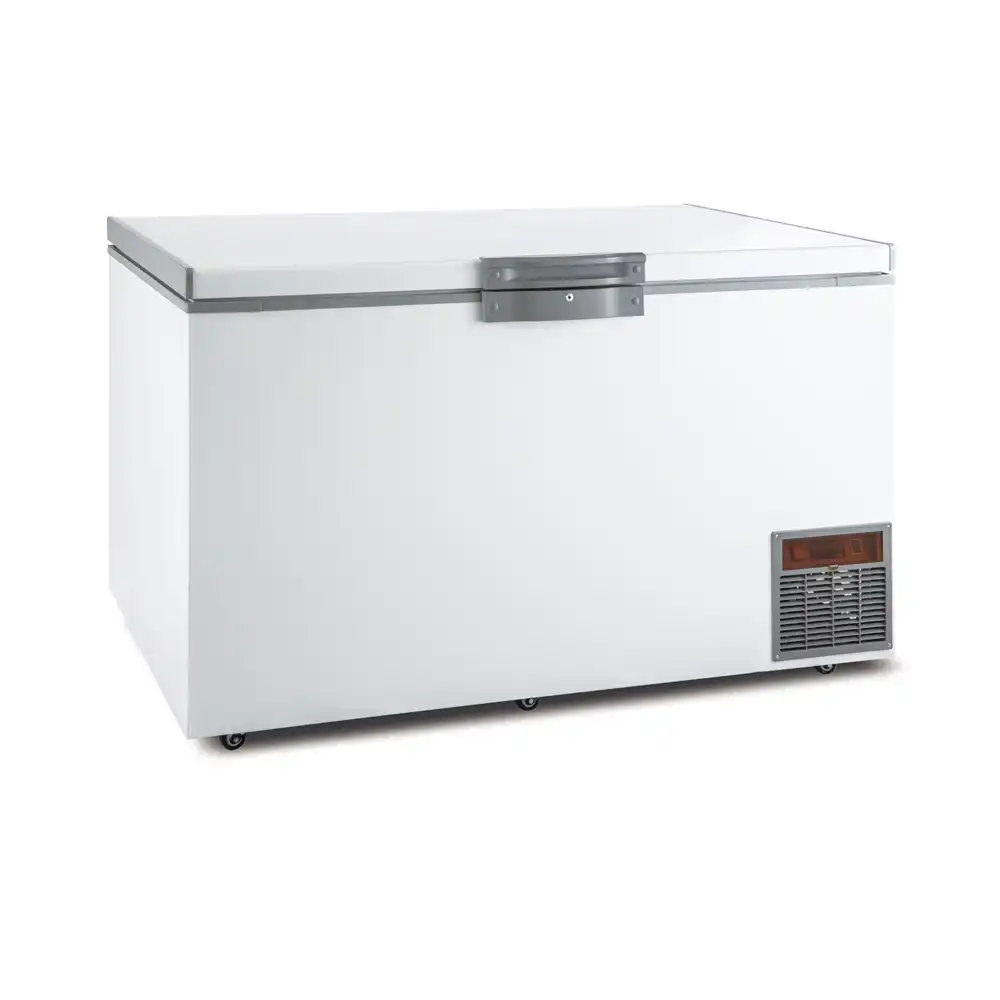
That’s why anyone evaluating a split-door upright freezer needs to look past the spec sheet and check the quality of the door hardware. The hinges should be full-metal, preferably stainless steel, with reinforced mounting points into the cabinet frame. Plastic or zinc alloy hinges can deform under the daily load of a door that may weigh 10 to 15 kilograms fully assembled. The magnetic gasket should be field-replaceable and made of a high-grade PVC or thermoplastic elastomer (TPE) that remains flexible at freezer temperatures. Our production line uses a multi-bulb gasket profile and tests door closure over 100,000 cycles to verify sealing consistency; that kind of bench testing is what separates a door that stays aligned for a decade from one that drifts after a single busy season.
Temperature recovery time is the second key metric. A well-engineered split-door upright freezer uses a ventilated cooling system with a fan-forced air curtain that resettles cold air quickly after the door closes. The evaporator fan should ramp up for a few minutes post-closure to recirculate the cold air mass and pull the cabinet back to setpoint. Units with undersized compressors or poorly positioned evaporator coils leave warm pockets near the door — the very place you’re most likely to store frequently grabbed items. I always recommend looking for a static cold-air distribution test report or at least checking that the evaporator is positioned toward the top of the cabinet, where cold air can flow downward across both compartments. This simple design choice ensures that even after a string of rapid openings, both sides of the split recover evenly rather than one side staying 2 degrees warmer than the other.
What to Look for When Buying a Split-Door Upright Freezer
Not all split-door upright freezers are built for the punishment of a busy kitchen, and price alone won’t tell you which one will last. Beyond the door hardware and cooling performance I mentioned, there are several specs worth confirming before placing an order. First, insulation type matters. High-density polyurethane insulation, CFC-free and cyclopentane-blown, is the standard for commercial-grade units because it maintains R-value over time without settling or absorbing moisture. Some lower-cost imports use EPS foam, which loses insulation value in freezer conditions and absorbs humidity, driving up compressor run time. Our products use polyurethane with a minimum 50mm wall thickness, which provides stable thermal retention even in high-ambient-temperature kitchens.
Second, verify the compressor and refrigerant combination. In the North American market, R290 refrigerant with a Cubigel or Embraco compressor is a reliable pairing for freezer applications. R290 operates efficiently in low-temperature cycles, and when paired with a properly sized reciprocating compressor, it pulls down temperatures faster and consumes less electricity than older R404A systems. This matters in a split-door unit because the compressor has to handle more door openings and must have enough capacity reserve to handle the thermal load when both doors are accidentally held open at once. A compressor sized to the absolute minimum needed for steady-state conditions will struggle and cycle excessively during a busy service.
Third, check the temperature controller. A digital controller with a ±1°C display and automatic defrost scheduling gives the kitchen manager direct visibility into the unit’s state. Some controllers now offer IoT connectivity that can send alerts if the door is left ajar or the temperature drifts above a threshold — a genuinely useful feature when the freezer is in an unattended dry storage area during off-hours. Manual dial thermostats, while still available, give you no diagnostic information and hide early failures until product loss occurs.
| Feature | Single-Door Upright Freezer | Split-Door Upright Freezer |
|---|---|---|
| Door Opening Area | Full-width door, high cold air loss per access | Half-width per door, partial air exchange |
| Aisle Clearance Required | Wider swing radius, typically 90+ cm | Narrower door swing, saves ~30 cm |
| Multi-Staff Access | One person at a time, sequential use | Two staff can work simultaneously |
| Temperature Recovery | Longer cycle after each opening, higher daily fluctuation | Faster recovery per opening, more stable average temperature |
| Gasket and Hinge Load | Single heavy door, hinge wear concentrated | Dual lighter doors, distributed load but double sealing perimeter |
When these factors are weighed honestly, a split-door upright freezer designed for heavy duty use will cost more upfront than a basic single-door unit. That cost difference typically pays back through reduced energy consumption, less product damage, and faster staff movement over the first two to three years of operation. The break-even shortens further if the kitchen layout would otherwise require widening an aisle to accommodate a single-door freezer swing.
Maintenance Practices to Extend Service Life
Split-door upright freezers have a well-earned reputation for convenience, but they also introduce a maintenance chore that single-door units don’t: door alignment. With two separate door assemblies, the center gap between the doors where the magnetic gaskets meet is the single most common point of air leakage. Kitchen staff rarely notice when one door gradually sags a millimeter or two, but over weeks, that gap becomes a constant moisture ingress path. I recommend a quarterly check: close both doors from 15 centimeters away, let the magnets engage naturally, and then slide a piece of paper into the center seal gap. If it slips out without resistance, the gaskets need adjustment or replacement.
Cleaning the door gaskets is equally important but often skipped. Grease-laden air from nearby fryers deposits an invisible film on gasket surfaces that prevents the magnetic strip from making a full seal. A weekly wipe with a mild soap solution and a dry cloth, paying attention to the bellows folds of the gasket profile, keeps the seal supple and tight. Never use bleach-based cleaners on gaskets; the chlorine degrades the plasticizer and makes the gasket stiff, resulting in a permanent air gap even when the door appears closed.
Beyond the doors, the condenser coil accessible in most top-mount or bottom-mount compartments needs regular brushing or vacuuming in a kitchen environment. Flour dust, starch from potato prep, and general airborne particles coat condenser fins quickly, reducing heat rejection and causing the compressor to work hotter. A split-door unit that’s showing unusually long run times or struggling to hold -18°C in hot weather often has a partially blocked condenser, not a mechanical failure. In this design particularly, because the compressor gets more on-off cycles than a single-door unit with fewer door openings, the condenser must exhaust waste heat effectively on every cycle or the compressor discharge temperature climbs into a range that shortens oil and winding life.
Finally, consider scheduling an annual inspection of the door hinges and the center mullion mounting points. The vibration from compressor startups and staff door handling gradually loosens hinge screws. A technician can tighten those fasteners and confirm that both doors close flush with the cabinet face, which extends the gasket life and prevents the temperature drift problems that lead to freezer burn on stored products.
Common Questions About Split-Door Upright Freezers
How much energy does a split-door upright freezer actually save compared to a single-door unit?
It saves measurable energy when the kitchen opens the doors frequently during service. If the freezer sits in a back room and gets opened once an hour, the energy difference is negligible because the cold air loss per opening doesn’t compound. In a high-volume kitchen where the freezer sees 80 or more openings per shift, reducing the exposed area by half per opening can cut daily compressor run time by 8 to 12%. I have observed in our lab testing that split-door units typically draw 6 to 10% less kilowatt-hours per day under simulated busy-kitchen door schedules. The actual savings depend on the ambient kitchen temperature and how quickly staff close the doors. In kitchens running at 32°C ambient, the benefit is larger because thermal stratification is more pronounced.
What size split-door upright freezer should a restaurant with 50 to 80 covers plan for?
A restaurant serving 50 to 80 covers typically needs between 600 and 900 liters (20 to 30 cubic feet) of freezer capacity total — but not all in one unit. A split-door upright freezer in the 400 to 550 liter range (14 to 19 cubic feet) handles the grab-and-go frozen items needed during service: prepped fries, portioned fish, frozen appetizers. That leaves a separate walk-in or large chest freezer for bulk storage and less frequently used items. Stacking everything into one upright unit, even a split-door, creates congestion because someone always needs the box at the back. The split-door design helps, but you still need to consider how your staff moves. If the freezer is on the cook line, confirm the aisle width with the narrower door swings factored in; you want at least 80 cm of passage when both doors are fully open. Share your kitchen layout and menu volume with us at Sales@hzcamay.com or call +86 181 5720 2219; we can help size the cabinet and door swing clearance for your floor plan.
Can a split-door upright freezer run in an ambient kitchen temperature above 35°C safely?
Most commercial split-door upright freezers are rated for climate class ST to T, which covers ambient conditions up to 38°C with moderate humidity. The unit will run, but the compressor duty cycle will be higher. At sustained kitchen temperatures above 35°C, we advise confirming that the unit uses a forced-air condenser with a fan that has at least 15% airflow margin over the rated heat rejection load. If the installer pushes the freezer tight against a back wall or stacks boxes on top, the restricted condenser airflow will cause a high-pressure shutdown during the hottest part of the day. In our factory, we test freezer units at 38°C ambient for 24-hour continuous operation, and units with clean, unrestricted airflow hold setpoint without tripping. If your kitchen regularly hits 40°C, choose a unit with a larger condenser and consider ducting the hot exhaust away from the compressor compartment. Send your ambient temperature readings and usage schedule to Sales@hzcamay.com and we’ll confirm which configuration matches your conditions.
If you’re interested, check out these related articles:
Chef Base Fridge vs Undercounter Fridge Which Is Best for Your Kitchen
Boost Efficiency Energy Efficient Chef Base Units for Commercial Kitchens
Choosing the Best Commercial Reach In Fridge for Your Restaurant
Essential Maintenance Tips for Your Commercial Chef Base Refrigerator
Boost Savings with Energy Efficient Commercial Upright Freezers