

In 26 years of manufacturing commercial refrigeration, I’ve seen too many kitchen operators choose worktop materials based on appearance or upfront price, only to face health code violations or early replacement costs. Commercial kitchen worktop materials must do more than provide a flat surface — they must resist heat, moisture, and aggressive chemical sanitizers without becoming a bacteria breeding ground. When that worktop sits over a refrigerated cabinet, the material goes through a whole different level of stress from condensation and thermal cycling. This guide draws on our factory’s engineering experience to help you evaluate materials against real kitchen conditions, not just showroom promises.
What Are the Most Common Commercial Kitchen Worktop Materials?
Commercial kitchens typically rely on a handful of material families, each with distinct suitability.
Stainless steel Type 304 (18/8 chromium-nickel) is the default in regulated kitchens. It is non-porous, weldable for seamless junctions, and resists acidic foods. When 304 is not enough — around heavy chloride exposure from saline brines or certain cleaning agents — Type 316 adds molybdenum for extra corrosion resistance. Most of our Camay worktop-refrigeration units use 304 stainless steel inside and out, with a No.4 brushed finish that hides scratches and makes wiping down easy. The material readily meets NSF/ANSI 51 requirements for food-contact surfaces.
Granite and natural stone Granite handles high heat and looks upscale, but it is inherently porous. Even after sealing, the sealant degrades under commercial strength sanitizers. Thermal shock from a hot pan followed by a cold water spill can cause micro-cracks, and once those cracks appear, bacteria penetrate deep. Granite is sometimes chosen for bakery or pastry stations where heat is moderate and knife work is light, but it needs regular re-sealing and careful inspection.
Wood — butcher block Still found in heritage butcheries and artisan bakeries, wood is kind to knife edges and offers a warm appearance. Its drawback is absorbency: moisture from wet doughs or cleaning causes swelling and warping. Wood requires frequent oiling with food-grade mineral oil and rapid drying. In a busy kitchen, maintaining that discipline is difficult; we have seen wood tops fail within two years when hygiene protocols lapse.
Solid surface — acrylic and epoxy These engineered materials provide seam-free, smooth surfaces and can be shaped into integrated sinks. They resist most food acids but can scorch above 150°C and discolor from strong sanitizers like iodine-based solutions. Solid surface is more common in front-of-house or light-prep counters than in heavy-duty cooking lines.
Laminate High-pressure laminate over particleboard is the least expensive option. Once the surface layer is scratched or the substrate absorbs moisture, the entire panel swells and deforms. We do not recommend laminate for any station that sees wet prep, hot pans, or repeated cleaning. It is sometimes used in dry storage shelving or office break areas, but that is not the focus here.
| Material | Hygiene (Non-Porous) | Heat Resistance | Impact Resistance | Typical Lifespan | Best For |
|---|---|---|---|---|---|
| Stainless Steel (304) | Excellent | Excellent | Good | 15–20 years | All prep areas, wet zones |
| Granite | Good (sealed) | Excellent | Moderate (brittle) | 10–15 years | Baking, pastry |
| Wood | Poor | Poor | Good | 5–8 years | Butchery, artisan baking |
| Solid Surface | Good | Moderate | Good | 10–15 years | Light prep, front-of-house |
| Laminate | Poor | Poor | Poor | 2–4 years | Dry storage only |
Which Performance Factors Matter Most for Worktop Materials?
Every material is a compromise. For commercial kitchens, four performance factors determine whether a worktop passes or fails in daily use.
Hygiene Non-porosity is the single most important property. A surface that can trap food residues or moisture will grow bacteria, no matter how often it is cleaned. Seams, joints, and corners are the weak link. In our production, stainless steel worktops are fabricated with full-penetration tungsten inert gas (TIG) welds, then ground and polished to a satin finish that leaves no crevices. Coved corners with a 10 mm radius prevent debris collection at the wall junction. NSF/ANSI 51 requires that food-contact surfaces be smooth, free of pits and crevices, and cleanable — a standard that porous or compromised surfaces fail outright.
Durability and heat resistance A pan straight from the stove can exceed 200°C. Stainless steel handles this without visible change; solid surface scorches and laminate delaminates. Repeated thermal cycling is an underestimated failure mechanism. A granite countertop may survive many heat cycles, but one impact from a dropped stockpot can chip the edge. We have seen stone tops in busy kitchens develop crack networks within three years from the combination of thermal stress and impact.
Chemical resistance Commercial kitchens use powerful sanitizers: quaternary ammonium, chlorine bleach, iodine, and acid-based descalers. These chemicals can etch stone sealers, corrode lower-grade stainless steel, or stain solid surfaces. 304 stainless steel maintains its passive chromium-oxide layer against most food-service chemicals; only prolonged contact with chlorides in hot environments calls for 316.
Fabrication quality A material is only as good as its assembly. Welds that are not ground smooth, joints that are not sealed, brackets that create hidden cavities — all become sanitation hazards. When evaluating a worktop supplier, ask about weld finishing, corner radius, and whether the top is built with NSF certifiable standards. Our ISO 9001:2015 certified factory produces worktops with documented quality processes and end-to-end inspection.
How Do Worktop Materials Perform with Refrigeration Equipment?
This is where many standard worktop recommendations fail. Placing a worktop over an undercounter chiller or chef base creates a thermal sandwich: one side cold, the other warm. If the material and the insulation below are not engineered together, condensation forms on the underside of the worktop. That moisture drips down onto the fridge door seal, corrodes hinges, and fosters mold.
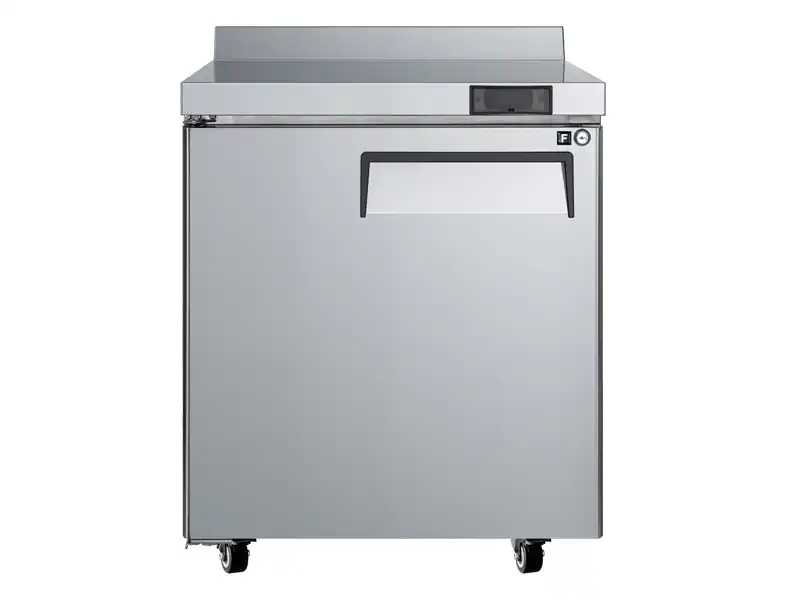
Stainless steel, being a thermal conductor, chills quickly on the underside. Without proper insulation, the top surface can reach the dew point, and water beads appear even on the upper face. In our Camay undercounter worktop refrigerators — the MTR-48 and MTR-60, for example — we integrate a layer of foamed-in polyurethane/cyclopentane insulation between the cold compartment and the top deck, plus a thermal break that prevents the exterior flange from getting cold. That combination keeps the 304 stainless steel top at a stable, usable temperature and stops condensation cold.
Non-metallic materials like solid surface or granite are less conductive but add weight and complexity. A 2 cm granite top over a 1.5 m undercounter fridge can make the unit difficult to move on casters and may exceed the door hinge rating over time. Moreover, if the stone’s underside is not adequately sealed, trapped moisture accelerates spalling. Wood is the worst choice here: constant cold on one side, warm on the other, and the wood warps within weeks.
From our production data, integrated worktop-refrigeration solutions built as a single engineered unit show a condensation-related failure rate below 0.5% over a three-year warranty period. When the top and the cooling system are designed together — insulation thickness matched to the temperature differential, top plate thermally decoupled from the cabinet frame — the result is reliable. Retrofitting a generic worktop onto a standard fridge rarely achieves the same outcome. (If you are planning a kitchen with multiple integrated stations, share your layout with us at Sales@hzcamay.com — our engineers can help specify the right material and insulation scheme to avoid condensation problems before installation.)
What Is the True Cost of Worktop Materials Over Time?
Procurement comparisons usually stop at the price per linear meter. That number feels concrete, but it hides the full story. Over a 10‑year operating window, the lifetime costs for different materials diverge sharply.
Take a 3‑meter worktop. A laminate top might cost $800, but water damage typically forces replacement every 2–4 years. Over 10 years, you buy three tops — $2,400 in material alone, not counting the labor to swap them or the downtime while the station is offline. A granite top might be $2,000 and last 12 years, but with annual resealing at $150–200 and one chip repair at $300, the 10‑year total approaches $4,000. A 304 stainless steel top may cost $2,500 upfront, but it requires no sealing, no special cleaners, and often lasts 15–20 years with only routine wipe-downs. Its 10‑year cost is essentially the purchase price.
Beyond the direct numbers, consider the cost of a health inspection failure. A single citation for a cracked or unsanitary worktop can mean fines, a temporary closure, and reputational damage far exceeding the price difference between laminate and steel. Every operator we have talked to, from single-unit restaurants to international chains, tells us the same thing: stainless steel pays for itself through avoided downtime and compliance confidence.
How Do You Choose the Right Material for Your Kitchen?
Start with an honest map of your kitchen’s activities. Different zones have different demands, and mixing materials can be smart.
High-heat and wet zones Grills, sauté stations, steamer lines — anywhere that combines intense heat with water and sanitizers — stainless steel is the only material that holds up. Choose 304 as a baseline, and consider 316 if your cleaning protocol uses strong chlorinated agents or if the kitchen is near a saltwater coast.
Baking and pastry areas Where heat is moderate and knife work is heavy, wood or granite can work, provided you commit to a strict maintenance schedule. Wood will need daily drying and weekly oiling; granite will need sealant renewal every 12–18 months.
Stations with undercounter refrigeration As covered earlier, go with stainless steel and factory-engineered insulation. If you are mating a separate countertop to an existing fridge, insist on a thermal break layer — typically a 10 mm closed-cell foam sheet bonded to the underside — and gasket all edges to block warm air.
Custom configurations Many kitchens need odd-shaped tops or cutouts for sinks, troughs, and ingredient wells. Stainless steel offers the greatest fabrication flexibility. Our factory regularly produces bespoke worktops with integrated drains, diamond-pattern anti-slip sections, and coved upstands, all cut from 304 alloy. When requesting custom work, provide a CAD drawing and specify the required certifications (ETL, CE, NSF) so the manufacturer can build and document accordingly.
Your supplier should be able to supply full material certifications, weld macro photographs, and third-party test reports. We keep such documentation on file for every worktop unit that leaves our factory, as it is part of our ISO 14001 and ISO 45001 management systems.
Making the wrong worktop material choice eats into your kitchen’s productivity and puts your compliance at risk week after week. With over 26 years of building commercial refrigeration and integrated worktop solutions, we have helped partners around the world specify materials that stand up to the heat, the moisture, and the health inspector. Reach our engineering team at Sales@hzcamay.com or call +86 181 5720 2219. Share your kitchen dimensions and a short description of your workflow, and we’ll recommend a durable, cost‑effective worktop configuration.
Common Questions About Commercial Kitchen Worktops
What is the most hygienic material for a commercial kitchen worktop?
Stainless steel is the most hygienic choice because it is non-porous and can be built with seamless, ground-smooth surfaces. In our factory, every welded joint is polished to remove the microscopic crevices where bacteria would otherwise multiply. Routine cleaning with standard quaternary ammonia or mild bleach solutions maintains that hygienic condition for the life of the top.
Can I use granite in a commercial kitchen?
Granite can work in limited settings, such as a pastry or baking station, provided the surface is sealed properly and re-sealed at least once per year. The risk is that commercial sanitizers degrade the sealant, and a single undetected crack can become a bacterial reservoir. Granite is not recommended for wet, heavy‑prep areas or anywhere it will face thermal shock from hot pans.
How often should a stainless steel worktop be replaced?
A well‑fabricated 304 stainless steel worktop in a busy commercial kitchen typically lasts 15 to 20 years. Replacement is usually only needed if the kitchen is reconfigured and the existing size no longer fits, or if the top has been deeply gouged by years of heavy abuse beyond normal wear. Light scratches from daily use do not affect hygiene or performance.
Is laminate acceptable in a commercial kitchen?
Laminate is acceptable only for non‑prep areas, such as a waitstaff side station where no food is handled. Even there, if a hot coffee pot or cleaning chemical sits on the surface, scorching or delamination will result. We advise against using laminate anywhere near food preparation, as its short lifespan and moisture sensitivity make it a liability.
How do I integrate a worktop with an undercounter fridge without condensation?
The key is to select a unit where the worktop and cooling system are engineered as one assembly, typically with a layer of foamed‑in polyurethane/cyclopentane insulation and a thermal break that decouples the cold cabinet from the top surface. If you are mating a separate top to an existing fridge, you will need to add a closed‑cell foam insulation barrier and seal all edges to prevent warm, humid air from reaching the cold underside. The arrangement must also allow for ventilation of the condenser coil. Share your floor plan with our team at Sales@hzcamay.com, and we can review the proposed integration to flag potential condensation trouble spots before you order.
If you’re interested, check out these related articles:
Heavy Duty Chef Base Refrigeration for Efficient Commercial Kitchens
How to Choose the Best Chef Base Refrigerator for Your Kitchen
Choosing the Best Commercial Reach In Fridge for Your Restaurant
Ultimate Buyers Guide for Commercial Reach In Refrigerators
Boost Efficiency Energy Efficient Chef Base Units for Commercial Kitchens