

A commercial refrigerator runs around the clock and its energy consumption can account for a significant share of a kitchen’s utility bill. While many operators focus on daily habits to keep costs in check, the larger determinant of energy use is built into the unit at the factory: insulation quality, compressor selection, and refrigeration architecture. After twenty-six years of engineering and manufacturing commercial refrigeration, I see far too many buyers overlook these design-level decisions and make purchase choices based on upfront price alone. The result, years later, is a refrigerator that costs more to run than it ever saved on the invoice. This article explains which manufacturing and design factors actually drive energy efficiency, so you can invest in equipment that delivers lower operating expense and consistent cooling.
How Insulation Design Shapes Energy Performance
Insulation is the part of a commercial refrigerator you never see, but it is the single largest contributor to steady energy consumption. Every unit leaks some cold; the rate of that leakage is set by the type, density, and thickness of the insulation foam. In our manufacturing, we use in-situ foamed polyurethane with cyclopentane as the blowing agent. That combination delivers a fine, closed-cell structure with very low thermal conductivity. For the operator, this means the compressor cycles fewer times per hour because the cabinet retains cold longer after each cooling cycle.
A standard cabinet with lower-density foam or poor adhesion to the inner and outer panels will form micro-gaps over time. Those gaps become thermal bridges that pull warm air across the insulation barrier and make the compressor work harder. Our quality checks include foam density sampling and adhesion tests on every production batch to prevent that degradation before the unit leaves the floor. You cannot fix a cavity in the foam after delivery, so the insulation quality that matters for energy cost is already set at the time of manufacture.
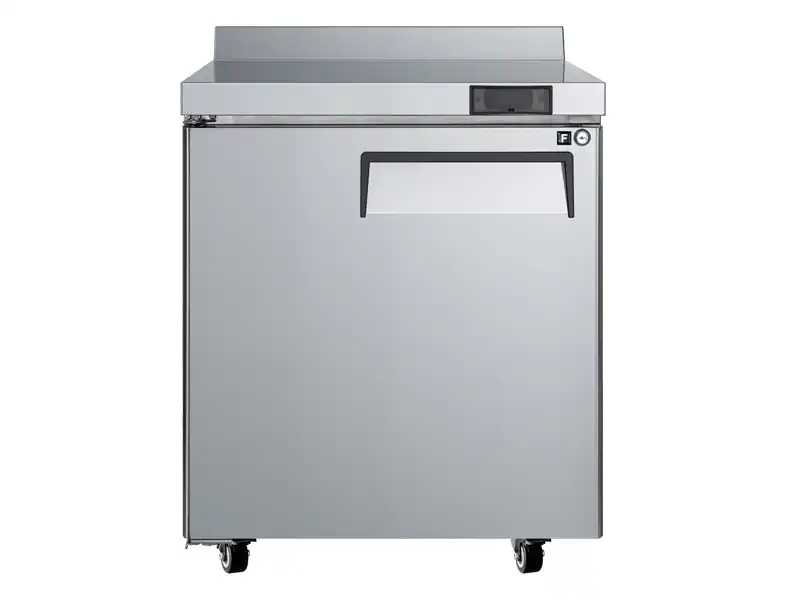
This is where the conversation moves from “is the fridge holding temperature?” to “what is the heat gain rate through the walls?” A refrigerator with higher-grade insulation always has a lower baseline heat infiltration, and over a ten-year service life that difference compounds into thousands of kilowatt-hours.
Compressor and Refrigerant Pairings That Reduce Running Costs
The compressor is the engine, and the refrigerant is the fuel. Their pairing determines how much electricity the unit draws for each unit of heat it moves out of the cabinet. In the Camay product line we primarily use Cubigel compressors matched with R290 refrigerant, a hydrocarbon with excellent thermodynamic properties and zero ozone depletion potential. R290 operates at lower pressure ratios than older HFC refrigerants, which means the compressor works against less head pressure and consumes fewer watts for the same cooling output.
Some compressors run at fixed speed; others can modulate. While variable-speed compressors offer attractive part-load efficiency for large walk-in systems, in the cabinet-sized segment a correctly sized fixed-speed compressor with a well-matched capillary tube often achieves a better energy-use ratio over the full ambient temperature range. We validate this in our climate chamber testing, where we run units at 38°C ambient and 53% relative humidity, the ST~T climate class conditions. A refrigerator that performs efficiently in that environment will hold its efficiency even during a heat wave or in a tight kitchen without air conditioning.
| Model Example | Compressor | Refrigerant | Climate Class | Ambient Test Point | Daily Energy (kWh/24h) |
|---|---|---|---|---|---|
| MTR-48 Undercounter | Cubigel | R290 | ST~T | 38°C, 53% RH | 2.1 |
| MF-23 Freezer | Cubigel | R290 | ST~T | 38°C, 53% RH | 3.0 |
| MWTF-27-L Worktop | Cubigel | R290 | ST~T | 38°C, 53% RH | 1.8 (estimated) |
The data above is measured in our factory testing; actual site numbers will shift with door openings and product load. Still, across hundreds of units we see consistent evidence that the Cubigel/R290 combination yields a lower average power draw than older compressor-refrigerant platforms for equivalent internal volumes.
Smart Digital Controls: More Than a Display
A digital thermostat with a one-degree setpoint resolution is a basic tool. A smart control system that learns door-opening patterns and adapts defrost scheduling goes much further. In our cabinets, the optional IoT and WiFi module lets the controller log compressor run time, evaporator temperature, and door switch events. Over the course of a week, a pattern emerges: which shifts cause the most door openings, how quickly does the interior recover, and whether the defrost heater is engaging more than necessary.
Adaptive defrost is one of the quickest energy wins in a hot kitchen. A standard timer defrost runs on a fixed schedule, whether there is frost on the evaporator or not. A demand-based defrost, using evaporator temperature drop rate or cumulative compressor runtime, triggers only when ice actually starts to build. In a humid kitchen, that can reduce defrost heater energy by twenty to thirty percent. The control board also monitors condenser coil temperature to flag a dirty coil before the head pressure rises and efficiency drops. For a multi-site operator, the ability to view all units’ energy performance on a dashboard makes it easy to spot a unit that is drifting out of spec before the next electricity bill arrives.
Day-to-Day Practices That Preserve Design Efficiency
Even the best engineering cannot overcome neglect. The operating practices that degrade efficiency the fastest are blocked condenser airflow and worn door gaskets. A condenser coil coated with grease and dust cannot reject heat efficiently; the compressor then runs hotter and longer, raising energy consumption while slowly shortening compressor life. Cleaning the condenser quarterly with a soft brush or vacuum is a five-minute task that pays back in months.
The door gasket is a cheap component that wears with age. When the seal becomes stiff or cracked, warm, moist kitchen air leaks in continuously, forming frost on the evaporator and accelerating defrost cycles. Replace gaskets at the first sign of compression set or tearing. Also, overloading shelves blocks internal airflow and creates warm zones that make the thermostat call for cooling more often. Maintaining at least an inch of clearance around product on all sides keeps the air curtain intact and cuts down compressor starts.
These operational steps are well-known, but they are often treated as separate from the design conversation. In reality, a refrigerator built with high-grade insulation and an efficient compressor will still waste energy if the condenser is choked. The design gives you a low baseline; maintenance keeps you there.
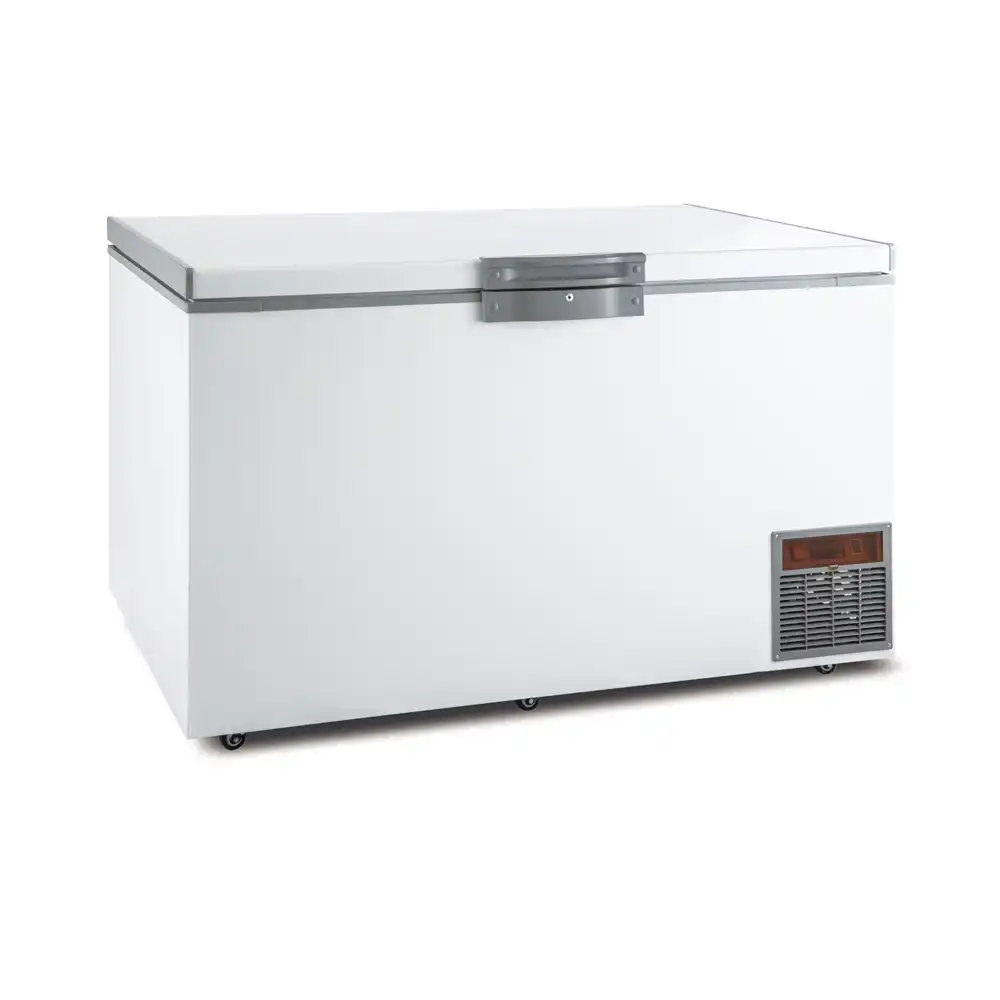
If your program involves kitchens with heavy grease loading or high ambient temperatures, it is worth confirming the condenser cleaning access on a candidate model before purchase. An easy-to-remove front louver cuts maintenance time substantially, something we address in all our ventilated models by making the filter or coil accessible without removing side panels.
The Real Cost of a Low-Price Purchase
Buyers who select the cheapest available unit often see the electricity meter start eating back that savings within the first year. A commercial refrigerator that costs two hundred dollars less at purchase but consumes one hundred dollars more per year in electricity will overtake the efficient model by the third year and never look back. Over a ten-year lifespan, the operating cost difference can approach one thousand dollars, excluding any service calls.
Our undercounter and worktop series carry Energy Star certification where applicable, and we publish the DOE-tested daily energy consumption so that buyers can run a simple lifecycle cost calculation. The numbers are transparent: you multiply the daily kWh by your local utility rate and by 365, then add estimated maintenance. When you compare that figure against a speculative import with no published energy performance data, the decision leans toward documented performance.
If you are weighing a long-term equipment plan, share your expected ambient conditions and daily usage pattern with us at Sales@hzcamay.com or call +8618157202219. We can run a comparative energy analysis across several model sizes and confirm which configuration fits your operational profile best.
Common Questions About Commercial Refrigerator Energy Efficiency
How much energy does a typical energy-efficient commercial refrigerator use?
It depends on size, door type, and ambient conditions. A two-door undercounter refrigerator in our MTR series draws about 1.9 amps at 115V under steady state, which works out to roughly 2.0 to 2.4 kWh per day in actual kitchen use. Freezer units are higher because the larger temperature lift requires more compressor work. For planning, use 2.5 kWh/day for a mid-sized refrigerator and 4.0 kWh/day for a freezer as safe round numbers, then adjust with actual site conditions.
Is R290 refrigerant really better for energy consumption than older HFC refrigerants?
Yes. R290 has better heat transfer coefficients and lower pressure drop in the evaporator and condenser compared to legacy R404A or R134a. That means the compressor does less work to achieve the same refrigeration effect. In our testing, the same cabinet with R290 draws 6–10% less power than an R134a equivalent, and the compressor discharge temperature is lower which extends oil life.
What maintenance tasks have the biggest impact on energy use?
Condenser coil cleaning is number one, followed by door gasket integrity. After that, verify the defrost drain is clear and check that the unit is not positioned against a wall with restricted airflow. These four checks take less than fifteen minutes a month and can prevent the majority of energy drift.
Can I retrofit an old commercial refrigerator with smart controls to save energy?
Adding an external adaptive defrost timer is sometimes possible if the wiring allows, but a true smart control system with IoT logging is built into the factory electronics and cannot easily be added after the fact. For an older unit, the best energy-saving retrofit is often a new electronic thermostat with tighter deadband, plus a thorough insulation inspection around the door frame edges.
How do I know if my electricity bill is higher than it should be because of my refrigeration equipment?
Measure the actual power draw at the plug with a logging meter for one week. Compare the total kWh against the manufacturer’s published daily energy consumption, factoring in your door-opening frequency. A drift above 15–20% usually signals a failing door gasket, a dirty condenser, or a refrigerant charge issue. If you share those numbers with us, we can help interpret the pattern and identify the likely fault before you call a technician.
If you’re interested, check out these related articles:
Boost Savings with Energy Efficient Commercial Upright Freezers
Essential Maintenance Tips for Commercial Reach In Refrigerators