

A commercial ultra freezer is more than a big cold box. If you get the specifications wrong, you do not just lose product, you lock yourself into years of excess energy cost and unnecessary service calls. I have spent twenty-six years in commercial refrigeration manufacturing, and I have seen kitchens buy freezers that could not hold temperature during a busy shift, simply because nobody checked the insulation thickness against the ambient conditions. This guide covers what I have learned about evaluating construction quality, matching temperature capability to real-world use, and maintaining the equipment so it stays reliable for a decade rather than a few years.
What Temperature Range Does Your Application Require?
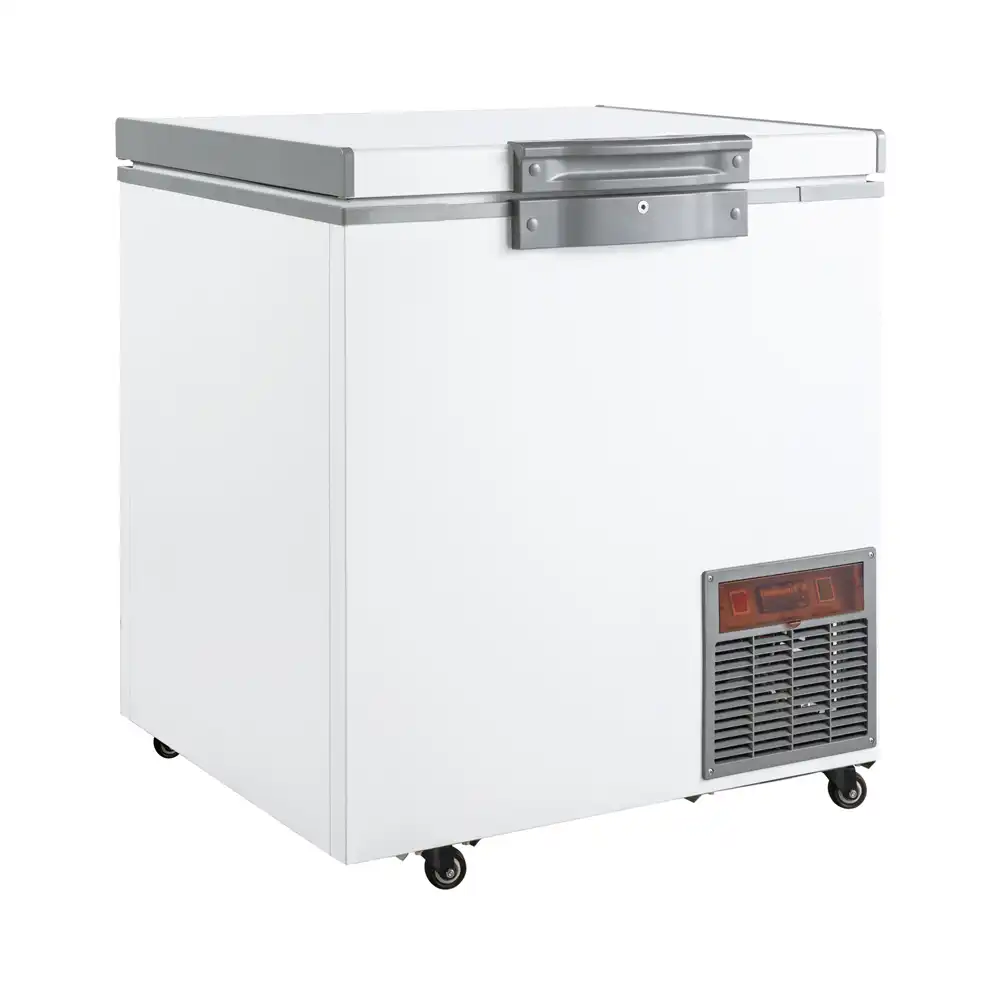
The first selection decision is the temperature band. Commercial ultra freezers typically operate in three categories: low-temperature freezers holding -15°C to -25°C for general food storage, medium ultra freezers in the -25°C to -45°C range for longer preservation of high-value products, and deep ultra freezers reaching -45°C to -86°C for laboratory, pharmaceutical, or seafood applications.
For a busy restaurant kitchen storing frozen meat and prepared foods, a unit rated -18°C to -25°C is sufficient and will cost less to run. But if you are freezing tuna for sashimi or storing heat-sensitive biologicals, -45°C is the minimum I would recommend. The Camay DW45W788 achieves -15°C to -45°C using a single-machine self-cascading system with a Secop compressor, which is a common configuration for mixed food processing environments. The insulation on these units, polyurethane/cyclopentane foam, is CFC-free and thick enough to maintain temperature even when the ambient kitchen temperature hits 38°C. That matters because many kitchens in Southeast Asia or the Middle East install freezers rated for cooler ambient conditions and then wonder why the compressor never cycles off.
If your program involves seafood or any acid-based preservation, ask the manufacturer for the compressor duty cycle at your specific ambient temperature. A freezer that cycles correctly at 25°C ambient may run continuously at 35°C, cutting compressor life in half. Do not assume a spec sheet temperature range accounts for your kitchen.
How to Evaluate Construction Quality and Components
When I walk through a factory floor inspecting units before shipment, I check three things first: the interior material, the door seal, and the compressor brand. The interior matters because in a commercial kitchen, staff will clean with harsh chemicals. 304 stainless steel is standard in all Camay ULT freezers, and I consider it non-negotiable for a unit expected to last more than five years. Cheaper units use 201 or 430 stainless steel, which pits and rusts when exposed to chlorine-based sanitizers common in food service.
The compressor tells you more about long-term reliability than any badge on the front. Across our production lines, we install Secop or Embraco compressors by default for ultra freezer builds. These brands have a proven supply chain for spare parts and qualified service networks, which means if a unit does fail five years from now in a country you have just started exporting to, you can find a technician who can fix it. That is a practical consideration most buyer guides miss.
The other components to examine are the evaporator material, the fan motor, and the door seal design. Our DW45W788 uses a pure copper evaporator with a German EBM fan, and the door has a double seal with a safety lock. For units exposed to heavy traffic, we recommend a reinforced door hinge and replaceable gaskets, because door seals on ultra freezers take more abuse than any other refrigerator in the kitchen. When the seal fails, frost builds up, the compressor runs longer, and energy cost rises. I have seen operators complain about a freezer “not cooling” when the only problem was a torn gasket they had ignored for months.
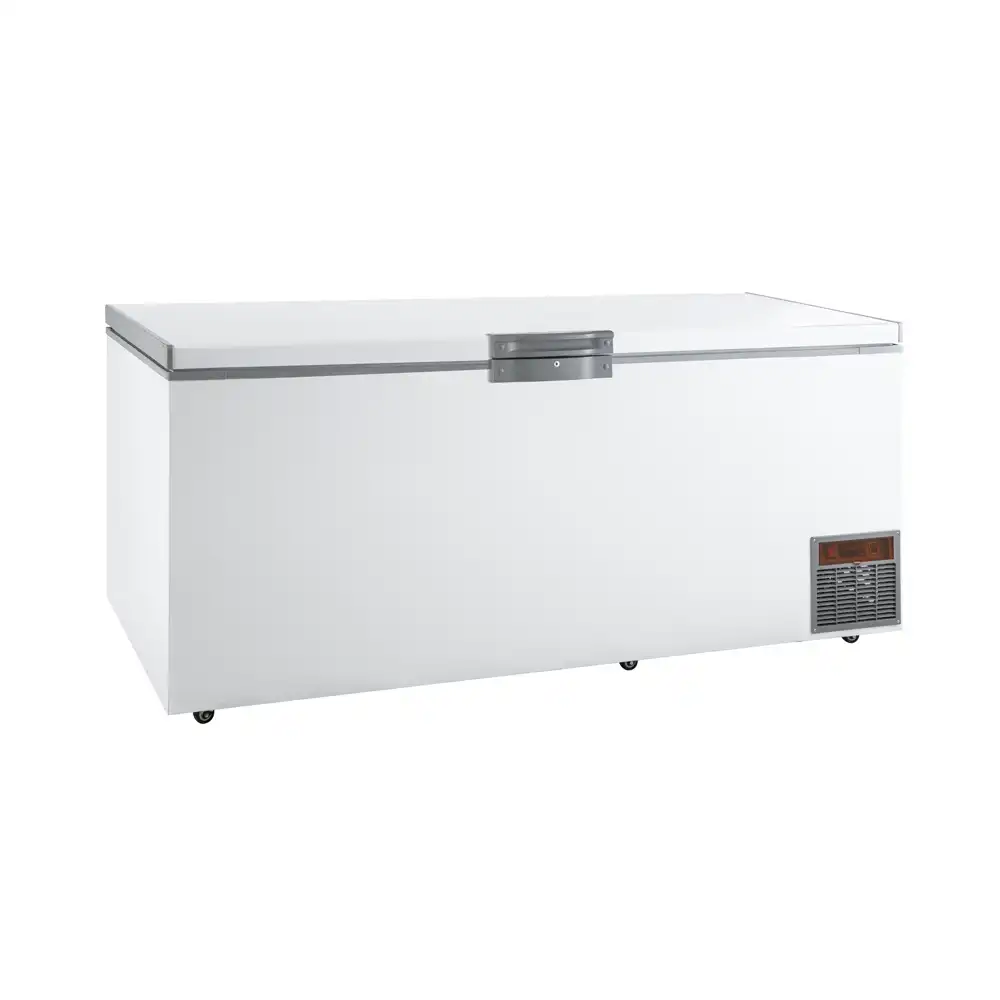
A comparison of key build specifications across two typical Camay models makes this concrete:
| Specification | DW45W788 | DW45W685 |
|---|---|---|
| Capacity | 768 L | 665 L |
| Temperature range | -15°C to -45°C | -15°C to -45°C |
| Compressor | Secop | Secop |
| Insulation | Polyurethane/Cyclopentane, CFC-free | Polyurethane/Cyclopentane, CFC-free |
| Exterior dimensions (W×D×H mm) | 2200×885×940 | 1950×885×940 |
| Net weight | 130 kg | 122 kg |
The lesson is that two units from the same series with different capacities share the same underlying engineering, so what you are really choosing is the size and total cooling capacity. If your storage load is seasonal, buying a larger unit may seem safer, but an oversized freezer short-cycles when partly empty and uses more energy than a properly sized one. We have guided international partners toward the DW45W685 for small food processing lines and the DW45W788 for central kitchens, based on product volume and turnover rate.
Energy Efficiency and Total Cost of Ownership
The purchase price of a commercial ultra freezer is only the down payment. Over a seven-to-ten-year service life, energy consumption accounts for the largest share of total cost. I have analyzed operating data from units installed in hotel banquets and seafood processing facilities, and the difference between a well-insulated, properly sized freezer and a bargain unit can be a thousand dollars a year in electricity alone. The insulation type and thickness drive that number. Polyurethane/cyclopentane insulation is the industry standard for low thermal conductivity, but the foam density and door seal design determine how much cold escapes each time the door opens.
For operators managing multiple units, I recommend asking for the kWh per 24-hour consumption at two different ambient temperatures, your peak summer condition and your average annual condition. Then calculate the cost at your local utility rate. A unit with an efficient Secop compressor and thick insulation may cost more up front, but the payback period is often under three years in a high-usage kitchen.
Another cost factor is defrost type. Automatic defrost is convenient but introduces a brief temperature spike in the cabinet. For ultra freezers holding temperature-sensitive product, manual defrost or an adaptive defrost system may be required. In pharmaceutical and seafood applications, we often specify a manual defrost cycle because the product is typically cycled out on a fixed schedule and defrosting is done during empty periods. That decision alone can add two years to the freezer’s effective lifespan by reducing thermal cycling stress on the cabinet.
If your kitchen is running three or more units, it is worth confirming the power supply capacity. Ultra freezers draw significant start-up current, and sizing the electrical panel for simultaneous compressor starts avoids nuisance tripping. At Camay, we can provide the start-up amperage and recommend phase balancing for multi-unit installations, a level of detail that prevents commissioning delays.
Essential Maintenance Practices for Long-Term Reliability
A commercial ultra freezer that runs twelve hours a day needs a maintenance discipline, not a checklist stuck to the side. The most common failure I see is condenser coil neglect. In a kitchen with airborne grease and flour dust, the condenser fins clog within a few months if there is no regular cleaning schedule. The compressor then runs hotter, the refrigerant cycle loses efficiency, and eventually the unit fails to reach setpoint. Cleaning the condenser coil with a soft brush and vacuum every three months, and more often during high-production seasons, keeps a five-year compressor running for ten.
Door gaskets are the second maintenance priority. I have learned from service logs across hundreds of units that a damaged or dirty gasket causes the compressor to cycle on and off more frequently, which wears out the start components. The test is simple: close the door on a piece of paper. If the paper slides out with no resistance, the gasket has lost its seal. Replace the gasket immediately; it is a fifteen-minute job that costs a fraction of a compressor replacement.
Defrost scheduling matters for units without automatic defrost. If you see ice buildup thicker than half an inch on the evaporator, defrost the unit. Build a defrost cycle into the weekly routine that aligns with your lowest inventory period. After defrosting, wipe down the interior with a food-safe sanitizer and let the cabinet reach temperature before reloading. This prevents thermal shock to the product and reduces moisture that leads to freezer burn.
Temperature monitoring is also part of maintenance. A digital controller with an alarm output is standard on our units, but I recommend connecting it to a remote monitoring system or at least a local alarm beacon. In a busy kitchen, staff will not notice a temperature drift until the product is already compromised. If your health inspection requires HACCP logs, you will need that data anyway. Position the sensor near the door, where temperature fluctuates most, rather than at the back where it is coldest.
Selecting a Manufacturer with Verified Quality Assurance
Once you have defined the technical requirements, the manufacturer selection becomes the most consequential decision. I am transparent about this because I have seen importers commit to a supplier based on a low quotation and a few product photos, only to receive units with weld failures, inconsistent foam density, and no after-sales support. The certifications tell part of the story. A manufacturer with ISO 9001:2015, ISO 14001:2015, and ISO 45001:2018 has systems in place for quality, environmental management, and occupational safety, and those systems reduce the probability of production defects. Our factory in Zhejiang holds all three, plus product-level certifications like ETL, CE, and ENERGY STAR for applicable models.
Beyond the certificates, I look for the factory’s ability to customize. For a seafood exporter who needed a freezer that could maintain -45°C in a 40°C container yard, we modified the condenser size and added a phase-loss protection relay. That type of responsiveness comes from engineering depth in-house, not from a trading company that relays your questions to a third-party factory.
The other practical litmus test is spare parts availability. If the manufacturer cannot supply a spare parts list with part numbers and delivery lead times, you are buying a disposable asset. We keep a percentage of spare parts stock specifically for after-sales, and we ship from the factory within weeks, not months. For a busy commercial kitchen, a freezer down for two weeks means lost revenue that dwarfs the initial equipment cost.
Common Questions About Commercial Ultra Freezers
Can an ultra freezer be used for both food and lab samples?
It is not advisable. Even with strict cleaning protocols, cross-contamination risk is high. Food applications involve organic residues that can affect lab samples, and many lab protocols require documented temperature validation that is difficult to maintain in a shared unit. If your facility needs both, budget for two separate freezers with dedicated cleaning schedules.
How long should a commercial ultra freezer last?
With proper maintenance, I would expect ten to fifteen years from a well-built unit. The compressor typically lasts eight to twelve years before needing replacement, and the cabinet structure and insulation can go twenty years if the exterior is stainless steel and the unit is not moved frequently. The key variable is ambient temperature and maintenance frequency. A freezer operating in a 38°C kitchen without condenser cleaning may need a compressor replacement in five years.
What is the most overlooked spec when comparing units?
The climate class. Many buyers only check temperature range and capacity, but the climate class defines the maximum ambient temperature at which the unit can maintain its rated interior temperature. Our commercial ultra freezers are rated for ST-T climate class, meaning they perform at 38°C ambient. If you are in a tropical region, insist on this class, because a unit rated only for 32°C will struggle during the hottest months and may void the warranty if operated outside its rated range.
Can I convert a standard freezer to an ultra freezer?
No. Ultra freezers use a different refrigeration cycle, typically a self-cascading or two-stage system, with different refrigerants, compressor types, and insulation thickness. A standard freezer cabinet cannot be modified to reach -45°C or lower without a complete rebuild of the refrigeration system and insulation, which would cost more than buying a purpose-built ultra freezer.
How do I safely transport an ultra freezer after purchase?
Transport an ultra freezer upright and secure it against vibration. After transit, let the unit sit unplugged for at least twenty-four hours to allow the compressor oil to settle before powering on. This is a step I emphasize because I have seen compressors fail on first start-up when this rest period is skipped. For installations requiring tight commissioning schedules, factor this wait time into your timeline. If your project has specific site constraints, share the access dimensions and voltage requirements with our team at Sales@hzcamay.com and we will confirm the delivery preparation steps.
If you are selecting a commercial ultra freezer for your kitchen, processing facility, or lab, we recommend starting with a specification review against your actual operating conditions. Email your temperature requirements, capacity, and ambient environment to Sales@hzcamay.com or call +86 181 5720 2219, and we will propose the right configuration from our certified production line.
If you’re interested, check out these related articles:
Boost Savings with Energy Efficient Commercial Upright Freezers
Optimizing Kitchen Efficiency with Integrated Worktop Refrigeration
Boost Efficiency Energy Efficient Chef Base Units for Commercial Kitchens
Ultimate Buyers Guide for Commercial Reach In Refrigerators
Upright Freezer vs Refrigerator Key Differences Explained