
In 26 years of commercial refrigeration engineering, I have seen one mistake cost a processing plant more than the price of the freezer itself: choosing a unit that could not hold temperature under daily production loads. When you are freezing high-value seafood, ready-to-eat meals, or sensitive ingredients, a few degrees of fluctuation can mean thousands of dollars in lost product. This article is for procurement managers and food safety engineers who need a practical, manufacturing-informed guide to ultra-low temperature freezers. We will look beyond the spec sheet and focus on what separates a freezer that performs reliably for a decade from one that fails after two.
Why Ultra-Low Temperature Freezers Matter in Food Processing
Standard commercial freezers operate around -18°C to -22°C. For many products that is adequate. But in food processing, we deal with materials that require deeper cold: fresh seafood headed for export, heat-treated proteins that need rapid chilling, or ingredients destined for extended frozen storage. An ultra-low temperature (ULT) freezer pushing down to -45°C or even -86°C slows enzymatic degradation and ice crystal growth to a level that ordinary freezers cannot match.
At our facility, we routinely test ULT units for food processing partners. The difference between a product frozen at -25°C and one frozen at -45°C is visible in texture and moisture retention. For high-fat fish like tuna, -45°C is the minimum I would recommend; below that, you risk cellular damage that shows up in the final product. This is not speculation. It is what we have measured across hundreds of units shipped to markets with strict cold chain requirements.
Matching Temperature Range to Your Product
Not all food processing needs -86°C. The most common question I get is whether a -45°C unit is enough. For the majority of applications, the answer is yes. But you need to be precise about what you are freezing and how long you intend to store it.
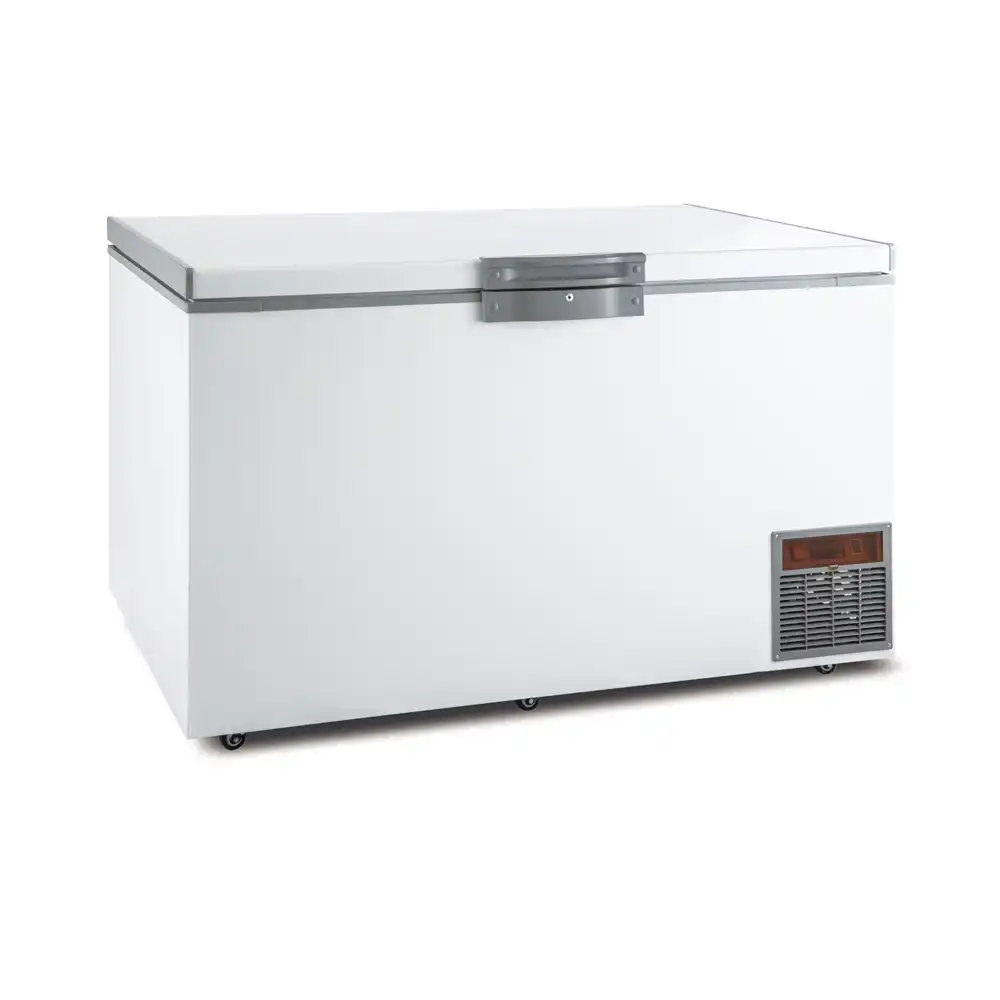
A -45°C freezer will reliably hold products for 6 to 12 months with minimal quality loss. This covers most meat, poultry, dairy ingredients, and prepared foods. The Camay DW45W788, for example, maintains -15°C to -45°C with a 768-litre interior and a SECOP compressor. For a mid-size food processor, that range does the job economically.
A -86°C unit is for the exceptions: deep-sea fish intended for long-haul transport, biological culture preservation, or ultra-long-term storage of high-margin ingredients. The cost step-up is significant and so is the energy draw. I always tell buyers: if you cannot cite a specific product specification or customer requirement that demands -86°C, you are likely overspending on capacity you will never use.
Evaluating the Core Components: Insulation, Compressor, and Door Seal
A ULT freezer is only as good as its weakest link. Three elements determine whether it will hold temperature over years of daily use.
Insulation thickness and material: Cheap units use lower-density foam that compresses over time and loses thermal resistance. We use polyurethane and cyclopentane insulation, CFC-free and foamed in place, with a double door seal design on our DW45 series. That combination matters. I have torn down units where insulation had shrunk two centimetres from the cabinet wall after three years, creating cold spots. In food processing, cold spots mean product variation.
Compressor brand and configuration: A Cubigel or SECOP compressor, properly sized, will run steadily for years. The single-machine self-cascading refrigeration system in our ULT line is designed for reliability cycles that a standard compressor simply cannot handle. When assessing a supplier, ask for the compressor duty cycle ratings and the ambient temperature performance curve. If they cannot provide those, walk away.
Door seals and gaskets: Every time a forklift loads or unloads pallets, the door opens. The seal must recover quickly and completely. We use a double gasket system with an air pressure balance port that prevents vacuum lock after closing. That little detail prevents seal warping and the slow temperature creep that plant managers notice only when the alarm goes off at 2 a.m.
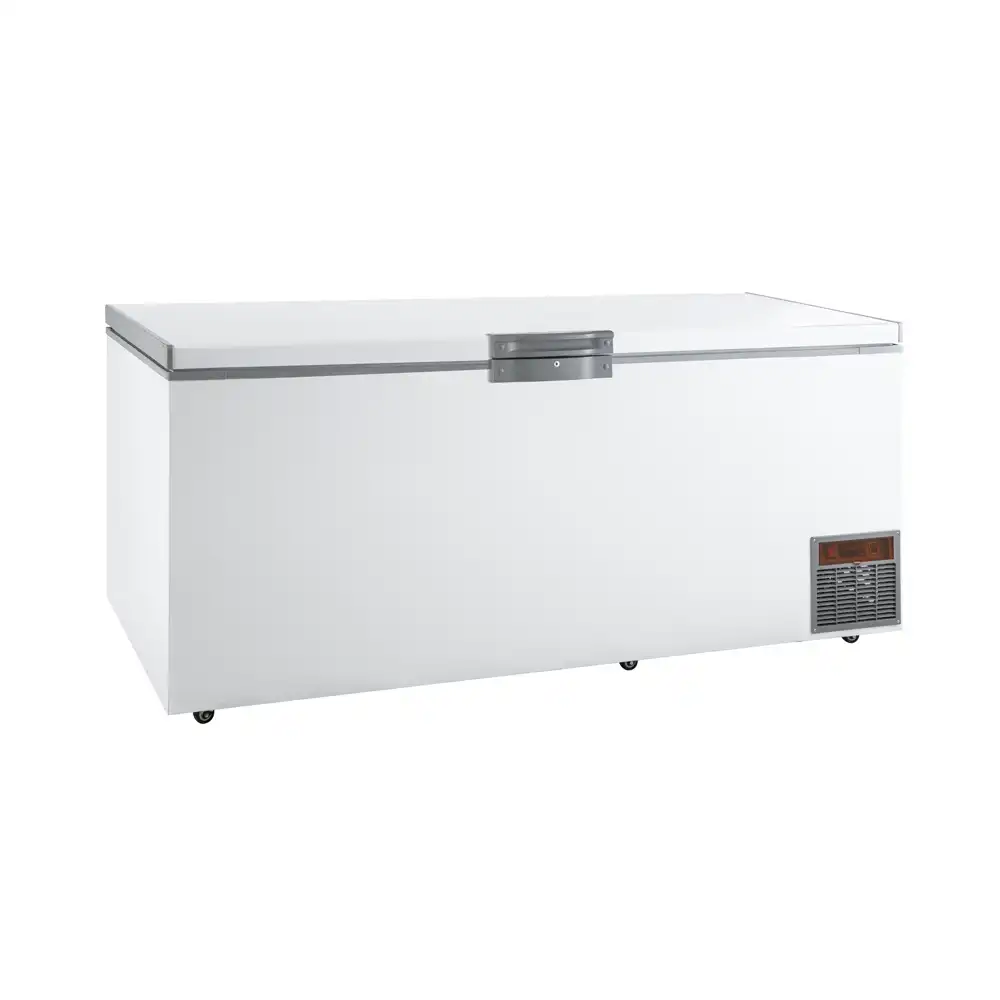
| Specification | Camay DW45W788 (-45°C) | Camay DW45W685 (-45°C) | Typical -86°C ULT Unit |
|---|---|---|---|
| Net Capacity | 768 L | 665 L | 600–800 L (varies) |
| Temperature Range | -15 to -45°C | -15 to -45°C | -40 to -86°C |
| Insulation Type | Polyurethane/Cyclopentane | Polyurethane/Cyclopentane | VIP + Polyurethane |
| Compressor | SECOP | SECOP | Dual-stage cascade |
| Power | 750 W | 700 W | 1,200–2,000 W |
| Doors | 1 | 1 | 1 with inner doors |
Manufacturing Quality Indicators Beyond the Spec Sheet
I have overseen production of thousands of commercial refrigeration units, and I can tell you that a glossy data sheet hides shortcuts. Here is what to look for when you audit a manufacturer.
Internal cabinet finish and corner design: 304 stainless steel interiors with rounded corners are not just for cleaning. They eliminate crevices where frost accumulates and turns into ice dams that degrade insulation. If the interior has exposed fasteners or sharp angles, moisture will eventually compromise the wall.
Refrigerant choice and environmental certification: R290 is the standard for energy-efficient commercial refrigeration, but some low-cost manufacturers still use older refrigerants with higher global warming potential. Check that the unit carries DOE, ENERGY STAR, and CE certification. Our factory also holds ISO 9001, ISO 14001, and ISO 45001 management certifications, which is a signal that the production process itself is audited. Those certifications are not easy to obtain and they indicate a commitment to consistency.
Shipping and packaging: This sounds trivial, but ULT units are heavy and sensitive. If the supplier does not use reinforced crating and shock indicators, you will receive a unit with a misaligned door or a cracked compressor mount. I have personally rejected shipments from sub-suppliers for that reason.
Understanding Total Cost of Ownership: Energy, Maintenance, and Downtime
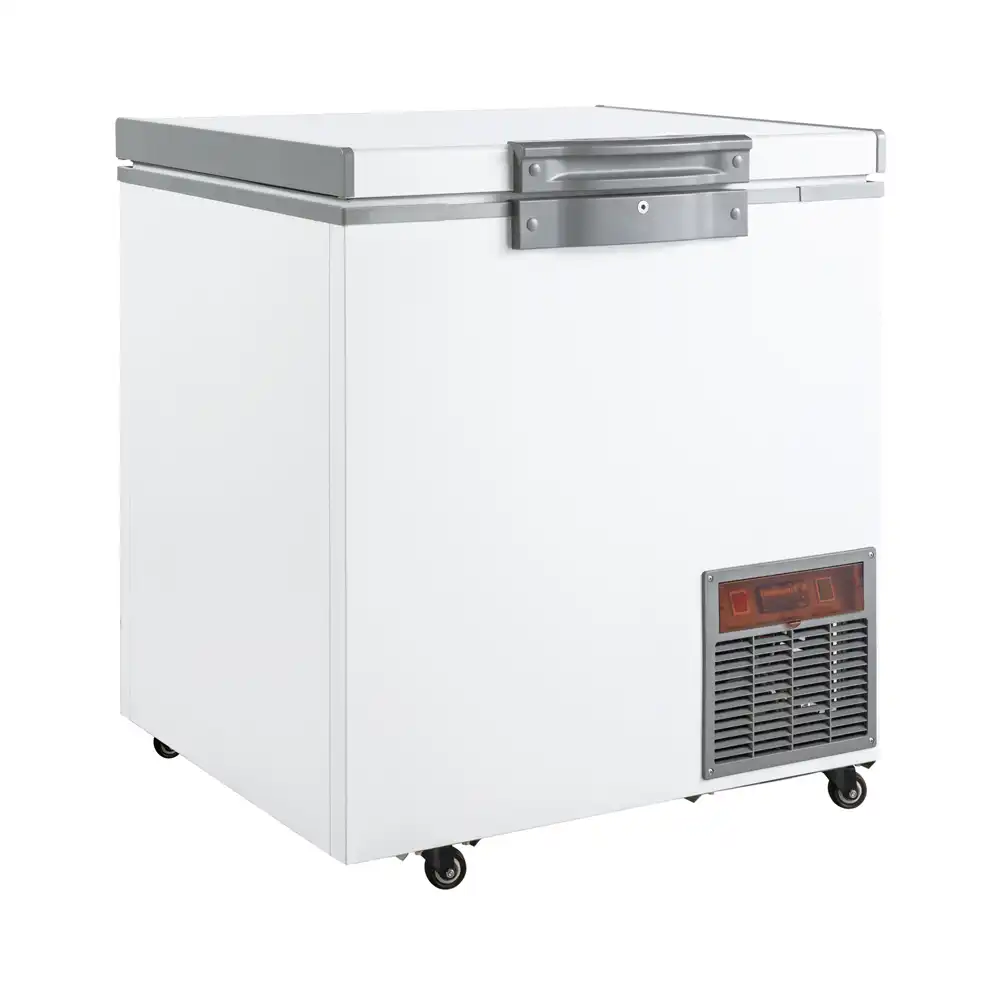
The purchase price is the tip of the iceberg. Over 10 years, energy and maintenance will dwarf the initial cost. A well-insulated -45°C unit from a reputable manufacturer draws 700–750 watts. A poorly insulated unit can draw double that because the compressor runs constantly to compensate for heat gain. At industrial electricity rates, that difference pays for the freezer within three years.
Maintenance requires access to the condenser coil for cleaning. Our units have removable anti-dust meshes and easy-access condensing units. If a unit is crammed into a tight enclosure, coil cleaning becomes a chore that gets skipped, and efficiency drops. I design service access into every layout we propose.
Downtime is the true cost. If a freezer fails and you lose 600 litres of frozen product, the loss is immediate and unrecoverable. That is why I insist on having at least one spare temperature controller on site and a maintenance contract with a local technician who knows the brand. A supplier who does not stock spare parts in your region is not a partner; they are a risk.
Vetting Your Supplier for Long-Term Partnership
When you buy an ultra-low temperature freezer, you are entering a relationship that will last at least a decade. The supplier matters as much as the equipment.
First, ask about OEM and ODM capabilities. A manufacturer that can customize sizes, interiors, and controller settings can adapt to your production line, not the other way around. We routinely build custom shelving and voltage configurations for food processing clients because standard models rarely fit every plant layout.
Second, visit the factory or request a virtual tour of the production line. Look at the sheet metal fabrication, the foaming process, and the testing area. Every unit should be run-tested for at least 24 hours before packing. If a manufacturer does not do full-load temperature mapping, they are skipping the most important quality gate.
Finally, ask for references from other food processing clients. Not restaurants, not labs. Food processing. The conditions in a plant are different: high ambient heat, heavy door cycles, and cleaning chemical exposure. A freezer that survives a busy processing floor is a different animal from one that sits in a quiet laboratory.
If you are specifying ultra-low temperature storage for a new line or replacing a failed unit that could not hold temperature, we are available to discuss your exact requirements. Send your target temperature range, capacity, and any product-specific constraints to Sales@hzcamay.com or call +8618157202219. We can confirm a configuration with the insulation, compressor, and service plan that matches your production reality without overspending on unnecessary specs.
Common Questions Ultra-Low Temperature Freezer Buyers Ask
How long can food be stored in a -45°C freezer without quality loss?
This depends entirely on the product. Fatty fish like salmon and tuna will hold well at -45°C for 8–12 months with minimal rancidity and texture degradation. Lean meats and poultry can extend to 12–18 months. Prepared meals with sauces or high moisture content should be used within 6–9 months because ice crystal growth continues slowly even at low temperatures. If your holding time exceeds two years, I always recommend stepping up to -86°C, but for most production cycles, -45°C is the practical ceiling.
Do I really need a -86°C freezer for food processing?
In 90% of cases, the answer is no. The exception is when you are processing high-value product for export markets with strict cold chain requirements, such as deep-sea tuna for Japanese sashimi or pharmaceutical-grade food ingredients. In those programs, a -86°C unit is non-negotiable because it prevents histamine formation and lipid oxidation that a -45°C unit cannot fully suppress. Our team assesses this on a per-product basis; if you are uncertain, share your product specifications and we will give you an honest recommendation.
What is the most common cause of ULT freezer failure in food plants?
Electrical issues from unstable power supply are the leading cause, followed by condenser coil blockage from airborne flour dust or packaging debris. We always recommend installing a voltage stabilizer and scheduling weekly coil cleaning as part of the sanitation routine. The third most common cause is a worn door gasket that is not replaced promptly. A $50 gasket can prevent a $5,000 product loss.
How do I know if the insulation is high quality?
Check the foam density and the adhesion to the cabinet. High-quality ULT freezers use polyurethane foam with cyclopentane, foamed in place under pressure to fill every cavity. If you can feel cold spots on the exterior cabinet after the unit has been running, the insulation has gaps. Request a thermal imaging report from the manufacturer. We perform these on every unit as part of final quality control.
What spare parts should I keep on hand?
At a minimum, keep a spare door gasket, a set of controller fuses, and a condenser fan motor. These are the items that wear first and can be replaced by a local technician without specialized training. If you are operating in a remote area, also keep a complete temperature controller module. Our after-sales support includes a recommended spares list tied to your specific model, and we stock replacement parts for global shipping. If you need a spares kit configured for your site, send your model number and location to Sales@hzcamay.com and we will get you covered.
If you’re interested, check out these related articles:
Essential Maintenance Tips for Commercial Reach In Refrigerators
Choosing the Best Commercial Reach In Fridge for Your Restaurant
Essential Maintenance Tips for Your Commercial Chef Base Refrigerator
Heavy Duty Chef Base Refrigeration for Efficient Commercial Kitchens