

After twenty-six years of specifying commercial kitchen equipment, I can state something that holds true across every project I have seen: the work surface you choose determines not just your kitchen’s daily rhythm but its long-term operational costs. Stainless steel worktops remain the standard in professional kitchens, yet many procurement decisions still undervalue the compounding advantages of material selection. The difference between a well-specified 304 stainless steel worktop and a thinner gauge alternative is measured in years of service, not months. This article examines how stainless steel construction directly impacts hygiene compliance, structural durability, and lifecycle cost in high-volume commercial environments, drawing on what our manufacturing lines and global partner feedback have made clear.
What Makes Stainless Steel the Benchmark for Food Contact Surfaces
Stainless steel dominates commercial kitchen work surfaces for reasons rooted in material science, not convention. The chromium oxide layer that forms on quality stainless steel creates a passive, self-repairing barrier. When the surface is scratched in normal use, chromium reacts with oxygen and reforms this protective film within minutes. Mild steel and aluminum cannot replicate this, which is why cut corners on worktop material show up as rust spots within the first year in coastal or high-humidity kitchens.
Not all stainless steel performs equally. Grade 304 contains approximately 18% chromium and 8% nickel, giving it superior resistance to acidic foods, cleaning chemicals, and moisture compared to grade 201, which substitutes manganese for some nickel content. In kitchens processing tomatoes, citrus, or vinegar-based preparations, 201 worktops develop surface pitting noticeably faster. The specification difference might save a few dollars per square foot at purchase. It costs significantly more in replacement and sanitation risk over a five-year operating window.
The non-porous nature of stainless steel also eliminates what we consider the hidden hygiene problem in commercial kitchens: material absorption. Wood and plastic cutting surfaces develop micro-fissures that trap organic matter. Stainless steel, properly finished, presents a continuous surface that leaves no refuge for bacterial colonies. Health inspectors recognize this structural difference. It is why stainless steel worktops satisfy NSF and HACCP requirements without the conditional use notes that accompany other materials.
How Durability Translates to Lower Lifecycle Costs
Procurement teams often compare worktop pricing on a per-unit basis, but the more revealing metric is cost per year of service. A 16-gauge 304 stainless steel worktop with properly welded seams and reinforced undershelves routinely serves twelve to fifteen years in a busy restaurant kitchen. Thinner 20-gauge worktops with spot-welded joints can dent, warp, or develop seam separation within three to five years. The initial price gap, typically 20% to 30%, vanishes when the thicker unit outlasts its cheaper counterpart by a factor of three.
Denting is not cosmetic. A dented worktop traps water, food particles, and cleaning residue in low spots that wipe-downs miss. Over time, standing moisture attacks even stainless steel in oxygen-deprived microenvironments, leading to crevice corrosion. This failure mode is entirely preventable by selecting adequate gauge thickness for the expected load. In our production planning for the Camay worktop and undercounter lines, we size gauge and reinforcement based on the assumption of daily use with heavy stockpots, mixer stands, and frequent impact, not occasional light prep.
The undershelf and leg assembly matter as much as the work surface itself. Adjustable stainless steel legs with leveling feet prevent the rocking that stresses welded joints. Undershelves built from the same gauge as the top surface provide structural triangulation that keeps the entire unit rigid under load. These details are not visible in a catalog photo, but they determine whether a worktable remains flat and stable after five years of hard use or develops a wobble that accelerates wear on every joint.
Hygiene Advantages That Go Beyond Surface Cleaning
Stainless steel supports cleaning protocols in ways that go deeper than wipe-down convenience. The material tolerates the aggressive sanitizers that commercial kitchens require, including quaternary ammonium compounds at concentrations that degrade epoxy coatings and plastic laminates over repeated exposure. A stainless worktop does not absorb chemicals, does not swell, and does not develop the hazy surface degradation that signals material breakdown.
Rounded internal corners and coved backsplashes, both achievable with stainless steel fabrication, eliminate the 90-degree angles where debris accumulates. In our Camay worktop series, the one-piece backsplash with radiused corners reduces cleaning time by allowing a single continuous wipe path rather than multiple stop-and-scrub maneuvers at each junction. This design detail matters most during shift changes when cleaning crews have limited time between service periods. A surface that cleans faster is a surface that gets cleaned more thoroughly under real-world time pressure.
Temperature tolerance adds another hygiene dimension. Stainless steel withstands direct contact with hot sheet pans and roasting trays without warping or off-gassing. Other work surface materials, particularly laminate-topped tables, release volatile compounds when exposed to sustained heat above 150°F. In a kitchen where speed demands placing hot equipment on the nearest surface, stainless steel eliminates both the chemical risk and the physical deformation risk. The surface remains flat, non-reactive, and ready for the next task.
Selection Criteria That Most Buying Guides Overlook
Experience across hundreds of OEM and ODM projects has taught me to watch for specifications that separate durable stainless steel worktops from units that will disappoint within the warranty period. These are the criteria that matter most and that generic equipment catalogs often omit.
| Selection Factor | What to Specify | Why It Matters |
|---|---|---|
| Steel grade | 304 (18/8) minimum | Prevents pitting from acidic foods and chemical exposure |
| Surface gauge | 16-gauge for heavy prep; 18-gauge minimum | Resists denting and maintains flatness under load |
| Seam construction | Full TIG-welded and polished | Eliminates crevice corrosion and food trap points |
| Undershelf gauge | Match top surface gauge | Provides structural rigidity and prevents racking |
| Leg assembly | Adjustable stainless with leveling feet | Prevents wobble-induced joint stress |
The gauge specification deserves particular attention because manufacturers do not all report it transparently. A worktop listed as “stainless steel construction” without a gauge number is typically 20-gauge or thinner. For procurement teams comparing bids, request the material specification sheet for the exact model number. If gauge is not disclosed, assume the thinnest option in that manufacturer’s range, and factor the shorter service life into the total cost calculation.
Noise and vibration transfer is another overlooked selection point. Stainless steel worktops with integrated undershelves and proper leg bracing dampen vibration from adjacent equipment better than lighter-gauge alternatives, which can amplify the hum of nearby compressors and mixer motors. In open kitchens, this acoustic difference affects the front-of-house experience directly. A solid worktop contributes to a quieter kitchen without adding a separate acoustic treatment.
When Worktop Selection Intersects with Refrigeration Integration
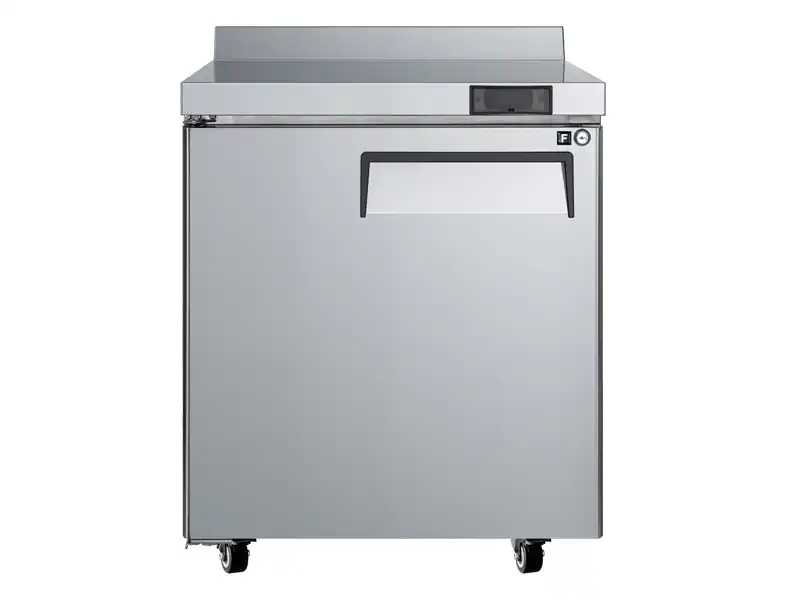
Many commercial kitchens use stainless steel worktops in conjunction with undercounter refrigeration or chef base units, and the interface between these components creates both opportunities and failure points. A freestanding worktop placed over an undercounter refrigerator must accommodate the refrigerator’s ventilation requirements while maintaining a stable, level prep surface. Gaps between units collect debris and complicate cleaning.
The more durable solution in heavy-prep stations is a dedicated refrigerated worktop that integrates the cooling system within the work surface structure. Our Camay MWTF series uses a single stainless steel top surface across the entire unit, with the refrigeration compartment sealed and insulated below. This eliminates the seam between worktop and refrigerator entirely, giving cleaning crews a continuous surface and removing the gap that harbors moisture and food waste.
For kitchens using separate worktops and undercounter refrigeration, silicone caulk along the joint between the two is not a permanent fix. The thermal expansion and contraction from refrigeration cycling breaks caulk seals within months. Mechanical fastening with a stainless steel filler strip, or better still, selecting an integrated unit from the outset, avoids the recurring maintenance cost. In projects where we have supplied both the worktop and the undercounter refrigeration from our MTR series, we configure the leg heights and leveling range to eliminate the gap without relying on sealants.
Long-Term Maintenance and the Real Payback Period
Stainless steel worktops do not demand exotic maintenance, but they do reward consistency. Daily cleaning with a neutral pH detergent and warm water, followed by a clear-water rinse and dry wipe, prevents the water spotting that accumulates from hard water minerals. Chloride-based cleaners, including undiluted bleach, will attack the passive layer over time and should be followed by thorough rinsing if their use is unavoidable. The common practice of leaving sanitizing solution to air-dry on the surface is not best practice on stainless steel. It deposits concentrated residues that can initiate localized corrosion.
Scratch management is a realistic expectation, not a failure. Directional scratches from knives and scouring pads are normal wear on a working kitchen surface. These scratches do not compromise hygiene because the passive chromium oxide layer reforms continuously. The difference between cosmetic scratching and functional damage is depth. Scratches deeper than approximately 0.5mm can trap organic matter and benefit from professional refinishing. Surface-level marks from normal use require no intervention beyond standard cleaning.
The payback period on a quality stainless steel worktop varies by kitchen volume, but our project data shows a consistent pattern. Kitchens operating eighteen hours daily with heavy prep loads recover the premium over thinner-gauge alternatives within two years through avoided replacement, reduced cleaning labor, and zero hygiene-related downtime. For procurement teams building a five-year equipment budget, the thicker gauge worktop is the lower-cost option before the third year of operation. This is not a theoretical projection. It is what repeat customers confirm when they reorder the same specification for their next location.
Addressing Common Questions About Stainless Steel Kitchen Worktops
Do all stainless steel worktops resist rust equally?
No. Rust resistance depends on the chromium and nickel content of the specific alloy. Grade 304 stainless steel contains enough chromium to maintain a continuous passive layer in kitchen environments. Grade 201, which replaces some nickel with manganese, offers noticeably lower corrosion resistance, particularly when exposed to salt, acidic ingredients, and chloride-based sanitizers. In kitchens within five kilometers of a coastline, even 304 can develop surface tea staining if not rinsed regularly. For those environments, specifying 316 grade adds molybdenum for enhanced chloride resistance, though the cost increase is typically justifiable only for exposed outdoor cooking areas or extremely corrosive indoor environments.
Are thicker worktops noticeably better for hygiene?
Thickness itself does not make a surface more hygienic. The hygiene advantage of a thicker worktop is indirect and mechanical. A 16-gauge surface resists the denting and warping that create low spots where water and debris pool. A thinner 20-gauge surface that develops even shallow depressions will trap moisture in areas that wiping cannot reach. So the hygiene benefit comes from maintaining a flat, continuous surface over years of hard use, not from the gauge number printed on the specification sheet.
How often should stainless steel worktops be professionally serviced?
Professional refinishing is not a routine maintenance item. A properly specified 304 stainless steel worktop in a commercial kitchen typically requires only daily cleaning and periodic inspection of welds, leg levelers, and joint integrity. Professional attention becomes relevant when deep scratches exceed 0.5mm, when seam separation appears at welded joints, or when surface discoloration persists after standard cleaning. Most kitchens we supply do not need professional refinishing within the first eight to ten years of service, provided daily cleaning protocols are consistently followed.
Can a stainless steel worktop last as long as the rest of my kitchen equipment?
In our experience across twenty-six years of manufacturing and global project delivery, the stainless steel worktop is frequently the longest-serving piece of equipment in a commercial kitchen. Compressors, gaskets, and electronic controls in refrigeration units have finite service lives. A heavy-gauge stainless steel worktop with proper leg support and weld integrity has no mechanism of degradation beyond physical abuse and chemical mistreatment. When a kitchen undergoes a full equipment refresh, the worktops often remain in place while the mechanical refrigeration units are replaced. This longevity is what makes the selection decision a true lifecycle cost exercise rather than a simple per-unit price comparison.
What should I verify before ordering stainless steel worktops for a new kitchen?
Confirm the steel grade, surface gauge, and seam construction from the manufacturer’s specification sheet rather than relying on catalog descriptions. Verify that adjustable stainless steel legs with leveling feet are included rather than optional. If the worktop will sit over undercounter refrigeration, specify the total height clearance and ventilation requirements upfront to avoid installation conflicts. For kitchens with heavy equipment loads, request reinforced undershelf bracing. If your program involves multiple locations or standardized kitchen layouts, share your total project scope early so the manufacturer can batch-produce consistent specifications and maintain lead-time reliability.
Your Kitchen Work Surfaces Are a Long-Term Investment — Let Us Help You Specify Correctly
Selecting the right stainless steel worktop means balancing immediate budget constraints against the reality that a thinner, lower-grade alternative will cost more in total ownership within three years. I have watched kitchens discover this pattern the hard way, and I have supplied equipment to kitchens that got it right from the start. The difference is almost always in the specification review stage, where asking the right questions about gauge, grade, and seam construction before ordering prevents the compromises that accumulate into operational costs later.
If you are planning a new kitchen, expanding an existing facility, or standardizing equipment across multiple locations, share your requirements with our team. We can help you confirm the correct gauge and grade for your expected load and cleaning protocols, and we can coordinate worktop specifications with your undercounter or chef base refrigeration selections so that the installation is seamless and the gap-free surface you expect is what arrives on site. Reach us at Sales@hzcamay.com or call +8618157202219. Send your project dimensions and daily volume estimates, and we will return a specification recommendation based on what has held up in kitchens operating under similar conditions.
If you’re interested, check out these related articles:
Heavy Duty Chef Base Refrigeration for Efficient Commercial Kitchens
Boost Savings with Energy Efficient Commercial Upright Freezers
Essential Maintenance Tips for Your Commercial Chef Base Refrigerator