

Under-counter refrigerators occupy some of the most valuable square footage in a coffee shop—the space directly beneath the preparation surface. Choosing a unit that combines sufficient capacity, consistent cooling, and low energy consumption is not merely a purchase decision; it determines the shop’s daily workflow speed and the portion of monthly overhead that goes to electricity. From two and a half decades of manufacturing these appliances, I have found that the biggest gap in buyers’ information is not the size or the star rating, but the internal components and assembly quality that make one unit consume noticeably less power than another while holding temperature through hundreds of door cycles a day. This article addresses that gap, showing what to look for inside the cabinet—insulation, compressor, refrigerant, and structural details—so the refrigerator you install pulls its weight without pulling excess current.
How Energy Efficiency Works in Undercounter Refrigeration
Energy efficiency in a stationary refrigerator comes down to three things: how well the cabinet resists heat gain, how little work the compressor must do to remove the heat that does enter, and how effectively the system rejects that heat to the surrounding air. For a coffee shop, the challenge is amplified by the fast pace at which staff open doors to grab milk, alternatives, prepared syrups, and cold brew batches, often in a warm environment behind the espresso machine.
The first line of defense is the insulation. In high-quality units, the walls and door are filled with polyurethane foam blown with cyclopentane—a CFC-free process that achieves a dense, closed-cell structure. We have measured that even a 10-millimeter reduction in foam thickness can raise daily compressor runtime by roughly two hours in a busy café setting, because the cabinet wall becomes a poorer thermal barrier. The second factor is the door and gasket system. A self-closing door that aligns squarely and seals without gaps prevents moisture infiltration and the constant cold-air leakage that forces the compressor to cycle on every few minutes.
The compressor itself matters, but not in the way many buyers assume. A larger compressor that is oversized for the cabinet volume will short-cycle, drawing high start-up current repeatedly without long, efficient run times. A properly matched compressor—for instance, the Cubigel units paired with our MTR-48 and MTR-60 under-counter refrigerators—runs at a steadier rhythm and draws fewer total watt-hours over a day. The smart digital thermostat, which on many models now offers optional IoT connectivity, adds a further layer by preventing temperature overshoot and reducing unnecessary starts.
Insulation, Compressor, and Refrigerant—What Actually Lowers Energy Use
When a coffee shop owner compares energy labels, they are really comparing the combined effect of three internal decisions the manufacturer made. If you know what those decisions were and why they matter, you can anticipate real-world performance before the unit arrives.
Insulation density and thickness. The foam between the inner and outer steel walls does not just fill the gap; it provides the thermal resistance that keeps cold air in and kitchen warmth out. In our MTR and MTF series, we use a minimum of 60 millimeters of polyurethane/cyclopentane foam with a density that holds an R-value that remains stable even after years of vibration and door slamming. Thinner foam or open-cell fillers degrade faster and raise the cabinet’s heat-load over time. I have seen third-party units where the foam had settled after two years, creating a hollow top section that turned the fridge into a condensation trap. That does not appear on an energy label, but it appears on the electricity bill.
Compressor selection. A ventilated cooling system with a properly sized compressor does more than maintain temperature; it balances humidity, prevents frost buildup on the evaporator, and allows the defrost cycle to run efficiently. For the 115‑volt market, the Cubigel compressor we specify draws as little as 1.7 amps on the MTR-48 while moving enough heat to hold 368 liters at 0.5 °C to 5 °C. An oversized compressor might draw 2.5 amps and still fail to keep the top shelf below 8 °C when the ambient temperature rises above 32 °C—a common condition behind a coffee bar.
Refrigerant type. R290 (propane) has become the standard in energy-conscious commercial refrigeration for good reason: it operates at lower head pressures, transfers heat more efficiently than older HFC refrigerants, and carries a Global Warming Potential of just 3. Every under-counter refrigerator in our catalog runs on R290, which directly reduces the compressor’s electrical load compared to R134a or R404A designs of the same capacity. The difference is not theoretical; we have run side-by-side tests where the R290 unit consumed 15 % to 18 % less electricity over a 24‑hour test cycle under identical ambient conditions.
Matching Fridge Size to Your Coffee Shop’s Daily Output
An undersized under-counter refrigerator forces staff to over-pack shelves, blocking airflow and causing uneven temperatures. An oversized unit wastes floor space and runs more compressor cycles than necessary because the thermal mass inside is never fully utilized. The right choice starts with the daily volume of the products that need cold storage.
For a small specialty coffee shop producing 80 to 120 drinks per day, the following items typically occupy around 300 to 350 liters of refrigerated space: four to six gallons of whole and alternative milks, a few litres of house-made syrups and sauces, cold brew kegs or pitchers, and backup dairy for the afternoon rush. A compact two‑door under-counter unit such as the Camay MTR-48 (368 liters) fits this requirement while leaving enough air circulation for consistent cooling.
A high-volume café that pushes 200 or more drinks per shift often needs additional capacity for prepared desserts, bulk cold brew, and larger milk deliveries. The MTR-60 (476 liters) or the three‑door MTR-72 (576 liters) provides that room without requiring staff to bend or stretch into deep shelves, because the interior depth of these models stays at a reachable 601 millimeters. The table below compares the key dimensions and capacities of these three models.
| Model | Doors | Capacity (L) | Width (mm) | Inner Temperature | Compressor Amps |
|---|---|---|---|---|---|
| MTR-48 | 2 | 368 | 1225 | 0.5 °C – 5 °C | 1.7 A |
| MTR-60 | 2 | 476 | 1530 | 0.5 °C – 5 °C | 1.9 A |
| MTR-72 | 3 | 576 | 1846 | 0.5 °C – 5 °C | 2.0 A |
A note on freezer variants: if the coffee shop also stores frozen pastries or ice cream, the MTF-48 under-counter freezer (‑25 °C to ‑15 °C) offers the same 368‑liter footprint in a 1225-millimeter‑wide cabinet, keeping frozen stock directly below the prep counter without adding a second appliance elsewhere.
If your program includes a mix of frozen and chilled items and you are uncertain whether one combined unit can handle both without a dedicated freezer section, it is worth confirming the load plan with someone who understands the compressor’s duty cycle—reach out at Sales@hzcamay.com with your menu volume, and we can advise before you build out the counter layout.
Stainless Steel and Build Details That Extend Service Life
A refrigerator that runs efficiently for the first year but then develops door alignment issues, gasket tears, or rust spots will erase any short-term energy savings because the compressor works harder to compensate for air leaks and degraded seals. In coffee shops, where surfaces are wiped down dozens of times a day with sanitizing solutions, the materials and assembly quality determine how long the efficiency holds.
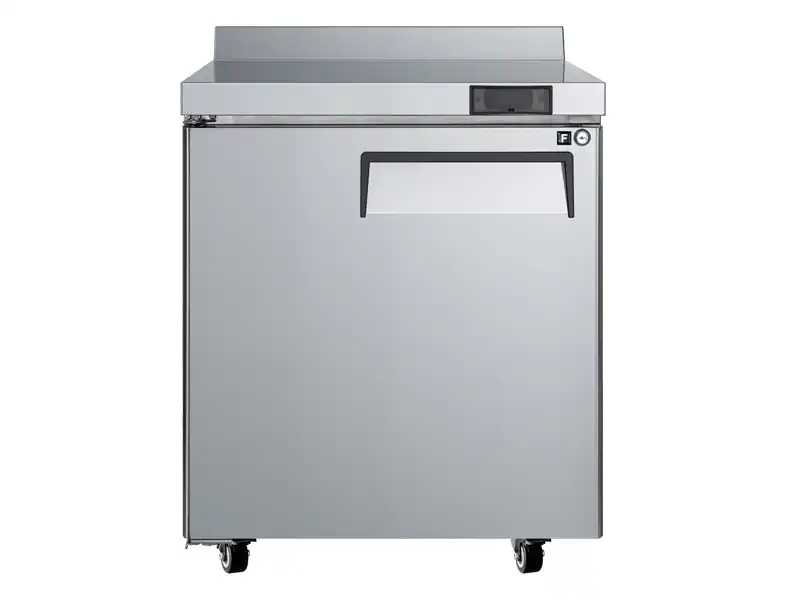
The exterior and interior of our under-counter models are built from 304‑grade stainless steel, formed with precision tolerances so that door cutouts and hinge mounts stay square. I have examined returned units from competitor brands where the door had sagged by three millimeters after 18 months because the hinge brackets were press-fitted rather than welded into the frame. That small misalignment opens a permanent gap that lets warm ambient air slip in, and the compressor adjusts by running longer. The self-closing mechanism with a recessed handle, combined with a lock-and-key option, ensures every closure is complete—no accidental half-latched door left open during a lunch rush.
The rounding of interior corners and the removable gasket system are maintenance features that also affect energy consumption. A gasket that traps sugar residue and dairy splatter becomes stiff and loses its seal over time. The ability to pull the gasket out, clean it, and snap it back in—without tools—means that seal integrity can be restored in minutes rather than months later after a service call. Similarly, the smooth, round-cornered inner shelf allows air to circulate without obstructions, preventing the temperature stratification that forces the thermostat to overcool the bottom shelf in order to reach setpoint at the top.
What to Check Before Finalizing Your Choice
Selecting a specific under-counter refrigerator is not the end of the decision; it is the moment to confirm that every interface with the coffee shop’s physical and electrical environment is accounted for. A unit that meets every specification on paper can still underperform if the installation and power conditions are not matched.
First, measure the actual clearance under the countertop—not the plan dimension, but the as-built height and depth, including any plumbing or electrical conduit that reduces the available space. The MTR series stands at 872 millimeters tall with optional 2‑inch casters; confirm that the cabinet can slide in and that the top work surface remains flush with the adjacent counter if the refrigerator is being used as a prep station.
Second, verify the power supply. The 115‑volt models in the table above should be on a dedicated circuit with a ground-fault interrupter, especially in a wet environment like a coffee bar. A shared circuit that also powers an espresso machine can introduce voltage dips that cause the compressor to trip its overload protection—a failure mode I have seen repeatedly when a new machine is plugged into an existing outlet without checking the panel schedule.
Finally, consider the ambient conditions. The vented cooling system pulls air in through the front grille and exhausts it from the sides. If the unit will be installed in a tight alcove with less than 100 millimeters of side clearance, the hot air recirculates back into the condenser intake, and the energy consumption rises. In one bakery installation we supported, moving the under-counter unit just 120 millimeters further from the side wall lowered daily electricity use by 9 % with no other change.
A selection that factors in all of these dimensions—internal components, size and workflow, material quality, and installation conditions—yields an appliance that not only carries an energy-efficiency label but actually delivers lower operating costs over the unit’s entire service life. Getting that right starts with talking to someone who can connect your daily production volume and space constraints to the specific refrigerator build, rather than guessing from a catalog page. If you would like to confirm which model and configuration will keep your coffee shop’s electric bill in check while holding temperature through peak hours, send your part number and quantity to Sales@hzcamay.com or call +8618157202219. We can confirm stock, lead times, and the exact dimensions that will fit under your counter.
Common Questions About Undercounter Refrigeration for Coffee Shops
What is the most common cause of high electricity consumption in a café under-counter fridge?
A door seal that no longer closes tightly. In busy coffee shops, the gasket collects milk residue, coffee grounds, and sugar, all of which harden the rubber and prevent a full seal. The compressor then cycles more often to compensate for the constant air exchange. Removing and cleaning the gasket every two weeks with a mild soap solution, rather than a harsh degreaser that can swell the material, restores the seal and keeps energy use close to the factory rating.
Isn’t R290 refrigerant dangerous in a small kitchen with open flames nearby?
R290 is flammable, which is precisely why the charge amount in an under-counter refrigerator is limited by international safety standards to a few dozen grams—far below the concentration that could ignite even if the entire charge leaked into the sealed cabinet space. The design standards include sealed electrical components and protected tubing routing, and the safety record over the past decade in commercial kitchens bears out that the real risk is negligible when the unit is factory-built and certified.
Should I choose a solid door or a glass door for the under-counter refrigerator behind the bar?
A solid door provides better insulation because the entire door area is filled with polyurethane foam, whereas a glass door, even a double‑pane one, allows more heat transfer. For back-of-house storage where staff do not need to see the contents before opening the door, the solid door keeps the energy consumption lower and reduces compressor runtime. Glass doors make sense only when customers or front-of-house staff need to view product without opening the door, which is rare under the counter.
How often should the condenser coil be cleaned, and does it really affect energy consumption?
Every 60 to 90 days, more often if the shop is in a dusty area or uses a lot of flour and cocoa powder. A clogged condenser coil prevents the refrigerator from rejecting heat effectively, so the compressor runs hotter and longer to achieve the same internal temperature. We have measured a 12 % increase in energy use on a unit whose coil was visibly matted with dust after three months of operation without cleaning. A soft brush or a vacuum with a brush attachment, applied with the unit unplugged, clears the coil quickly.
If I run the refrigerator overnight with less product inside, does the energy consumption change much?
It changes noticeably, and in the opposite direction from what many operators guess. A nearly empty refrigerator actually cycles more frequently because there is less thermal mass inside to buffer temperature swings. The cold air escapes quickly when the door opens, and the compressor must work to recool the larger empty air volume. Keeping a few gallons of water or back‑up product on the lower shelf acts as a thermal battery, stabilizing the internal temperature and reducing the number of compressor starts. If your shop’s load varies significantly between shift changes, share your typical menu volume and we can recommend an internal configuration that keeps the unit stable across light and heavy hours—contact Sales@hzcamay.com with your requirements.
If you’re interested, check out these related articles:
Boost Kitchen Efficiency Workflow Optimization with Chef Base Fridges
Boost Savings with Energy Efficient Commercial Upright Freezers
Upright Freezer vs Refrigerator Key Differences Explained