

After nearly three decades in commercial refrigeration, I’ve watched a well-chosen salad prep table turn chaotic lunch rushes into smooth, reliable service. It’s not just another cooler; it’s a cornerstone for food safety, speed, and consistent freshness. In the pages that follow, we share clear, practical considerations—temperature control, construction, capacity, energy efficiency—and show how our Camay MSR-48M meets real kitchen demands. The aim is simple: help restaurant owners and kitchen managers make a confident, informed choice that pays off in daily operations and over the long haul.
Why a Dedicated Salad Prep Table is Essential for Restaurant Efficiency
A dedicated salad prep table isn’t a luxury—it’s a smart, operational decision for restaurants committed to serving fresh, high-quality salads. By combining dependable refrigeration with a purpose-built workspace, it keeps the line moving and the ingredients at their best. Time and again, we’ve seen teams using proper prep tables outperform those relying on improvised setups.
1. Enhancing Food Safety and Ingredient Freshness
Food safety has no margin for error. A salad prep table keeps ingredients within safe temperatures during prep, curbing bacterial growth and protecting quality. Its integrated refrigeration maintains a stable cold environment, minimizing swings that can dull crisp greens or compromise proteins. For delicate produce, that precise temperature control is non-negotiable.
2. Streamlining Kitchen Workflow and Productivity
In a busy kitchen, every step counts. A well-designed salad prep table brings ingredients and workspace together, cutting down trips to the walk-in and shaving minutes off ticket times. With everything at arm’s reach, the line moves faster—especially during peak hours—and overall productivity improves.
3. Maximizing Space and Organization in Commercial Kitchens
Space is precious. Salad prep tables merge cold storage with a clean work surface, maximizing both vertical and horizontal real estate. With pans on top and refrigerated storage below, clutter drops and organization rises—an efficient footprint that pays dividends in tight quarters.
Key Features to Consider in a Commercial Salad Prep Table
When you evaluate salad prep tables, details matter. The right combination of refrigeration performance, build quality, capacity, and design will determine how well the unit serves your menu, pace, and space. We focus on features that measurably improve daily operations.
1. Understanding Refrigeration Systems and Temperature Control
Refrigeration is the core job here. Choose units with dependable, preferably digital, temperature control to hold a steady 0.5°C to 5°C (33°F to 41°F). Tight control protects food quality and extends shelf life. Ventilated cooling systems help maintain even temperatures throughout, avoiding warm spots that can undermine consistency.
2. The Importance of Durable Stainless Steel Construction
Commercial equipment takes a beating, so construction matters. High-grade stainless steel—such as 304—is the industry standard for durability, corrosion resistance, and ease of cleaning. Matching stainless steel inside and out supports hygiene and long service life, even under heavy daily use.
3. Evaluating Capacity and Configuration Options
One size doesn’t fit all. Match the table’s capacity and configuration to your menu and volume. Standard layouts include multiple top pans with refrigerated storage beneath. “Mega top” models add pan capacity on the work surface, while drawer configurations offer flexible storage. We recommend mapping your daily ingredient list to the pan and storage capacity you’ll actually use.
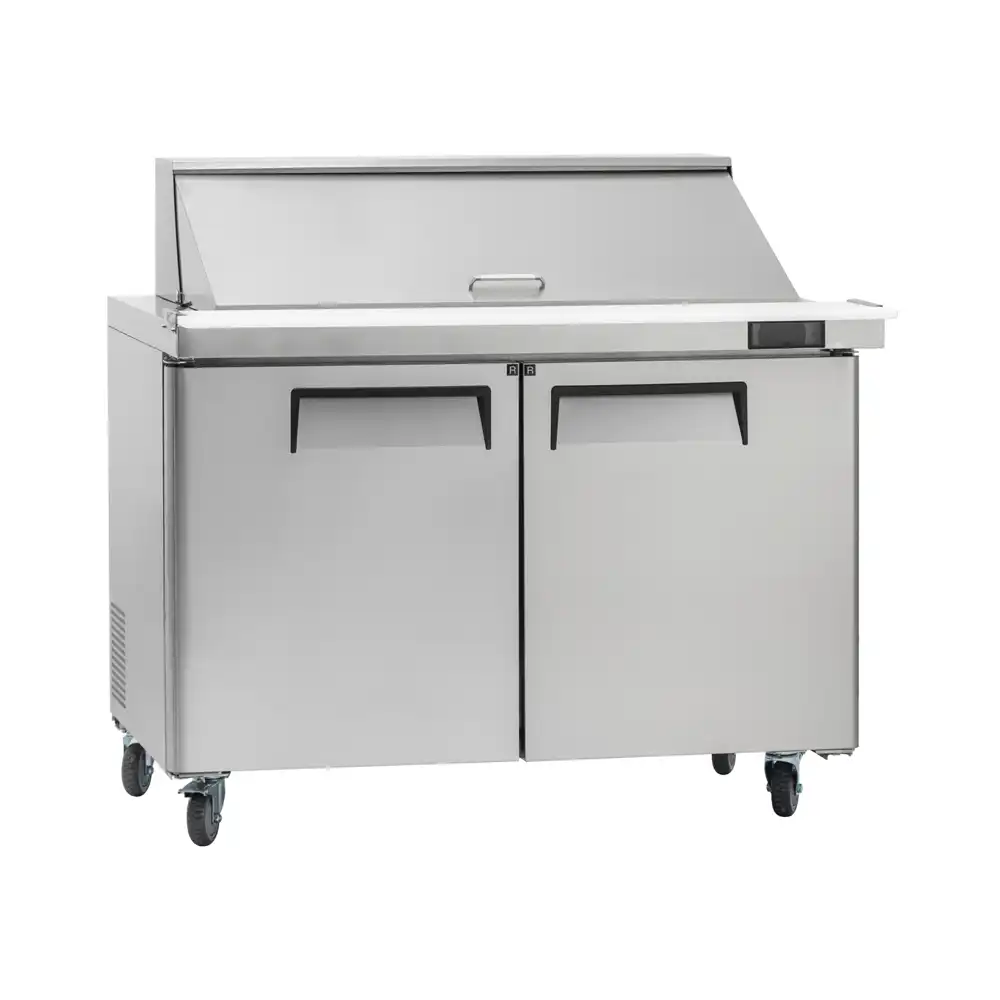
4. Mobility and Design for Flexible Kitchen Layouts
Kitchens change, and so should your setup. Optional casters let you reposition the unit for cleaning or layout tweaks. Recessed door handles, self-closing doors, and stay-open features improve ergonomics and help save energy. Thoughtful design shows up in small details that make shifts easier.
5. Prioritizing Ease of Cleaning and Maintenance
Hygiene must be effortless to be consistent. Favor removable gaskets, rounded interior corners, and accessible condenser coils to simplify daily and weekly cleaning. Automatic defrost also lightens the maintenance load. Regular care keeps performance high and extends the unit’s lifespan. If you’re interested, check 《Essential Maintenance Tips for Commercial Reach In Refrigerators》.
6. Energy Efficiency and Environmental Impact with R290 Refrigerant
Operating costs matter. Energy-efficient units lower utility bills and environmental impact. R290 refrigerant offers strong thermodynamic performance with very low global warming potential. Pair that with polyurethane/cyclopentane foamed insulation for excellent thermal retention. We prioritize solutions that are both sustainable and cost-effective.
Camay’s Advanced Salad Prep Solutions for Modern Restaurants
At ZHEJIANG KAIMEI CATERING EQUIPMENT CO., LTD., 28 years of hands-on experience shape every piece of refrigeration we build. Our Camay salad prep tables reflect a commitment to food safety, efficiency, and reliability tailored to the realities of commercial kitchens.
1. Introducing the Camay MSR-48M Salad Prep Table
The Camay MSR-48M captures what matters most in a modern line. This 13 cuft model features full stainless steel construction inside and out, uses eco-friendly R290, and runs on a heavy-duty Cubigel compressor. It maintains 0.5°C to 5°C (33°F to 41°F) for dependable preservation, and its top lid gives quick, clean access to ingredients during service.
| Feature | Details | Benefit for Restaurants |
|---|---|---|
| Model | MSR-48M | Proven design for commercial use |
| Capacity | 368 L / 13 cuft | Ample storage for diverse salad ingredients |
| Inner Temperature | 0.5–5°C / 33–41°F | Optimal food preservation and safety |
| Refrigerant | R290 | Eco-friendly and energy-efficient |
| Construction | Stainless steel exterior and interior | Durability, hygiene, and longevity |
| Doors | 2, self-closing, stay-open, recessed handles | Convenience, energy saving, and ergonomic operation |
| Cleaning Features | Rounded inner corners, removable gasket, automatic defrost | Simplified maintenance and enhanced hygiene |
| Mobility | Casters (optional legs) | Flexible kitchen layout and easy cleaning |
| Certifications | ETL Safety, ETL Sanitation (NSF Standard), DOE, ENERGY STAR, etc. | Compliance with industry standards and peace of mind |
| Insulation | Foamed-in polyurethane | Superior temperature retention and energy efficiency |
| Cooling System | Air cooling | Even temperature distribution |
| Compressor | Cubigel | Reliable and efficient performance |
| Digital Control | Smart digital temperature control (optional IoT and WiFi) | Precise monitoring and management |
| Power | 115V / 60Hz, 1.8 A, 207 W | Standard electrical compatibility and efficient power usage |
| Dimensions (WxDxH) | 1225×863×1181 mm / 48.23×33.98×46.50 in | Space-efficient design for commercial kitchens |
2. How Camay’s Features Address Restaurant Challenges
The MSR-48M targets the real pain points we hear from operators. Tight temperature control reduces food safety risks. Combining a generous prep surface with refrigerated storage streamlines the line. Stainless construction stands up to everyday punishment. Cleanability features make sanitation faster and more consistent. And R290 plus foamed-in insulation help keep energy costs in check. It’s built to perform when the board is full.
3. Certifications and Quality Assurance for Peace of Mind
Trust is earned through proof. The Camay MSR-48M carries ETL Safety, ETL Sanitation (NSF Standard), DOE, and ENERGY STAR certifications, demonstrating compliance with rigorous safety, sanitation, and energy benchmarks. Our factory holds QES-ISO 9001:2015, ISO 14001:2015, and ISO 45001:2018 certifications, underscoring our focus on quality management, environmental stewardship, and occupational safety.
Maximizing Your Investment in Commercial Kitchen Equipment
A salad prep table is a meaningful capital purchase. Selecting the right unit—and integrating it thoughtfully—pays off in less waste, faster service, and lower operating costs over time.
1. Calculating the Return on Investment for a Quality Prep Table
ROI shows up in multiple lines: reduced spoilage, lower ingredient waste, and faster prep that increases throughput and sales. Energy-efficient operation trims utilities. Durable stainless steel and quality components reduce repairs and extend service life. Together, these gains help the equipment quickly earn back its initial cost.
2. Long-Term Durability and Manufacturer Support
Longevity matters as much as day-one performance. Our stainless builds and vetted components are chosen for the long run. Post-purchase support is equally important: we back units with a 13-month warranty including free spare parts, plus permanent online technical support and training. That continuity keeps your operation up and running.
3. Integrating with Other Commercial Refrigeration Units
A salad prep table typically anchors a broader cold line. Plan for seamless integration with Under Counter refrigerators, worktop refrigerators, or Chef Base units so storage and prep flow naturally. A systems approach boosts efficiency and capacity across the kitchen. For more insights on integrating equipment, read 《Optimizing Kitchen Efficiency with Integrated Worktop Refrigeration》.
Contact Us
Choosing the right commercial salad prep table is pivotal to your restaurant’s success. Connect with ZHEJIANG KAIMEI CATERING EQUIPMENT CO., LTD. for tailored recommendations and dependable solutions. Phone: +86 181 5720 2219 | Email: Sales@hzcamay.com.
About the Author
David Qian, founder of ZHEJIANG KAIMEI CATERING EQUIPMENT CO., LTD., brings 28 years of experience in the refrigeration industry. His deep understanding of commercial equipment and kitchen workflows drives the company’s mission to deliver reliable, efficient, and innovative solutions for foodservice operations worldwide.
FAQs
1. What is the ideal temperature range for a commercial salad prep table?
Aim for 0.5°C to 5°C (33°F to 41°F). Holding this range preserves freshness for vegetables, dressings, and proteins while preventing bacterial growth and extending shelf life.
2. How often should a commercial salad prep table be cleaned?
Clean all food-contact surfaces and pans daily. Do a thorough inside-and-out cleaning weekly. Brush or vacuum the condenser coil every 1–3 months to maintain performance and energy efficiency.
3. What certifications should I look for in a commercial salad prep table?
Prioritize ETL Safety, ETL Sanitation (NSF Standard), DOE, and ENERGY STAR. These confirm the unit meets strict safety, hygiene, and energy-efficiency standards and aligns with regulatory expectations.
4. Can a salad prep table also be used for other food preparations?
Yes. Beyond salads, it works well for cold preparations like sandwiches and wraps thanks to its refrigerated storage and flat work surface. That said, it’s engineered primarily for salad components.
5. What are the benefits of R290 refrigerant in commercial refrigeration?
R290 (propane) has very low GWP and strong thermodynamic efficiency, which helps cut energy use and operating costs. It’s non-toxic with a short atmospheric lifespan, making it a sustainable choice.