

Selecting cooling equipment for a professional kitchen means looking past the spec sheet. Over 26 years of designing and manufacturing commercial refrigeration, I have learned that material quality, certification standards, and the production experience behind the equipment carry more weight than any brochure feature. The right cooling lineup directly affects food safety compliance, energy consumption, and how long the equipment holds up under the daily pressure of a high-volume kitchen. This article maps the 10 essential categories of commercial kitchen cooling equipment and explains what to look for from a manufacturing and reliability standpoint.
Core Refrigeration and Freezer Units
The backbone of any cold storage plan is a dependable reach-in and a hard-working freezer. These units work in tandem to keep daily stock accessible without crowding the prep zone.
Reach-In Refrigerators for High-Volume Storage
A commercial reach-in refrigerator handles the largest share of ingredient storage. In our Camay MR‑49 model, 1252 liters of capacity with a ventilated air-cooling system and automatic defrost maintain a steady 0.5°C to 5°C range. What is often overlooked is the insulation density. Polyurethane and cyclopentane foaming, free of CFCs, keeps cold air in and the compressor from overworking, a factor that directly influences energy bills and compressor life.
Solid Door Freezers for Long-Term Stock
For frozen storage, a solid-door unit such as the Camay MF‑23 provides -25°C to -15°C temperatures inside a smaller footprint. The self-closing door with lock and fan-assisted cold air circulation prevent warm-air infiltration during rush service. In kitchens we support, specifying a solid door rather than glass for back-of-house freezers consistently improves temperature stability and reduces frost buildup.
| Unit Type | Typical Temperature Range | Key Benefit |
|---|---|---|
| Reach-In Refrigerator | 0.5°C to 5°C | High-capacity ingredient storage |
| Solid Door Freezer | -25°C to -15°C | Stable long-term frozen storage |
| Upright Low-Temp Freezer | -22°C to -18°C | Vertical layout saves floor space |
Undercounter and Worktop Refrigeration
When floor space is at a premium, compact units that double as work surfaces solve two problems at once. Many operators underestimate the workflow advantage of having a cold well directly beneath the prep surface.
Chef Base Refrigerators for the Line
A chef base puts refrigerated storage right under the cooking station. Our MAR‑60A holds 117 liters at 0.5°C to 5°C while the stainless steel worktop withstands direct contact with hot sheet pans. The one-piece top with a drip-resistant V-edge keeps spills from reaching the interior, a small design detail that extends service life in a busy line.
Undercounter and Worktop Fridges
Undercounter models like the MTR‑60 use 476 liters of capacity on a compact 1530 mm width. The ventilated cooling system, R290 refrigerant, and optional IoT temperature monitoring make it easy to keep safety logs without manual checks. When you place these units at the bar, salad station, or waitstaff pickup point, the drop-in accessibility reduces cross-traffic and speeds up service.
Worktop Refrigerators for Multitasking
A worktop refrigerator combines an open-top cold rail with a lower storage compartment. Our MWTF‑27‑L delivers 202 liters at temperatures as low as -25°C, designed with a self-closing door and removable gasket for quick cleaning. This configuration is common in sandwich and wrap stations where the top ingredients stay chilled while the staff assembles orders directly from the unit.
Prep Station and Display Cooling
Specialized prep tables and display cases connect ingredient storage directly to the assembly task, shrinking the distance between the cold zone and the plate.
Refrigerated Prep Tables for Fast Assembly
Salad tables like our MSR‑48M hold 368 liters, with a top well designed for GN pans. Multi-zone temperature control keeps each ingredient at its ideal holding temperature, a feature that matters when mixing high-risk items such as cooked chicken with raw greens. The automatic evaporation of defrost water eliminates the need for drainage lines, simplifying installation.
Pizza Prep Tables and Salad Bars
For pizzerias, a dedicated pizza prep table such as our VRX395‑1600 provides 58 liters of refrigerated pan storage right at the stretching and topping station. The shallow rail design holds GN 1/3 pans and keeps the cook moving forward without bending into a reach-in. Salad bars in buffet settings follow the same principle but scale upward with additional cold storage and sneeze guards.
Display Coolers for Front-of-House
A display cooler like the DWG‑1200ZA does more than hold temperature. The glass front with LED lighting turns the unit into a sales tool. From bakeries to grab‑and‑go sections, the ability to maintain 0°C to 10°C while showing off layered cakes or chilled beverages helps convert passing glances into purchases.
If your program involves open-top prep tables that must hold diverse food groups at different temperatures, it is worth confirming the multi-zone control capability of the rail and base independently before finalizing your BOM. Reach out at Sales@hzcamay.com with your intended menu categories and we can verify which configurations meet your health-code requirements.
Blast Chillers and Ultra-Low Freezers
High-throughput operations that handle large batch cooking or sensitive food items need cooling technology that goes beyond simple temperature maintenance. Rapid temperature drop preserves texture and curbs bacterial growth in ways standard freezers cannot match.
Blast Chillers for Rapid Cooling and HACCP Compliance
A blast chiller pulls cooked food through the danger zone fast enough to satisfy HACCP logs without sacrificing moisture content. In central kitchen programs I have followed, integrating a blast chiller cut the chilling step from four hours to under 90 minutes for standard gastronorm pans, which directly increased production cadence and reduced labor costs. Units with a removable air filter and built-in evaporator defrost extended uptime, features we insist on in manufacturing.
Ultra-Low Freezers for Extended Preservation
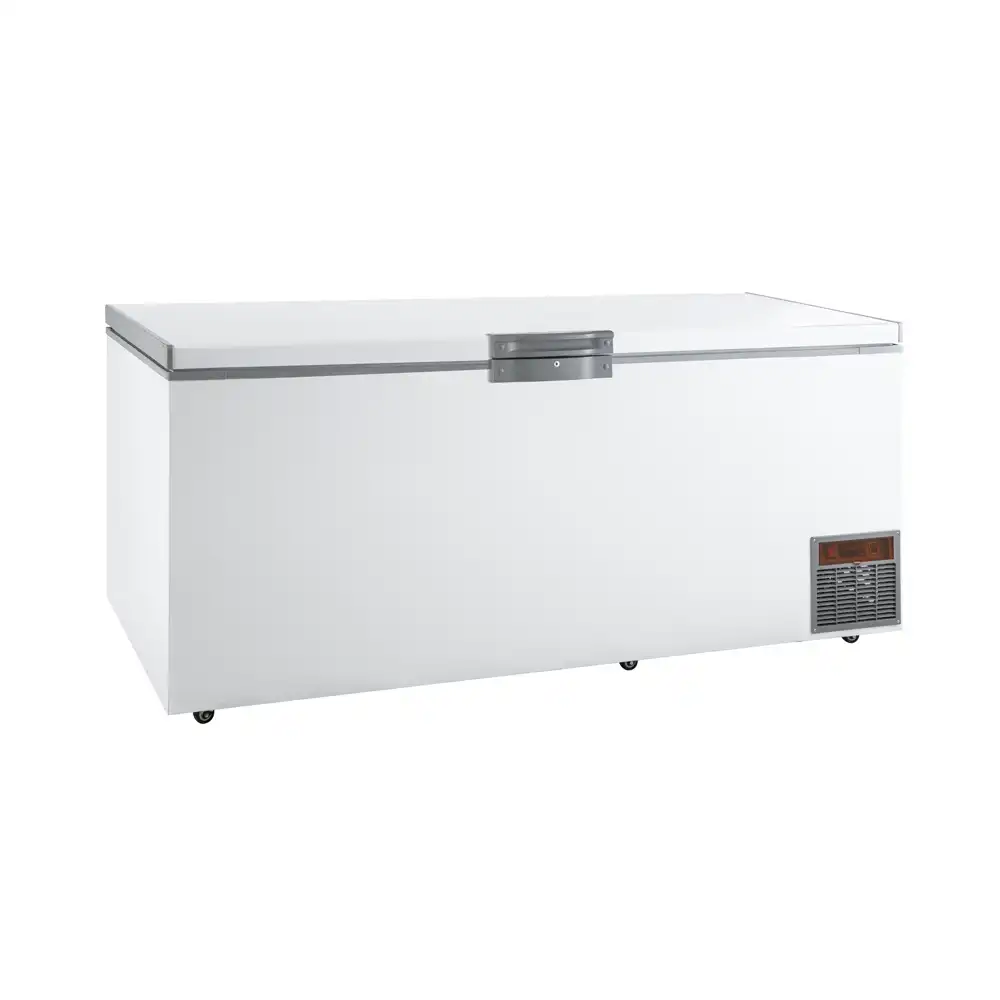
When a kitchen stores high‑value seafood, specialty cuts, or biological samples, an ultra-low freezer reaching -45°C or lower becomes necessary. Our DW45W788 holds 768 liters at -45°C using a SECOP compressor and hydrocarbon mixed refrigerant. The double door seal and safety door lock are standard; the real differentiator is the single-machine self-cascading refrigeration system, which simplifies service compared to cascade systems that require two separate refrigeration circuits.
Key Quality Indicators for Professional Kitchen Cooling Equipment
Understanding what separates a five-year unit from a fifteen-year unit starts with reading the build, not just the capacity number. These indicators apply across all cooling categories.
Material and Certification Markers
The stainless steel grade matters. We use 304 grade for interior and exterior panels because it resists corrosion from acidic foods and cleaning chemicals better than 430 grade, which some lower-cost units employ. Look for a manufacturer that holds ETL Safety, ETL Sanitation, and ENERGY STAR certifications. Factory-level ISO 9001 and ISO 14001 registrations indicate a commitment to consistent quality and environmental management, not just a one-time lab pass.
Compressor and Insulation Technology
The compressor is the heart; we standardize on Cubigel and SECOP because their duty cycle and refrigerant compatibility with R290 have proven reliable over decades. R290 refrigerant delivers high latent heat with lower global warming potential than legacy HFCs, but it requires a ventilation design that pairs well with the compressor. Insulation should be polyurethane foam with cyclopentane blowing agent and no CFCs. In our units, the foam thickness and door seal design maintain tight temperature bands even in ambient conditions up to 38°C.
Defrost and Airflow Design
Automatic defrost with fan-assisted cold air circulation prevents ice buildup that strangles coil efficiency. The inner chamber should have rounded corners and removable gaskets; these details cut cleaning time and reduce the risk of bacterial nesting, a point that health inspectors notice immediately.
Partnering with an Experienced Manufacturer
Securing the right equipment is only half the equation. The manufacturer behind the equipment determines availability of spares, customization ability, and long-term support. When evaluating a partner, ask not only for product certifications but for factory certifications. A factory that holds ISO 45001 for occupational health and safety, alongside ISO 9001 and 14001, demonstrates an operational maturity that shows up in product consistency. Over 26 years, our team at Zhejiang Kaimei Catering Equipment Co., Ltd has served partners worldwide through OEM and ODM programs, providing everything from a single chef base to a full kitchen cold chain. We manufacture in volume while maintaining tight quality control, and our after-sales includes a 13‑month warranty with free spare parts proportion and permanent online technical support.
Beginning with a manufacturer that understands large-scale production and international certification requirements saves you from expensive reinspections and retrofit work later. If you are currently mapping out a restaurant, hotel, or food processing project and need refrigeration partners, send your equipment list and city of installation to Sales@hzcamay.com or call +8618157202219. We will confirm the correct voltage, certification path, and lead time for your market.
Questions About Choosing and Sourcing Commercial Kitchen Cooling Equipment
What is the difference between a blast chiller and a standard freezer?
A standard freezer simply maintains a low temperature. A blast chiller actively drives the core temperature of hot food down through the danger zone rapidly, usually within 90 minutes, which preserves cell structure and meets HACCP critical limits. Standard freezers cannot achieve the same cooling rate because they lack the forced-air and refrigeration capacity tuned for rapid heat extraction.
How many types of cooling equipment does a typical 100-seat restaurant need?
A 100-seat restaurant will usually need a multi-door reach-in refrigerator, a solid door freezer, an undercounter unit for the bar, a refrigerated prep table for the salad station, a chef base for the hot line, an ice machine, and possibly a display cooler. A blast chiller becomes necessary if the kitchen does batch cooking or plans to prep in advance. Layout and menu ultimately determine the exact count.
Are R290 refrigerant units safe for a professional kitchen?
Yes. R290 is a hydrocarbon refrigerant with excellent thermodynamic properties and minimal environmental impact. It requires ventilated designs and proper clearance around the compressor, but when installed per the manufacturer’s specifications and in a well-ventilated kitchen, it is safe and commonly used throughout Europe and North America in commercial refrigeration.
What certifications should I look for in commercial kitchen cooling equipment?
At a minimum, look for ETL Safety (or equivalent electrical safety certification) and ETL Sanitation (NSF standard). For energy visibility, DOE and ENERGY STAR labels confirm third‑party performance verification. In Europe and other markets, CE, IEC‑CB, and country‑specific marks apply. Factory-level ISO 9001, 14001, and 45001 indicate the manufacturer runs a tightly managed operation, which translates to more consistent production quality.
How can I evaluate whether a manufacturer can handle a multi-site rollout?
Ask for their OEM and ODM project history, factory size, and ISO certifications. A manufacturer with decades of export experience and a track record of booking container orders across multiple regions is better positioned to deliver consistent quality across a fleet of restaurants. Confirm their voltage and certification portfolio matches your target countries. If your rollout involves kitchens with varying ambient temperatures, share that detail early to verify that the insulation and compressor spec will perform without cold spots or short cycling. Reach out at Sales@hzcamay.com with your project brief, and our engineering team can confirm the configuration.
If you’re interested, check out these related articles:
Ultimate Buyers Guide for Commercial Reach In Refrigerators
How to Choose the Best Chef Base Refrigerator for Your Kitchen